
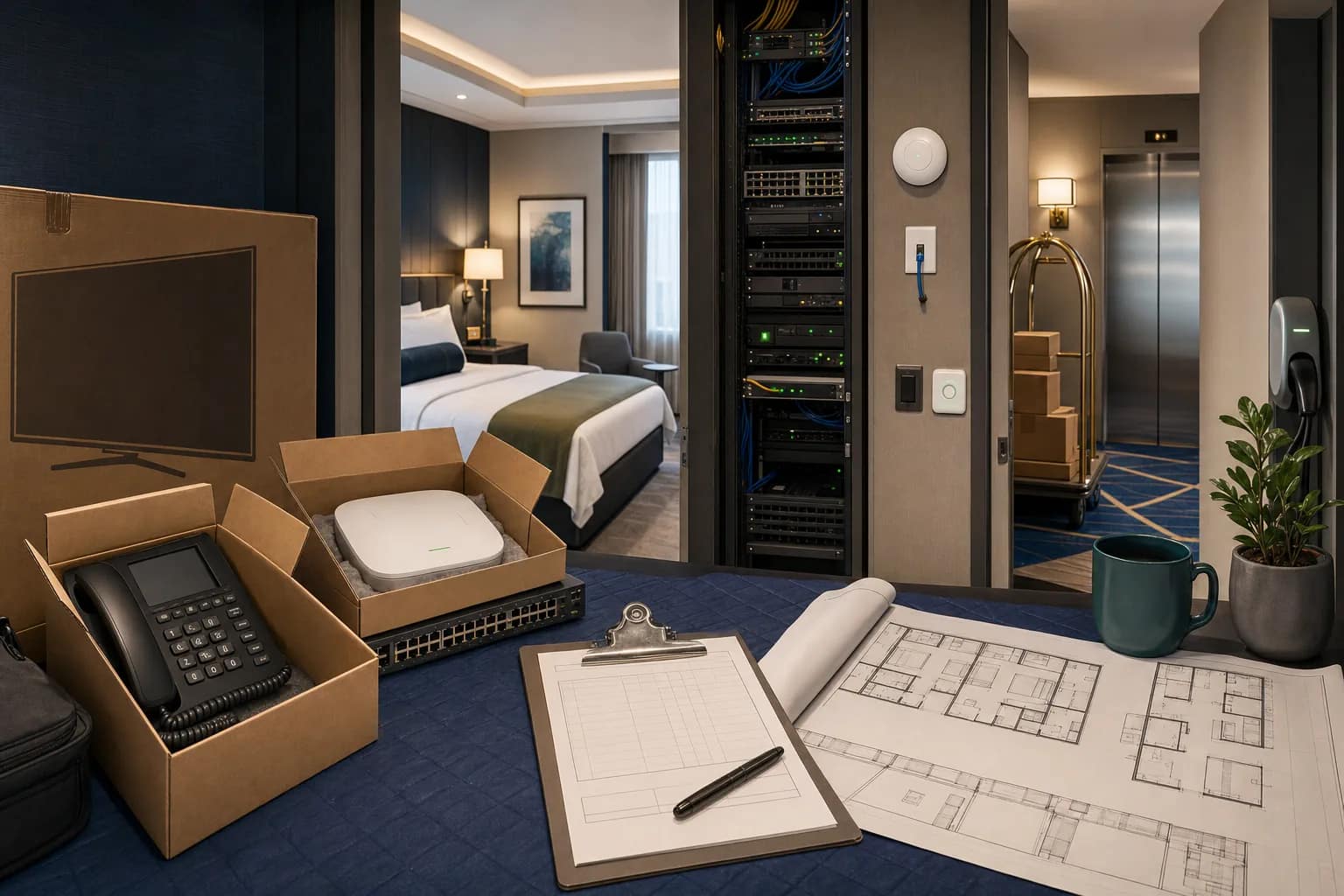
In hotel technology projects, the expensive mistake is not always buying the wrong hardware.
Sometimes it is buying the right hardware before the property is ready to receive it.
That is where otherwise reasonable TV, phone, Wi-Fi, or network projects start creating stored-material questions, ownership confusion, circuit timing problems, and avoidable change orders.
JET Hotel Solutions works across guest-room TV, PBX and room phones, guest Wi-Fi, network access, and cross-vendor coordination for hotel operators. In real refresh projects, the order date, delivery plan, and support handoff often matter as much as the equipment list.
If your hotel is about to approve a technology refresh, use this checklist before the boxes arrive.
1. Decide what problem the order is supposed to solve
A hotel team may know that the TVs are old, the room phones need to change, or the network needs an upgrade. That is not the same as having a finished delivery decision.
Before equipment is ordered, the operator should be able to answer:
- Is this a brand refresh, a reliability fix, a supportability improvement, or a property-improvement project?
- Is the order tied to a renovation timeline, a lender milestone, an ownership deadline, or a deferred maintenance push?
- Does the change affect only guest rooms, or does it also touch public space TVs, the front desk, the PBX path, the circuit, or guest Wi-Fi infrastructure?
If the operational goal is still vague, the receiving plan is usually vague too.
2. Confirm whether the property is ready to receive materials, not just approve them
Hotel operators sometimes treat ordering and receiving as one decision. They are not.
Before guest-room TVs, phones, access points, switches, or related hardware are delivered, someone needs clear answers for:
- Where will the equipment be delivered?
- Who will inspect it on arrival?
- Where will it be stored if the installation window moves?
- Who tracks serial numbers, room counts, damage photos, or shortages?
- Who owns insurance or stored-material documentation if a lender or ownership group asks for proof?
Those are not side questions. They often determine whether the project stays calm or becomes a paperwork and accountability problem before installation even starts.
3. Ask whether the order creates a stored-materials exposure
This matters more often than operators expect.
When a property orders a large quantity of TVs, room phones, network hardware, or connected-room equipment ahead of installation, ownership or the lender may treat the shipment as stored materials. That can trigger extra requirements around custody, condition, photo evidence, invoicing, and timing.
Before the order is placed, clarify:
- Will the materials sit at the property, with a vendor, or in a warehouse?
- Does the project team need receiving photos, pallet counts, or signed delivery logs?
- Will the ownership group reimburse or release funds based on delivered-not-installed materials?
- Who carries the responsibility if the goods arrive but the room or network environment is not ready?
If nobody owns those answers, the hotel may be buying schedule pressure instead of progress.
4. Make sure the delivery date matches the actual install path
Hotel technology refreshes rarely move in a straight line.
A shipment may be ready while guestrooms are still being turned. A TV order may arrive before mounts, cabling, or room counts are final. A phone replacement may look simple until analog lines, elevator phones, fax, or emergency call paths are reviewed. A network-related order may land before the circuit, static IP, or managed-router cutover is actually locked.
Before the order is released, ask:
- What condition has to be true at the property before materials should arrive?
- What other vendors or trades need to finish first?
- What dates are real, and which dates are only aspirational?
- What happens if one part of the schedule slips by two weeks?
If the project cannot survive a timing slip, the order is probably being placed too early.
5. Check the systems that depend on the order
A hotel technology order usually touches more than the line item on the quote.
Before equipment is accepted, map the dependencies that can turn a delivery into a chain reaction:
- FTG TV or IPTV assumptions behind the TV refresh
- room phones, front-desk phones, analog paths, and PBX behavior
- guest Wi-Fi hardware and the switching, routing, or VLAN plan behind it
- carrier, modem, static-IP, or firewall dependencies for internet changes
- casting or connected-room tools that assume a certain network and TV path
- dashboards, vendor portals, or support teams still tied to the old environment
That is why a simple delivery problem can suddenly become a TV issue, a phone issue, and a network issue at the same time.
6. Clarify who owns the first response after the equipment is installed
Operators should not wait until the cutover to figure out who gets the first call.
Before the order is accepted, confirm who owns the first-response path if:
- a TV does not provision correctly
- room phones or front-desk phones behave differently after the swap
- the new guest Wi-Fi environment creates complaints
- the circuit goes live but dependent services still need configuration changes
- the property needs final documentation, support contacts, or escalation paths
The best delivery plan does not stop at unloading the hardware. It leaves the hotel with a clear support path.
7. Use a short receiving checklist before the order moves forward
Before the property approves delivery, the team should be able to say yes to these questions:
- Do we know exactly what the refresh is supposed to solve?
- Do we know where the materials will be delivered, inspected, and stored?
- Do we know whether ownership or the lender will treat this as stored materials?
- Do we know which TV, phone, Wi-Fi, and network dependencies must be ready first?
- Do we know who owns the carrier, IP, and cutover questions?
- Do we know who answers the first support call after the change?
If the answer is no to several of those questions, the property may need a delivery plan review before it places the order.
Why this matters for hotel operators
The box price is visible. The receiving and sequencing cost is usually hidden until something slips.
That is why hotel owners, management teams, engineering leaders, and property IT contacts should treat receiving readiness as part of procurement readiness. The order is not complete when the quote is signed. It is complete when the property knows how the hardware, the room plan, the network plan, and the support plan fit together.
If your hotel is planning a TV refresh, PBX replacement, guest Wi-Fi hardware update, or network-access change, JET Hotel Solutions can review the scope before the materials arrive so the property is not solving delivery and dependency problems after the fact.