
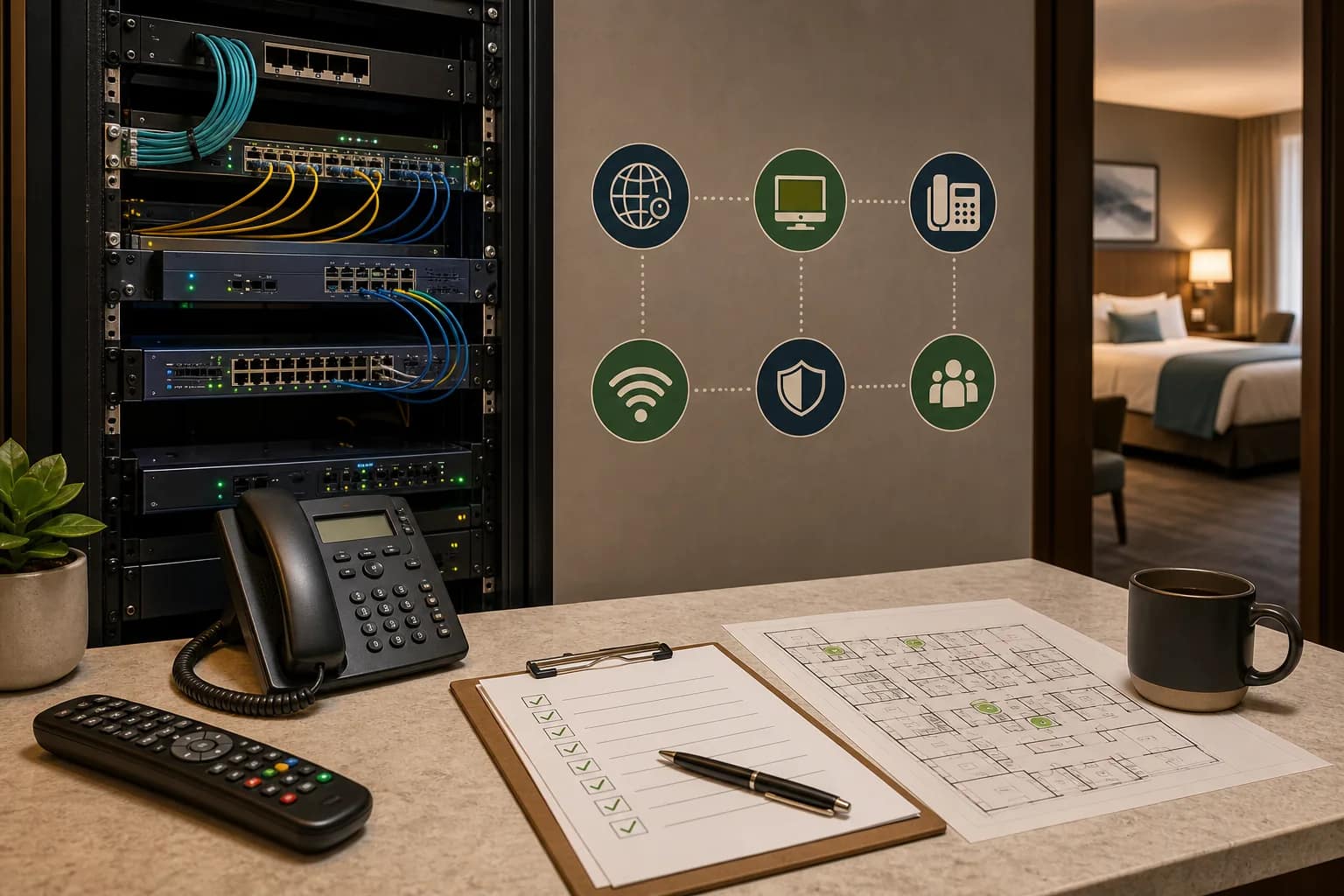
When hotel teams say they are upgrading the circuit, they are usually describing only the smallest part of the job.
The carrier order may be one line item, but the real work usually sits behind it: static IP changes, firewall updates, TV dependencies, PBX assumptions, guest Wi-Fi behavior, and the vendor handoffs that still point to the old path.
That is why a hotel fiber upgrade is rarely just a circuit swap.
JET Hotel Solutions works across network access, guest Wi-Fi, PBX and room phones, Free-to-Guest TV, and hotel vendor coordination. In real hotel projects, the expensive problems usually start when the property treats bandwidth as an isolated purchase instead of a shared dependency for other systems.
If your hotel is planning a carrier, DIA, or fiber change, use this hotel network upgrade checklist before the cutover date is locked.
1. Start with the actual reason for the circuit change
Not every upgrade solves the same problem.
Some hotels are chasing more bandwidth. Others are trying to fix instability, change providers, reduce costs, support a renovation, or align with a brand or ownership requirement. Those are different projects, and they create different downstream risks.
Before the order moves forward, the operator should be able to answer:
- Is this change about speed, uptime, provider replacement, cost, or a renovation milestone?
- Is the property replacing the carrier only, or also changing modem, router, firewall, static IP assignments, or managed network ownership?
- Which guest-facing and back-of-house systems still assume the current circuit path?
If the team cannot answer those questions clearly, the “upgrade” is already being scoped too narrowly.
2. Inventory everything that still depends on the current public IP path
This is where hotel circuit projects stop being simple.
A property may think it is changing bandwidth when it is really changing the address or routing assumptions behind multiple systems. That can affect remote support tools, vendor portals, firewall rules, whitelists, VPN behavior, and anything that still expects the old static IP block.
Before cutover, confirm:
- which systems use the current static IPs
- which vendors have whitelisted the current public IPs
- whether TV, casting, PMS integrations, PBX tools, or dashboards point to the old path
- who owns the update if the carrier changes the public addressing or the router handoff
This is one of the easiest ways to create an outage that looks unrelated to the circuit order until the property starts tracing dependencies.
3. Check the TV and guest-room technology path, not just the rack
Hotels often separate the network team from the guest-room refresh conversation. The property still feels the outage either way.
If the circuit or firewall path changes, review what the TV environment expects:
- FTG TV or IPTV distribution assumptions
- casting or connected-room services that depend on the existing network path
- monitoring or management tools tied to the old gateway or public IP
- vendor support access for TV headend, provisioning, or room-device management
A circuit cutover that ignores the TV path can leave the property arguing about whether the issue belongs to the carrier, the TV vendor, or the hotel network team while guests only see that the room technology stopped working.
4. Review the phone and PBX assumptions before the carrier date is final
Phone projects create hidden dependencies because they often outlive the original design assumptions.
Before a circuit swap or provider change, ask:
- Does the PBX, hosted-phone path, SIP trunk, or remote support setup assume the current carrier path?
- Do front-desk phones, room phones, analog devices, fax lines, elevator phones, or emergency phones need special handling?
- Will any provider, Mitel, or voice vendor need advance notice for IP or routing changes?
- Who tests the phone environment after the circuit cutover is complete?
Hotels get into trouble when the data-side change is scheduled first and the voice-side dependencies are treated like a separate project that can catch up later.
5. Coordinate the carrier, firewall, Wi-Fi, TV, and support vendors as one cutover
A circuit upgrade should not depend on everyone improvising the ownership map on cutover day.
Before the hotel commits to the carrier date, document:
- who owns the carrier handoff
- who owns firewall or router changes
- who validates guest Wi-Fi after the swap
- who checks TV or casting behavior
- who confirms phone or PBX service
- who is the single point of coordination if one step slips
Without that map, every downstream issue turns into a vendor ping-pong problem instead of a managed hotel cutover.
6. Build the cutover around validation, rollback, and timing reality
Hotels do not need the prettiest migration plan. They need one that survives a normal project day.
Before the date is locked, decide:
- what the pre-cutover validation checklist is
- who confirms internet service is live at the new handoff
- which TV, phone, guest Wi-Fi, and vendor-access checks happen first
- what the rollback path is if one critical dependency fails
- whether the change window matches actual hotel operating constraints
If the property cannot describe the first thirty to sixty minutes after cutover, the date is not really ready.
7. Use a short hotel network upgrade checklist before the project moves
Before the circuit order becomes a live cutover, the operator should be able to answer yes to these questions:
- Do we know exactly why the circuit or fiber change is happening?
- Do we know which static IPs, whitelists, and remote-support tools depend on the current path?
- Do we know what the TV, casting, and guest-room technology stack expects?
- Do we know what the PBX, SIP, analog, and emergency-phone path needs?
- Do we know which vendor owns each step of the cutover?
- Do we know the validation order and rollback path if the cutover does not go cleanly?
If the answer is no to several of those questions, the hotel may not need a faster circuit first. It may need a better dependency review first.
Why this matters for hotel operators
A bandwidth order is visible. The downstream dependency map usually is not.
That is why owners, management-company leaders, engineering teams, and property IT contacts should treat a circuit change as an operations project, not just a carrier task. The network path may sit behind TV, phones, guest Wi-Fi, vendor support, dashboards, and room-technology expectations that were configured long before the current project started.
If your hotel is planning a fiber, DIA, or carrier change, JET Hotel Solutions can review the circuit-upgrade scope before the cutover so the property is not discovering static-IP, TV, PBX, or vendor-dependency problems after the old path is gone.