
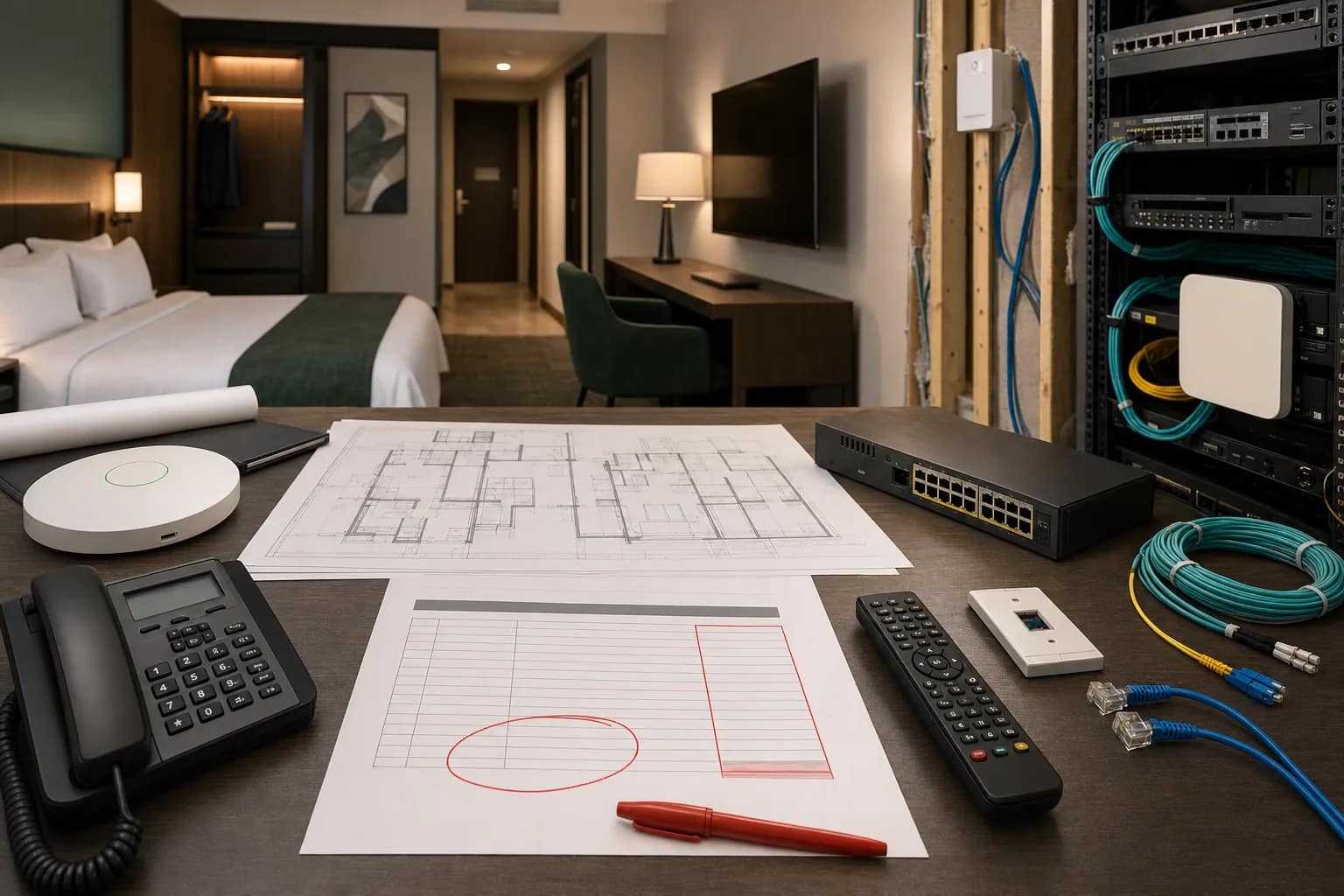
A renovation change order can look like a construction detail: move a wall, revise a room type, add an outlet, change a pathway, or shift a delivery date.
At a hotel, it can also change the technology plan.
That is because guest Wi-Fi, TV, phones, cameras, network closets, circuits, and vendor cutovers depend on physical scope, access, power, cabling, timing, and clear ownership. If one of those changes, the project team needs a second look before the revised scope is approved.
Not every change order affects every system. These seven checks help operators identify the ones that do.
1. What physical work is changing?
Start with the practical change, not the document title. Ask whether the revision changes room layouts, wall locations, ceiling access, pathways, telecom-room space, mounting locations, conduit, or cable counts.
Those details can affect access points, guest-room TV locations, room phones, cameras, data outlets, fiber routes, racks, patch panels, and the labor needed to test everything afterward.
2. Does the revised scope change power, pathways, or closet readiness?
A small construction change can create a large systems problem if it changes the conditions around the technology.
Before approval, confirm whether the revision affects:
- electrical circuits or outlet locations
- conduit, sleeves, risers, and pull paths
- MDF, IDF, or rack space
- grounding, cooling, and physical access
- ceiling closure dates or wall-close milestones
These are not separate from the technology scope. They are often the conditions that make the technology install possible.
3. Which hotel systems now need a revised dependency check?
Do not stop at the system named in the change order. Build a short dependency list for anything that relies on the revised room, pathway, timing, or network location.
That list may include guest Wi-Fi, Free-to-Guest TV or IPTV, PBX and room phones, CCTV, access-control interfaces, Network Access or DIA handoffs, static IP rules, managed switches, vendor portals, and remote monitoring.
The useful question is simple: what will be different for this system after the physical change is complete?
4. Does the schedule still match the technology sequence?
A revised construction schedule can leave a technology vendor with less room access, a smaller testing window, or an earlier cutover date than the original plan assumed.
Confirm the updated dates for delivery, storage, rough-in, cable pull, termination, installation, circuit turn-up, programming, room testing, staff training, and guest-ready signoff. If those dates no longer line up, the right answer may be to change the sequence before work resumes.
5. Who owns each new handoff?
When the scope changes, responsibility often becomes unclear. The GC may own the pathway. A low-voltage partner may own the cable. A carrier may own the circuit. A technology vendor may own configuration. The property team still owns the guest experience.
Before signing the change order, name one owner for each handoff and one owner for the final question: who confirms the system works in the room, not just on paper?
6. What needs to be re-documented?
Updated drawings, port maps, rack elevations, cable labels, IP records, room lists, vendor contacts, and test plans are not closeout paperwork to handle later. They are the working map for the revised project.
If the team cannot point to the current version, the next vendor may install against an old assumption.
7. What is the new test and signoff plan?
Every changed scope needs a clear way to prove it is ready. That may mean testing Wi-Fi coverage in a revised area, verifying a TV and casting path in a moved room, placing a front-desk and guest-room call, checking camera coverage, confirming a circuit handoff, or validating a labeled port against the as-built.
Write down who performs the test, who sees the result, and what happens if it fails. That is much easier than discovering the missed dependency during opening week.
The operator takeaway
A good hotel renovation change order does more than price the physical revision. It resets the systems, schedule, ownership, documentation, and signoff work that the change affects.
JET Hotel Solutions helps hotel teams coordinate technology scopes across Network Access, guest Wi-Fi, PBX and phones, Free-to-Guest TV, low voltage, CCTV, vendor handoffs, and support ownership. Before a revised scope is locked, JET can help identify the technology questions that need a new owner, plan, or test.