
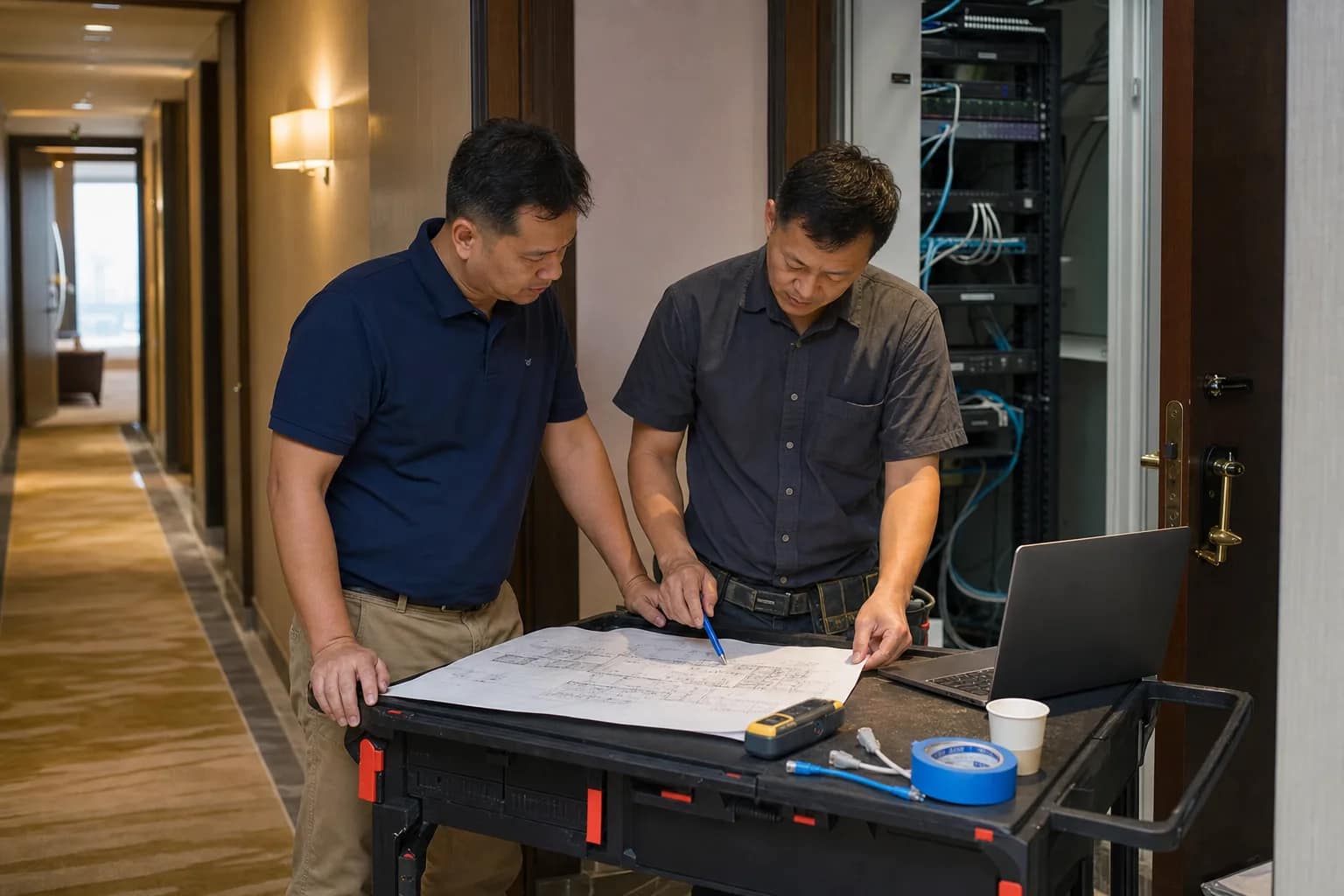
A revised hotel technology plan can be technically correct and still fail operationally.
The common problem is not that nobody is working. It is that several vendors are working from different versions of the same project. The owner approves a room or schedule change. The general contractor updates one milestone. The low-voltage team adjusts cable counts. The Wi-Fi, TV, phone, circuit, or security vendor still has the earlier date.
That is how a project reaches installation week with equipment ready but rooms unavailable, cabling complete but unverified, or a cutover booked before the property can test it.
The fix is not another long meeting. It is a short ownership map that turns every changed dependency into a named handoff.
Start with one revised source of truth
After a change order, brand revision, design update, or delivery shift, the project lead should issue one current technology plan. It should identify the affected rooms or areas, the approved equipment and cabling scope, the new sequence, the cutover window, and the person who accepts each handoff.
If the team cannot tell which version is current, the first task is version control—not installation.
1. The property or ownership lead owns the operating decision
The hotel-side lead decides what the property can tolerate. That includes room-out-of-order blocks, guest disruption, staff availability, access to telecom rooms, acceptable downtime, and the final go-live window.
This owner does not need to configure every system. The role is to make the decisions that vendors cannot make for the hotel:
- Which rooms or public areas can be released for work?
- When can service be interrupted?
- Who from operations must participate in testing?
- What result is required before a room returns to inventory?
2. The GC owns construction access and physical readiness
The general contractor or construction manager owns the conditions that allow the technology work to happen: room access, pathways, power, sleeves, backboards, ceiling status, wall-close dates, lifts, staging, and coordination with other trades.
A revised cutover date is not credible until these physical prerequisites have a confirmed date. “Construction should be done” is not a handoff. “Rooms 201–224 are accessible, powered, and released for technology testing on Tuesday at 8 a.m.” is.
3. The low-voltage lead owns installed-path verification
The low-voltage partner should confirm that the installed infrastructure matches the revised design. That means cable counts and destinations, labels, patch-panel ports, fiber paths, rack space, test results, and updated floor plans or port maps.
This matters because a system vendor can configure only what the field conditions actually support. A drawing that shows an access point, TV, phone, or camera location is not proof that the correct cable is installed, labeled, terminated, and tested there.
4. The carrier and network lead own service readiness
Network Access or DIA readiness has its own dependencies: demarc extension, handoff location, circuit activation, IP information, firewall rules, managed equipment, remote access, and escalation contacts.
If the change affects an MDF, IDF, circuit turn-up, static IP, or network path, the network owner needs to re-confirm the plan. A carrier appointment should not be treated as proof that guest Wi-Fi, phones, TV, or other dependent systems are ready to cut over.
5. Each system vendor owns configuration and functional proof
Guest Wi-Fi, Free-to-Guest TV or IPTV, PBX and room phones, CCTV, and other hotel systems need a named vendor owner. Each should document what inputs are required, what will be configured, when technicians or remote support will be available, and how success will be demonstrated.
For example, a Wi-Fi scope may depend on final access-point counts, brand approval, cabling readiness, switch configuration, and the correct installation window. A TV scope may depend on headend readiness, room drops, programming, and a representative room test. The systems share a project, but they do not share the same acceptance test.
6. One coordinator owns the cross-system cutover
Individual vendors can own their work without owning the whole guest journey. Someone still needs to reconcile the dependencies across construction, low voltage, circuits, Wi-Fi, TV, voice, security, and hotel operations.
That coordinator should maintain a compact cutover table with five fields:
- Dependency: what must be ready?
- Provider: who performs the work?
- Receiver: who accepts the handoff?
- Proof: what confirms readiness?
- Fallback: what happens if it is not ready?
The coordinator also owns the decision to stop. If the room block, cabling, circuit, approved design, or test team is not ready, moving the cutover anyway usually transfers the problem to hotel operations.
Use a room-level acceptance test
Hotels operate room by room, even when projects are managed by trade. Before releasing a renovated room or area, verify the guest-facing outcome: connect to Wi-Fi, test the TV path, place the required calls, inspect camera coverage where applicable, confirm labeled data ports, and record exceptions.
The test should name who performed it, when it passed, and who accepted the result. That creates a usable turnover record for operations and support instead of a collection of vendor closeout emails.
The operator takeaway
A revised cutover plan needs more than dates. It needs named owners for the operating decision, physical readiness, installed infrastructure, network service, system configuration, cross-vendor coordination, and final room acceptance.
JET Hotel Solutions helps hotel teams coordinate Network Access, guest Wi-Fi, low voltage, PBX and phones, Free-to-Guest TV, CCTV, vendor handoffs, testing, and support ownership. When the project changes, JET can help turn the revised scope into one practical cutover plan that the property and every vendor can execute.