
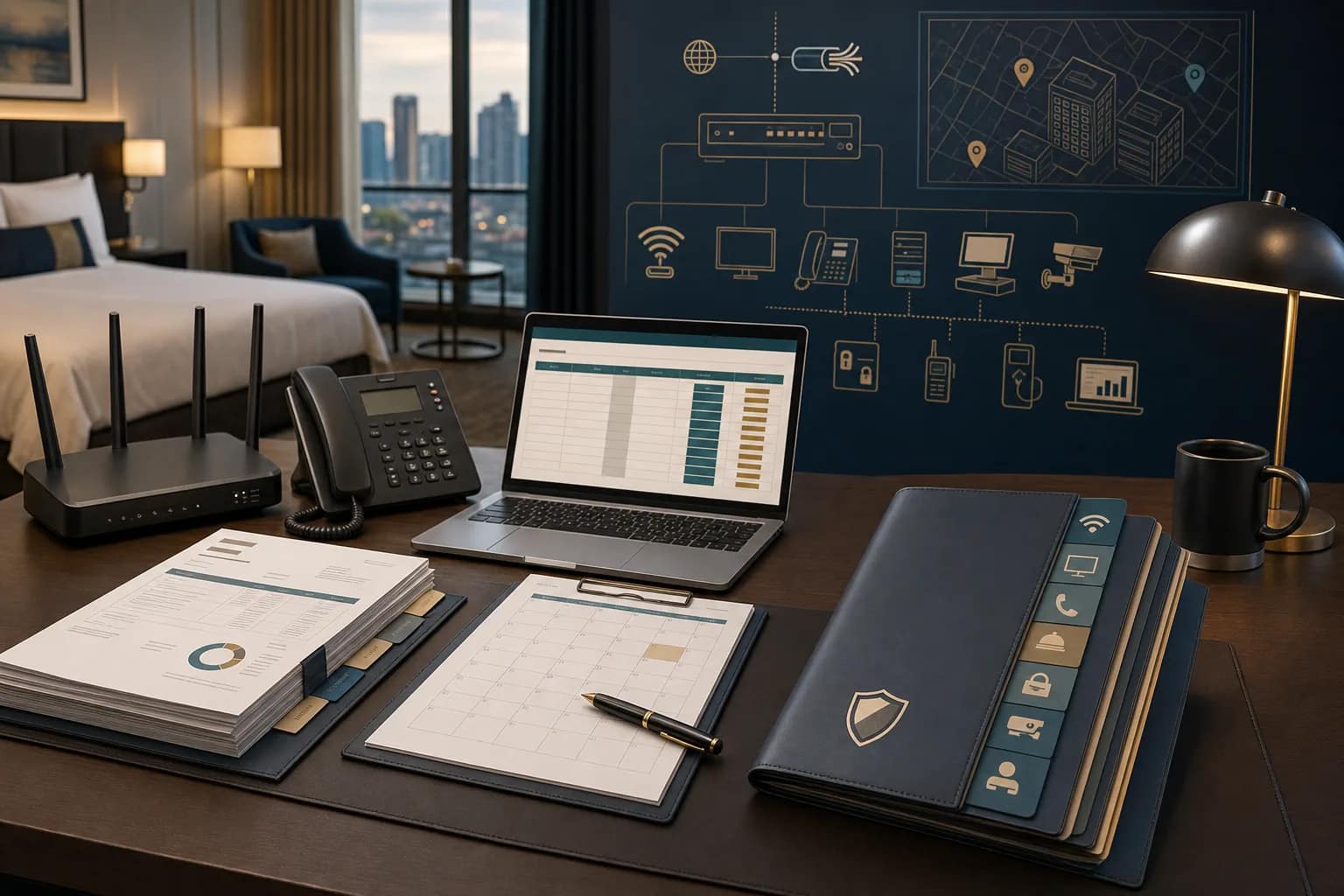
Recurring hotel technology spend can look stable right up until the week an owner wants to change it.
That is when the real questions show up. Which notice date controls the circuit? Which static IPs still matter? Which guest-room TV or phone paths still depend on the old vendor? Who owns the cutover if the hotel changes service? Which monthly lines are active because they are necessary, and which are active because nobody has reviewed them recently?
Before a hotel renews internet, phone, or TV services, the operator should run a basic telecom audit. Not a generic TEM exercise. A hotel-specific audit that checks costs, dependencies, brand requirements, and the systems guests or staff will actually feel if something changes.
Use this checklist before the next renewal window closes.
1. Build one current inventory across internet, phones, TV, and related support lines
Hotels often know the headline monthly spend, but not the full operating picture behind it. The property may have dedicated internet, broadband backup, PRI or SIP phone paths, POTS or analog failover, FTG TV service, managed-router fees, support charges, static IP blocks, and installation or move-add-change obligations spread across different invoices and providers.
Start with one current list that includes:
- carrier or vendor name
- service type and speed
- billing amount and billing start date
- term end date and notice requirement
- circuit IDs, account numbers, and site addresses
- any static IP blocks, analog lines, or managed equipment tied to the service
If the hotel cannot see the full stack in one place, it cannot compare renewals intelligently.
2. Catch the notice dates before the rate conversation starts
The easiest way to lose leverage is to start the review after the notice window has already passed.
Before discussing new pricing, confirm:
- which services auto-renew
- how much notice is required to cancel or replace them
- whether the notice has to be property-specific or portfolio-level
- who inside ownership or management is actually authorized to give that notice
A lower replacement quote does not help if the property is still trapped in the previous term because nobody tracked the deadline.
3. Map what still depends on the existing service before you replace it
This is where a “simple” internet, phone, or TV renewal stops being simple.
Hotels should confirm what still depends on the current service:
- guest Wi-Fi authentication or gateway paths
- PMS, POS, or credit-card processing dependencies
- casting, Connected Room, or FTG TV platforms
- phone-system failover, fax, elevator, alarm, or life-safety paths
- static IPs used by vendors, remote support, cameras, or management tools
If the hotel changes one service without tracing those dependencies first, the “savings project” can become an outage project.
4. Compare the current bill to the actual service the hotel still needs
Some recurring lines survive because they were once necessary, not because they still fit the property today.
Operators should ask:
- Is the hotel still paying for bandwidth, lines, or features sized for an old operating model?
- Does the property still need every analog line or legacy voice path on the invoice?
- Is a current FTG TV package aligned with the property’s actual guest-facing setup?
- Are there redundant or overlapping support charges across internet, phones, TV, and managed equipment?
In JET’s real portfolio work, the biggest savings conversations do not start with one magic quote. They start with a cleaner inventory and a better comparison of current service against current need.
5. Separate rate savings from scope changes
A replacement price is only comparable if the scope is comparable too.
Before accepting a “better” rate, confirm whether the change also alters:
- speed, SLA, or support model
- managed-router or monitoring responsibilities
- static IP allocations
- install or activation timelines
- who coordinates the carrier, hotel, and guest-tech vendors during cutover
If one quote looks cheaper because it excludes project management, support ownership, or cutover accountability, that is not the same as a lower total operating cost.
6. Keep brand and guest-tech requirements in the same conversation
Hotels do not renew technology in a vacuum.
Before changing internet, phone, or TV services, confirm whether brand standards, guest-room platforms, or approved-vendor requirements still affect the decision. Some properties can switch providers easily. Others have brand-program restrictions, portal requirements, device dependencies, or room-technology paths that make a “simple” swap more complicated.
This matters because a hotel can save money on paper and still create more work later if the replacement path ignores brand or guest-tech realities.
7. Plan the cutover as an operating event, not just a contract event
Renewal savings only matter if the service transition is survivable.
Before final approval, the hotel should know:
- who owns the install and testing calendar
- who validates PMS, POS, phones, TV, and guest Wi-Fi after turn-up
- who signs off on billing accuracy after the first live invoice
- who escalates if the carrier, TV vendor, or phone vendor disagree during the cutover
One reason owners use a hospitality-focused advisor is that the renewal is not just a paper exercise. It is a field coordination exercise too.
8. Use a short operator checklist before renewal approval
Before the hotel renews or replaces a recurring technology service, the operator should be able to answer yes to these questions:
- Do we have one current inventory of the service stack and notice dates?
- Do we know what still depends on the existing circuit, phone path, or TV service?
- Do we know whether the quoted replacement changes scope, support, or ownership?
- Do we know who gives notice, who owns the cutover, and who validates the first invoice?
- Do we know whether brand, guest-tech, or life-safety requirements change the decision?
If those answers are still vague, the property is not ready to renew. It is only ready to keep paying by default.
A practical example from hotel portfolio work
JET’s MC Hospitality case-study materials show why this matters. The work started with a portfolio baseline across internet, phone, and FTG TV services rather than a single carrier pitch. That process surfaced carrier-by-carrier comparisons, notice windows, site-by-site service reality, and a cleaner path to consolidated billing and cutover management across multiple hotels.
The lesson is not that every property should change providers tomorrow. The lesson is that hotel operators gain leverage when they review the full service picture before terms quietly roll forward.
Owner takeaway
A hotel telecom audit is really an operator audit. It checks whether the property still understands what it pays for, what the service supports, when the contract changes, and who owns the risk if the hotel wants something different.
JET Hotel Solutions helps hotel owners, management companies, and operators review internet, phone, TV, guest Wi-Fi, and related support dependencies before another renewal window closes. If your property is comparing options or trying to understand the monthly stack it already has, JET can help review the invoices, notice dates, dependencies, and cutover scope before the next term locks in.