
A room-side technology decision can look clean on paper long before it is truly safe to approve.
Ownership sees one less cable, one less gateway, or one simpler guestroom layout. Development sees lower low-voltage cost. Operations hears that the room stack is getting easier.
But hotel technology approvals get expensive when a simpler guest room is signed off before the dependency map is finished.
That is a live issue in JET work right now. On Wednesday, July 29, 2026, JET was still moving a revised low-voltage bid and pricing questions for Hyatt Place Arizona Boardwalk while also comparing hospitality TV and device-quality assumptions that affect what ownership is really approving.
That is the useful operator and owner frame: before a hotel signs off on the room stack, what should be verified so the savings story does not become a rework story?
1. Define what ownership is actually approving
Many hotel technology approvals get framed as one line item:
- fewer drops
- a lower low-voltage number
- a cleaner guestroom design
- a faster path to opening
That is not enough.
Before signoff, the property should name the exact dependency being removed and the exact system path replacing it. If the approval only describes the visible room change, the hotel may be approving hidden risk instead of real simplification.
2. Freeze the endpoint map before treating the scope as final
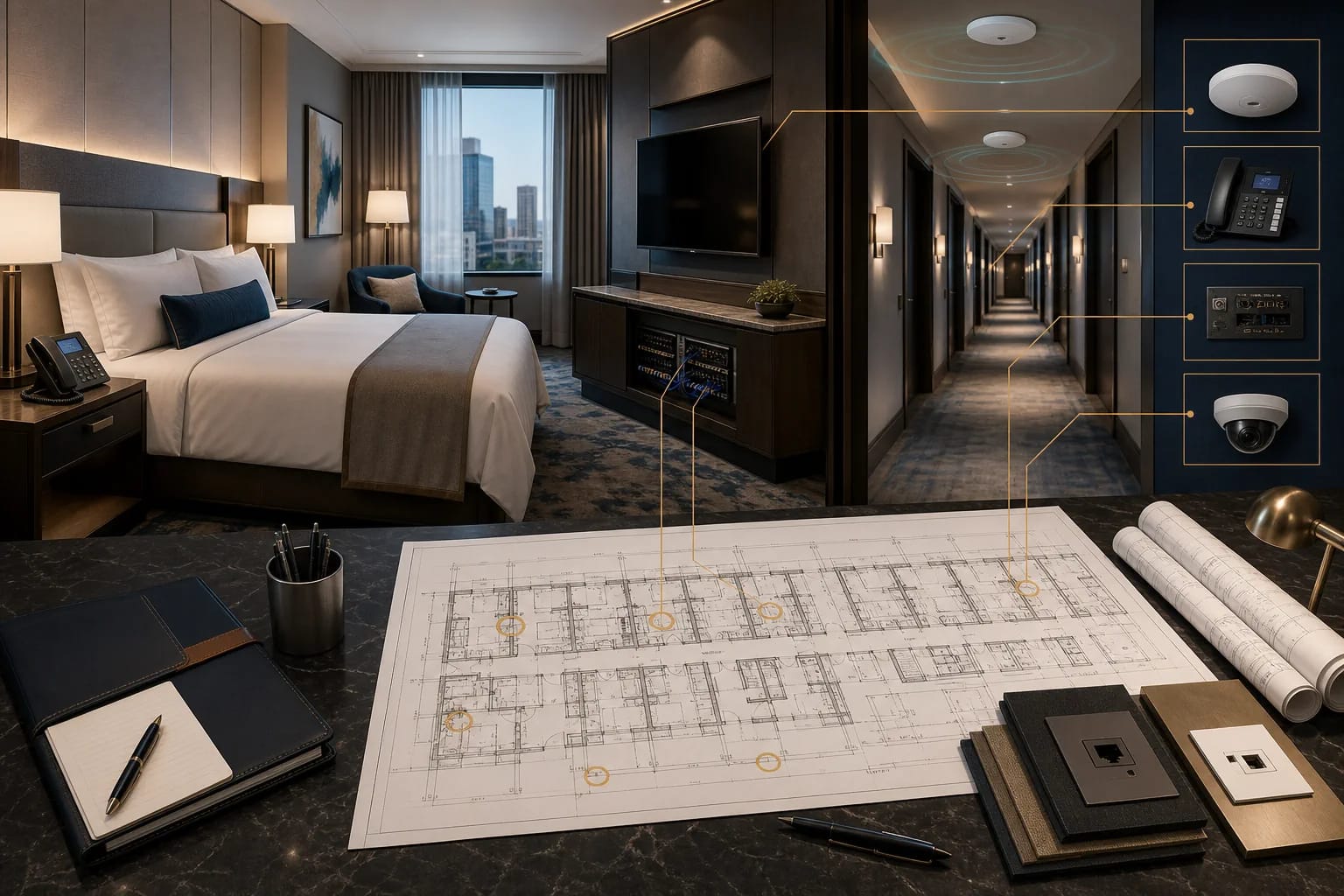
A room stack is not really locked in until the hotel can point to the endpoints that stay, move, or disappear.
That means confirming:
- guestroom phone path and whether any analog gateway assumptions remain
- Wi-Fi access point locations and the coverage assumptions behind them
- TV, FTG, and connected-room dependencies that still need ports, power, or back-of-house coordination
- camera, back-office, or support devices that still share the same closet and switching path
- which drops, patch-panel positions, and switch ports are actually being removed or repurposed
If the endpoint map is not clear, then the room design is not approved. It is only verbally preferred.
3. Treat low-voltage signoff as a systems signoff, not only a cabling signoff
Low voltage is where room assumptions become operating assumptions.
Hotels should review more than whether the cable can be pulled. They should also review:
- PoE and switching load for the remaining room and corridor devices
- whether the Wi-Fi design is carrying more voice, TV, or guest-service responsibility than before
- what still depends on IDF space, rack layout, or uplink capacity
- whether the support path changes when the physical layout changes
This is where the approval process usually breaks down. The visible room gets simpler while the network, closet, or support path gets less obvious.
4. Verify brand, operations, and opening-readiness assumptions together
A hotel can approve an infrastructure shortcut that still fails later because the brand, the operator, or the opening team assumed something different.
Before signoff, confirm:
- whether the approved room hardware and room experience still match the flag’s expectations
- whether front-desk, engineering, and housekeeping workflows still make sense under the new design
- whether the opening team can test the changed room path before go-live
- whether the hotel is simplifying one room element or creating a broader support-model change
A room-side decision becomes expensive when it is treated as a purchasing detail instead of an operating decision.
5. Put one owner on the overlap before the hotel signs off
Room-side simplification often crosses the same familiar lines:
- low voltage
- guest Wi-Fi and switching
- PBX, SIP, or phone configuration
- FTG TV or connected-room coordination
- post-cutover support and escalation
If ownership signs off before one party owns the overlap, the property gets the usual result: one vendor says the cabling passed, another says the network is fine, and operations is left proving the room problem after opening.
Before approval, document one owner for:
- pre-signoff testing
- final endpoint validation
- pilot-room confirmation
- opening support
- post-go-live escalation
6. Sign off on evidence, not only on drawings
The safest room-stack approval is not just a reviewed diagram or a cheaper bid. It is a checklist with evidence.
That evidence should include:
- updated endpoint counts
- validated room assumptions
- coverage or service-path confirmation where needed
- documented ownership for testing and support
- a clear list of what the hotel is intentionally no longer providing
The expensive part is rarely one extra cable or one extra port. The expensive part is approving the room-side savings story before the hotel has proved what still depends on it.
The right signoff protects the next decision too
A hotel does not need to overbuild every room.
But it does need to know what it is removing, what is replacing it, and who owns the result before ownership treats the scope as final.
If your team is reviewing low-voltage scope, room-phone changes, guest Wi-Fi dependencies, FTG TV coordination, or opening-stage support ownership, JET can help pressure-test the room stack before a “simpler” design becomes a later operating problem.