
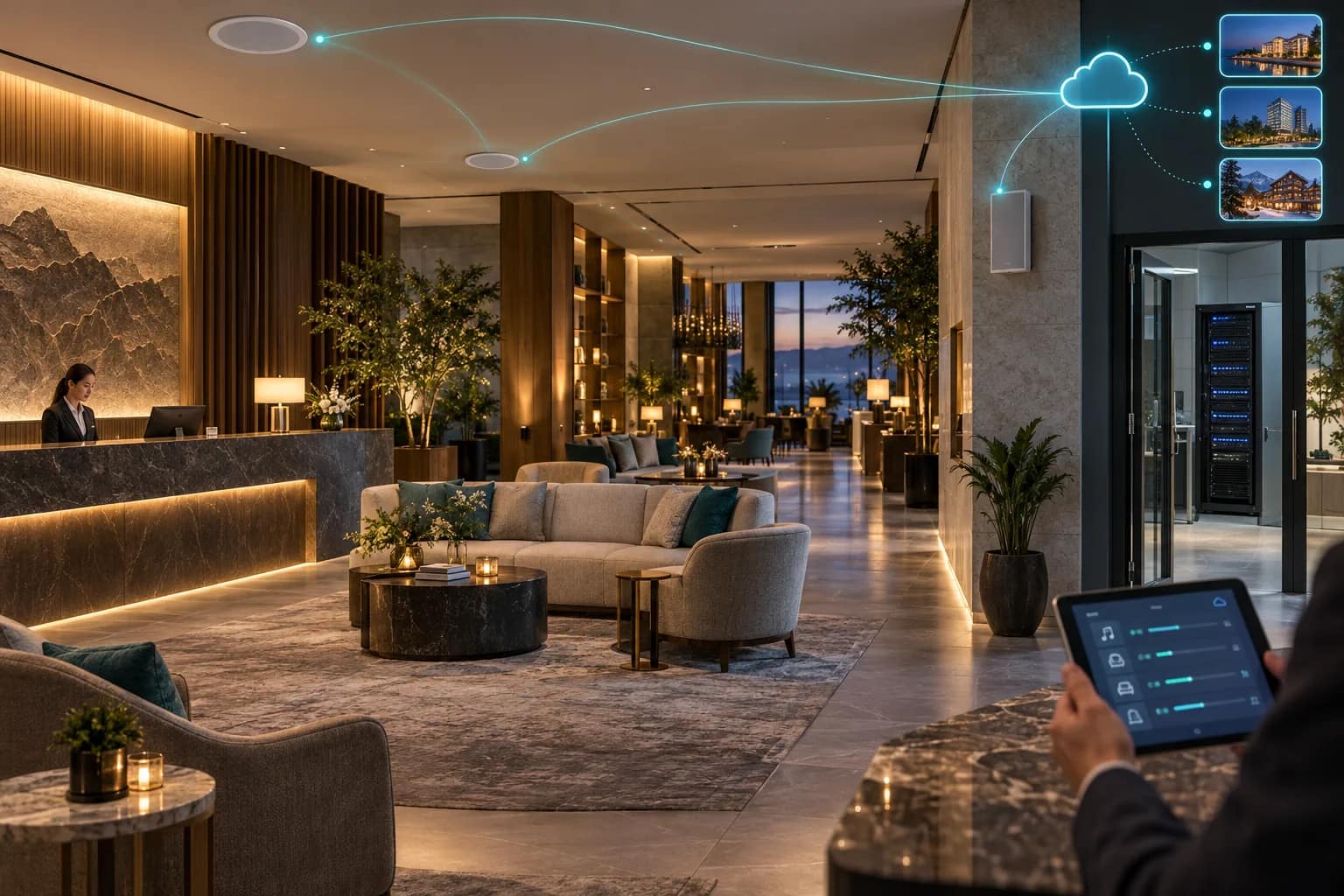
A commercial audio system is becoming a cloud-managed hotel platform, not just a rack of amplifiers feeding ceiling speakers. Verkada, a current participant in the JET Marketplace, announced a new Sound Systems product line on September 16, 2026. The release combines network speakers, audio players, ambient music, announcements, device health, and multi-site controls inside its Command platform.
The announcement matters beyond one vendor. It shows how enterprise audio is following cameras, access control, and building systems into centralized software. For hotel owners and operators, the opportunity is portfolio consistency. The risk is assuming cloud management removes the need for acoustic design, local operations, commercial music rights, network capacity, and careful emergency-system boundaries.
What Verkada announced
According to Verkada’s September 16 product announcement, Sound Systems will launch with two hardware paths. PoE-powered network speakers can operate without a separate amplifier or hardware processor. Network audio players can connect existing amplifiers and speakers to the cloud platform, allowing a property to modernize controls without immediately replacing every installed endpoint.
The first product group includes indoor, in-ceiling, and weather-rated surface-mount speakers. The audio-player group provides line-level outputs for smaller and larger systems. Verkada says U.S. availability begins in early October, while one compact speaker model will follow later in 2026. Those dates and features are vendor statements and remain subject to change.
Management happens at organization, site, subsite, space, or zone level. The platform can also deliver live or text-to-speech announcements and integrates with Soundtrack for commercially licensed music. That combination moves audio administration closer to the same operating model hotels already use for cloud-managed security and other connected systems.
Why hotel portfolios will notice the shift
A single hotel can often tolerate local controls and a knowledgeable engineer who understands the rack. A portfolio has a different problem: every property may use different sources, amplifier settings, zone names, music accounts, support contacts, and staff permissions.
Cloud management can create one view of device status, volume, content, and announcements across many locations. It can also make policy easier to apply. A brand or management company could define who may change lobby music, who may broadcast an announcement, and which regional team can see offline devices without granting full system access.
For hotels, the practical value is not merely remote volume control. It is the ability to compare sites, spot a failed endpoint, standardize recurring operating tasks, and reduce dependence on undocumented local settings. That can be useful across lobby, fitness, pool, restaurant, corridor, meeting, and back-of-house zones—provided each space is designed for its actual use.
Cloud control does not replace acoustic design
Software can show that a speaker is online. It cannot prove that guests hear even coverage at an appropriate level, that announcements are intelligible in a noisy lobby, or that the pool deck is not disturbing guestrooms. Speaker type, spacing, mounting height, surface materials, ceiling conditions, ambient noise, and zoning still determine the experience.
That is why a current hotel sound system design and acceptance review remains necessary even when the management layer is cloud based. Commissioning should test real operating conditions, not only confirm that devices appear green in a dashboard.
PoE speakers change the low-voltage conversation
Network speakers replace some traditional speaker-wire and amplifier dependencies with Ethernet, PoE, switching, and network configuration. That can simplify selected zones, but it also moves audio onto infrastructure that must be planned, powered, segmented, monitored, and supported.
The hotel now needs to account for switch capacity, PoE budget, VLAN design, cable pathways, closet locations, cybersecurity controls, and the operational effect of a switch or network outage. Outdoor and public-space devices still require correct mounting, environmental ratings, and accessible service paths. These choices belong in the property’s low-voltage design and delivery scope before ceilings close.
Audio players create a migration path
The most interesting part of the announcement may be the network audio players. Many hotels already own usable amplifiers and speakers. Replacing them solely to gain cloud control can waste capital and disrupt finished spaces.
A bridge device offers another path: retain serviceable downstream hardware while modernizing sources, schedules, permissions, monitoring, and remote management. The decision then becomes zone specific. A renovation might use new PoE speakers in a reconfigured lobby, connect an existing restaurant system through an audio player, and leave a ballroom AV system under its dedicated event controls.
This staged approach should still document what the cloud platform can and cannot observe. A network player may report its own health while remaining unable to identify a failed downstream amplifier channel or damaged passive speaker. Monitoring boundaries matter.
Music, paging, and emergency audio are different systems
Ambient music, operational announcements, event AV, voice evacuation, and fire-alarm notification serve different purposes and may fall under different technical or regulatory requirements. A unified interface should not blur those boundaries.
Hotels must confirm whether commercially licensed music is included, how playlists are assigned, what happens if the internet is unavailable, and which users can make announcements. They must also define whether an announcement feature is operational paging only or interfaces with a life-safety system. Any emergency integration requires project-specific review by the appropriate licensed design and fire-alarm professionals.
JET’s hotel background music scope guide provides the evergreen counterpart: zones, controls, sources, licensing, pathways, integration boundaries, measurable performance, and handoff.
What owners should compare as the category grows
The product category is likely to expand because cloud management solves a genuine multi-site operating problem. Still, owners should compare architecture rather than choosing from a feature list.
Important differences include whether audio continues locally during a WAN outage; which functions require subscriptions; how music licensing is handled; what logs are retained; how permissions work; what APIs and integrations are available; how firmware and cybersecurity updates are managed; and what happens to devices if a subscription ends.
Total operating cost should include switching and PoE, cabling, licenses, music service, installation, commissioning, staff training, replacements, and ongoing support. A network-native design may reduce rack hardware in some spaces while increasing dependence on the property network. A hybrid design may preserve capital but retain multiple troubleshooting layers.
A Marketplace spotlight, not a universal recommendation
JET currently lists Verkada in its Marketplace, and this release is relevant to hotels because it connects audio to a broader cloud-managed building platform. That does not make one architecture correct for every property, flag, renovation, or operating team.
The useful takeaway is the direction of travel: commercial audio is becoming software-managed, portfolio-aware, and increasingly integrated with other building systems. Hotels evaluating the shift should begin with zones, operating workflows, existing equipment, network readiness, licensing, and support—not with the dashboard demo.
Discuss a hotel audio and low-voltage scope with JET Hotel Solutions.
Source note: Product capabilities, pricing, and availability in this briefing are based on Verkada’s September 16, 2026 announcement and may change. JET’s interpretation focuses on hotel architecture and operations.