
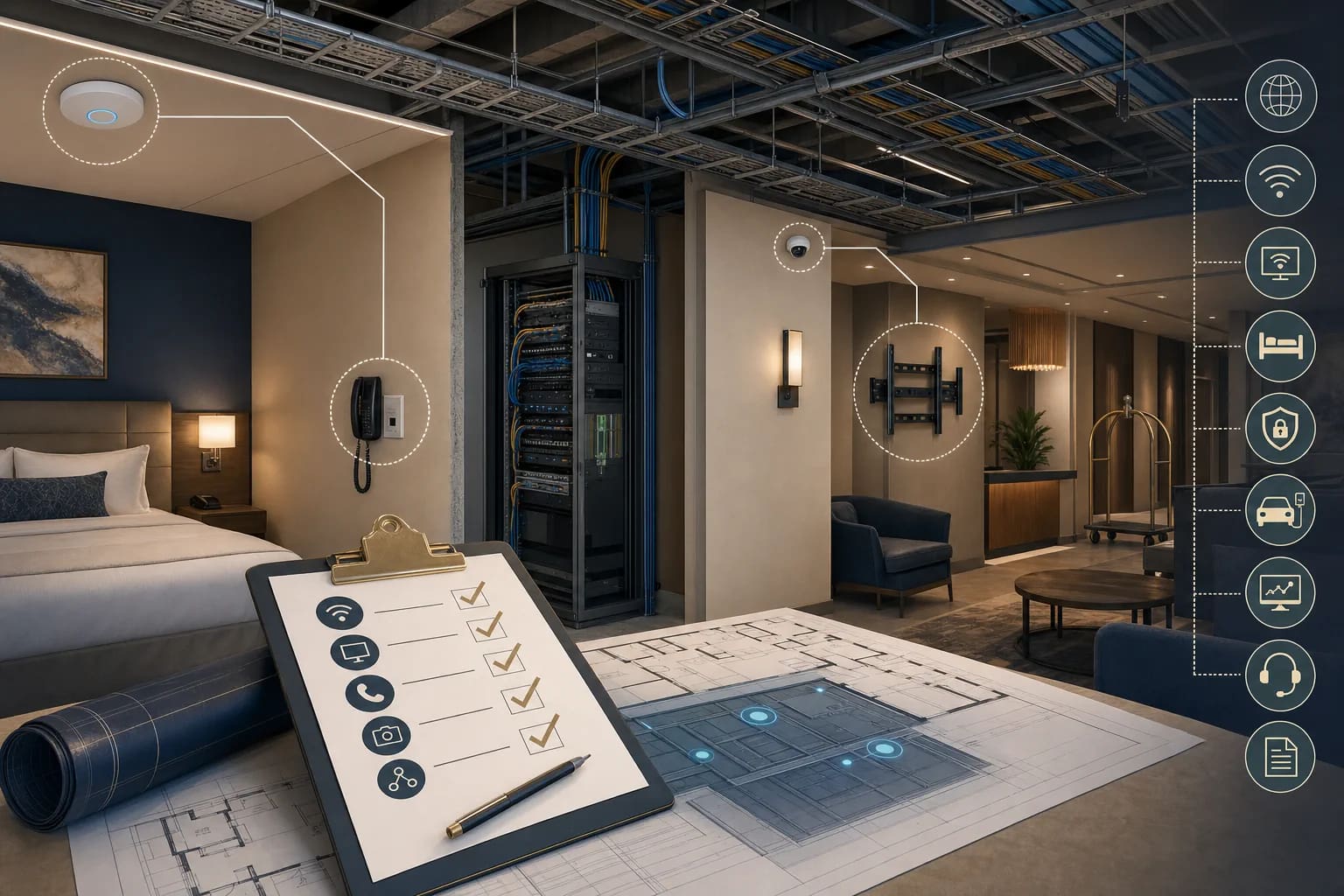
Hotel technology problems get expensive when they are discovered after the ceiling is closed, the low-voltage crew has left, or the opening schedule is already locked.
At that point, a missing patio access point, a forgotten analog line, an unlabeled TV feed, or an undocumented port map is no longer a quick field correction. It becomes a change order, a schedule slip, or a brand-inspection risk.
That is why hotel operators need a pre-close signoff checklist for the infrastructure behind guest Wi-Fi, public-space televisions, phones, and cameras before rough-in is treated as “done.”
Why Pre-Close Signoff Matters
By the time a property is talking about Wi-Fi complaints, TV activation, or PBX testing, most of the expensive physical decisions have already been made. If an access point location was omitted, a public-space television only received one feed, or an analog line was never called out for a copier or life-safety device, the cheapest time to catch it has already passed.
Recent project coordination threads across hotel builds show the same pattern:
- A back-patio WAP was discovered missing after the original design and after change-order cabling had already been completed.
- An analog phone line for a copier/fax area had to be added later through another change order.
- Public-space television locations needed both coax and CAT6, not one or the other.
- Ownership needed clear proof of testing, warranty, and port documentation before acceptance.
Those are not edge cases. They are what hotel technology work looks like when rough-in, equipment, and operations teams are not signing off against the same checklist.
Start With Every Endpoint The Property Will Actually Use
Before ceilings close or crews demobilize, walk the property and verify the endpoints that will be hardest to add later:
- Guest-room and corridor Wi-Fi access points
- Exterior and patio coverage points
- Lobby, breakfast, fitness, and meeting-room television locations
- Front-desk, back-office, admin, fax, copier, and life-safety phone lines
- Camera locations, field of view, and storage assumptions
- MDF and IDF build-out, patching space, and pathway access
This is where operators should be asking simple questions:
- Did every access point on the latest plan actually get cabled?
- Did anyone add an outdoor or patio requirement after the first design set?
- Do public televisions have the feeds the brand or operator expects?
- Did anyone quietly assume a copier, fax, elevator, or fire-alarm line would be “handled later”?
If the answer to any of those questions is uncertain, the signoff is not complete.
Verify Wi-Fi Scope Beyond Guest Rooms
Hotel Wi-Fi scope gets discussed like it begins and ends with guest rooms. In practice, the misses often happen in the spaces that are easiest to overlook:
- Patios and exterior gathering areas
- Meeting rooms and pre-function areas
- Fitness rooms and pools
- Lobby and breakfast spaces
- Back-of-house work areas where staff still rely on connectivity
If those locations are not checked before close-out, the property ends up trying to solve a physical-design problem with support tickets and blame.
This is also where the upstream infrastructure matters. A clean AP plan is only part of the job. Operators should confirm the switch capacity, uplinks, circuit handoff, and support owner that sit behind those endpoints, especially if opening, renovation, or brand timelines are tight.
Do Not Treat TVs, Phones, and Cameras As Separate Worlds
Use the hotel security system readiness guide when CCTV, recorder, network, remote access, and support decisions need to be approved together.
Hotels often buy televisions, voice, CCTV, and connectivity through different vendors or workstreams. That does not mean the physical dependencies are separate.
For example:
- Public-space TVs may require both coax and CAT6.
- Guest-room voice or admin stations may depend on scope that was assumed, not confirmed.
- Camera locations can look fine on paper but fail once finishes, sight lines, or storage assumptions are reviewed on site.
- Connected-room and PMS-linked systems still rely on the same cabling, rack condition, and port discipline as everything else.
Operators should walk those items as one coordinated stack, not as isolated vendor checklists.
Lock In Testing, Warranty, and Labeling Before Acceptance
A rough-in is not truly ready just because the cable is pulled.
Before acceptance, confirm:
- The testing method and what is actually being certified
- Whether the warranty path is explicit, not implied
- Whether patch-cord requirements, lock requirements, and brand-specific exceptions are understood
- Whether the installer is using the certification path the property expects
- Whether the team knows who owns punch-list corrections and by when
In hotel work, this matters because deficiencies discovered during pre-opening or after activation are much harder to fix if the documentation and acceptance criteria were loose from the start.
Require The Close-Out Package Before The Team Leaves
A hotel should not be chasing basic infrastructure records after the installer has moved to the next site.
The close-out package should be called out clearly and assigned to an owner before demobilization. At minimum, operators should expect:
- Test certification results
- As-built drawings in usable formats
- An outlet schedule
- A labeled port map and wired port map
- Warranty documentation
- A clear support-owner list for opening and post-opening issues
That package is not paperwork for paperwork’s sake. It is what keeps future support, vendor coordination, and ownership review from turning into guesswork.
A Practical Pre-Close Signoff Checklist
Before rough-in is treated as complete, ask your team to sign off on these seven items:
- Every planned WAP, including exterior or patio coverage points, is present on the latest field-verified plan.
- Public televisions and special-use areas have the required feeds and mounting coordination, not just rough assumptions.
- Analog, fax, admin, elevator, fire-alarm, and other special lines have named owners and confirmed drops.
- MDF and IDF spaces are serviceable, labeled, and sized for the actual device stack.
- Testing, warranty, and installer-certification requirements are confirmed in writing.
- As-builts, outlet schedules, and port maps are part of the accepted deliverable package.
- Someone on the operator side owns the final signoff before the ceiling closes or the crew leaves site.
That checklist is not complicated. The value is in forcing the review before the property pays for preventable misses later.
Where JET Fits
JET Hotel Solutions helps operators review the stack behind guest Wi-Fi, network access, PBX, free-to-guest TV, low-voltage, CCTV, and vendor coordination so scope gaps get caught before they turn into change orders or opening risk.
If your property is approaching a rough-in milestone, renovation checkpoint, pre-opening inspection, or vendor cutover, this is the right time to pressure-test the low-voltage and infrastructure signoff package, not after the first support call.
If you want a property-level review before the next close-in or cutover milestone, JET can help map the physical scope, the support path, and the documentation package that should exist before the project moves on.