
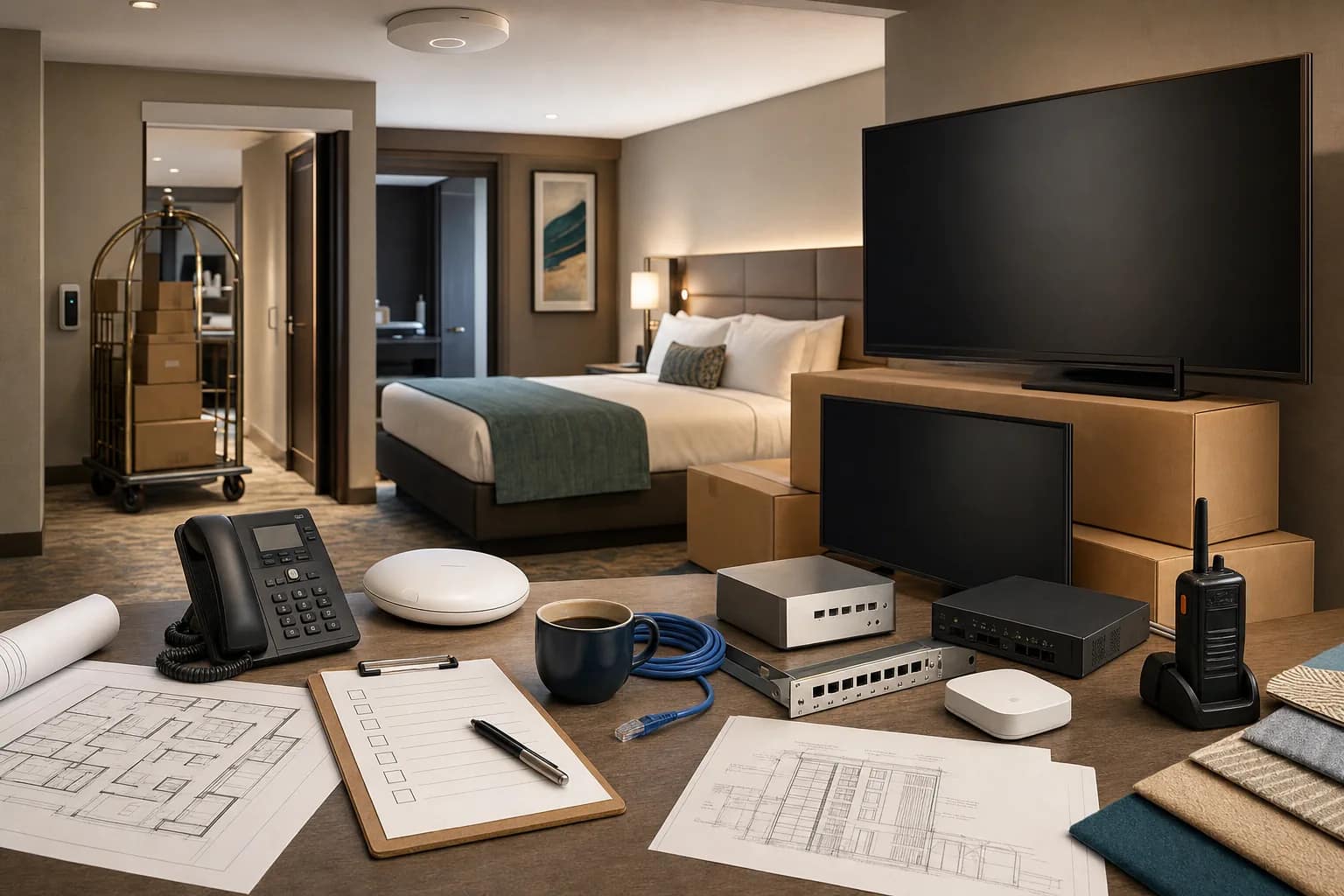
Ordering hotel technology too early can create a problem long before the first guest notices it.
A room refresh or property-wide upgrade often starts with a simple question: should we go ahead and order the TVs, phones, access points, or circuit upgrade now?
The honest answer is usually: only if the property is ready for what arrives next.
JET Hotel Solutions works across hotel network access, guest Wi-Fi, PBX and room phones, Free-to-Guest TV, vendor coordination, and low-voltage scope. In real projects, the hardware itself is rarely the only issue. Timing, storage, circuit dependencies, support ownership, and cutover planning usually matter just as much as the quoted price.
If you are planning a hotel technology refresh, use this checklist before you approve the order.
1. Define what the refresh is actually supposed to fix
A surprising number of hotel upgrades start with a symptom, not a scope.
“The TVs are old.”
“The phones need to go.”
“We should upgrade the internet.”
Those may all be true. But operators should be able to answer the practical version of the problem before equipment is ordered:
- Is the goal a brand refresh, a guest-experience fix, an operating cost change, or a supportability improvement?
- Is the property replacing a failing system, or trying to avoid a future failure during renovation, reflagging, or budget season?
- Does the change affect guest rooms only, or also back office, public spaces, meeting rooms, CCTV, staff communications, or PMS/POS dependencies?
If the property cannot explain what success looks like, the team is not ready to buy the right scope yet.
2. Check the systems that depend on the order
Hotel technology does not live in one lane.
A TV order can affect more than TVs. A phone refresh can expose analog-line dependencies. A circuit upgrade can change static IP requirements, modem placement, firewall rules, TV headend assumptions, and who owns the actual cutover.
Before you approve the order, confirm the downstream systems that will be touched:
- guest-room TVs and the FTG or IPTV path
- room phones, front-desk phones, emergency or analog lines, and PBX behavior
- guest Wi-Fi and the network equipment behind it
- managed router, firewall, VLAN, or static-IP dependencies
- Connected Room or casting features that rely on the network and TV environment
- vendor apps or dashboards that assume the old circuit or old device path still exists
A “simple” refresh usually stops being simple when one of those assumptions is discovered after the hardware is on site.
3. Do not ignore delivery timing and storage questions
This is where many projects become expensive for reasons that have nothing to do with technical quality.
If equipment arrives before the property is ready, the operator may suddenly need answers for questions like:
- Where will the TVs, phones, or network gear be stored?
- Is the equipment being held on site, by a vendor, or in a third-party warehouse?
- Who is responsible for photos, serial numbers, condition checks, and insurance documentation?
- Will a lender, ownership group, or project manager treat the order as stored materials with extra requirements?
- Is the property paying a deposit, partial billing, or full material billing before installation?
Those questions are not theoretical. They show up in real hotel projects when TVs, connected-room equipment, or telecom hardware are ordered before the timing is settled.
If the property team is not ready to answer them, it may be too early to place the order.
4. Confirm the circuit and IP story before a network-related refresh
When the project touches internet service, fiber, managed routers, or network hardware, the property should slow down and verify the full cutover story.
At minimum, ask:
- Is this an upgrade, a rip-and-replace, or a new service path?
- What happens to the old circuit and who owns cancellation timing?
- Will the property need different static IP allocations or updated configurations?
- What guest-facing or back-office systems still depend on the existing circuit path?
- Who owns the coordination between carrier, MSP, PBX/phone vendor, TV/FTG vendor, and property team?
Hotels get in trouble when they buy the new circuit or hardware first and only later discover that the contract, addressing, vendor ownership, or support model is still tied to the old path.
5. Ask whether the property is ready for installation, not just delivery
Ordering equipment is not the same thing as being ready to install it.
Before approving the refresh, confirm whether the property has:
- final room counts and device counts
- confirmed mounting, outlet, rack, MDF/IDF, or cabling assumptions
- brand, ownership, or GC signoff where needed
- site contacts and escalation contacts for the install window
- clear cutover sequencing for rooms, public spaces, and back-of-house systems
- a support plan for what happens if one part of the refresh slips
Operators do not need to overcomplicate this. They just need to make sure the room plan, network plan, and vendor plan are not working from different assumptions.
6. Clarify who owns the first response after the refresh
Even well-planned upgrades create follow-up questions after installation.
The property should know, before the order is placed, who owns the first call if:
- a guest-room TV does not activate correctly
- room phones or front-desk phones behave differently after the change
- guest Wi-Fi complaints rise after the cutover
- the new circuit is live but dependent systems are not stable
- the property team needs as-builts, port maps, or final support contacts
The best refresh projects do not just install hardware. They leave the hotel with a usable support path.
A practical hotel refresh checklist before you order
Pair the procurement timeline with a hospitality TV system readiness check so the property understands which guest-room services depend on the same network path.
- Define the operational goal, not just the hardware being replaced.
- Map every guest-facing and back-office dependency the change could touch.
- Confirm delivery timing, storage, billing, and stored-material expectations.
- Verify the circuit, static IP, and carrier-contract story for network-related changes.
- Make sure the property is ready for installation, not only eager to place the order.
- Document who owns the first support response after cutover.
Final thought
In hotels, a technology refresh is rarely just a purchase order.
It is usually a chain of dependencies across rooms, vendors, circuits, support contacts, and timing decisions. When those pieces are checked early, the refresh feels routine. When they are not, the property ends up paying to solve planning mistakes in the field.
If your team is reviewing TVs, phones, guest Wi-Fi hardware, network access, or a broader room-technology refresh, JET Hotel Solutions can help pressure-test the scope before the order, delivery date, or cutover becomes the problem.