
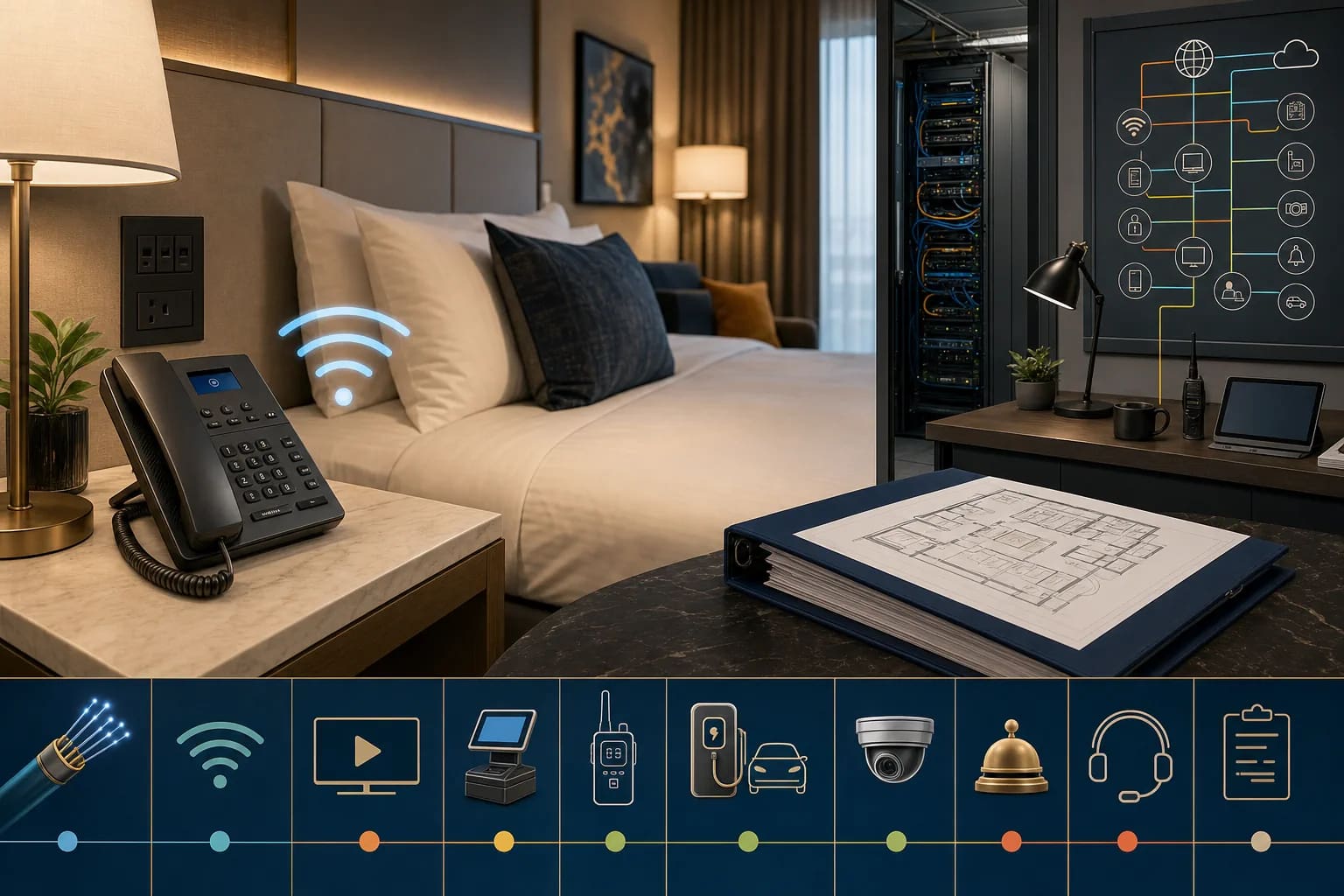
Cutting a cable run out of a hotel guest room sounds like an easy win.
On paper, a Wi-Fi guestroom phone can look like a cleaner answer than another analog gateway, another room drop, or another layer of PBX hardware. Ownership sees less cabling. Development sees fewer physical dependencies. The budget gets smaller.
But in hotel projects, the cheaper room-side design only works if the property confirms what is replacing the old dependency, not just what is being removed.
That question is showing up in live JET work right now. In current July 2026 project threads, JET is still pushing low-voltage scope toward signoff on one hotel while also checking whether a Hyatt project could use approved Wi-Fi guestroom phones to reduce analog gateways and one cable per room before the team presents the change to ownership.
That is the useful operator frame: if a hotel wants to simplify its room-phone design, what has to be true before the savings are real?
1. Confirm what problem the Wi-Fi phone is actually solving
A hotel should start by naming the exact cost or complexity it wants to remove.
Usually that means one or more of these:
- eliminating a dedicated room-side phone cable run
- reducing analog gateways or room-level voice adapters
- simplifying a large new-build low-voltage scope
- lowering installation labor in a guestroom refresh or opening project
If the team cannot state the exact dependency it is removing, the project may only be relocating the cost into wireless troubleshooting, support confusion, or a later change order.
2. Check brand approval and model fit before pricing around it
Hotel phone decisions do not happen in a vacuum. Brand standards, approved manufacturers, and room-type expectations still matter.
Before ownership gets excited about the lower infrastructure count, confirm:
- whether the proposed Wi-Fi phone model is brand approved for that flag
- whether the handset supports the guestroom feature set the property actually needs
- whether the front desk, admin, or back-office phone path still follows a different design
- whether the project is simplifying the guestroom only or the full hotel voice environment
This matters because a guestroom-phone shortcut can fail late if the brand, the ownership group, or the operations team assumed a different room standard all along.
3. Treat Wi-Fi voice as a wireless design question, not only a handset question
A Wi-Fi phone is only as good as the wireless environment it depends on.
Hotels should not assume that a network designed for guest browsing will automatically perform like a voice-ready platform. Before approval, review:
- guestroom and corridor coverage consistency
- roaming behavior between access points
- voice VLAN, SSID, and QoS assumptions
- PoE, switch, and closet design for the infrastructure that still supports the wireless path
- how the design performs at occupancy, not only during a quiet site walk
If the hotel has not tested the voice behavior of the wireless design, then the project is still carrying a hidden engineering question even if the room no longer has one more cable.
4. Separate guestroom simplification from life-safety and failover requirements
Removing a room-side analog assumption does not automatically remove every legacy or emergency voice dependency in the hotel.
Operators should still confirm:
- what remains on POTS, SIP, PRI, or analog failover paths
- whether elevator, emergency, fax, or life-safety lines still require dedicated handling
- how front-desk operations behave if the wireless environment is impaired
- who owns failover and post-cutover support if the room phones depend on the Wi-Fi environment
This is where many “simplified” hotel phone designs become more complicated in practice. The guestroom may lose a cable while the support model becomes less clear.
5. Define who owns the overlap between low voltage, Wi-Fi, and PBX
A Wi-Fi guestroom phone project usually crosses at least three scopes:
- low-voltage and room infrastructure
- wireless network design and support
- PBX, SIP, or hosted-phone configuration
If nobody owns the overlap, the property gets the usual result: one vendor says the network is fine, another says the handset is fine, and operations is left proving the call problem during opening or occupancy.
Before signoff, the hotel should document one owner for:
- wireless readiness testing
- voice feature validation
- guestroom pilot results
- cutover timing
- support escalation after go-live
6. Pilot the room experience before rolling it through the full count
The smartest hotel phone simplification plan is usually a controlled pilot, not a room-count assumption.
Test a few real rooms and confirm:
- guest call quality and reliability
- front-desk transfer behavior
- coverage in edge rooms and problem corners
- what happens during AP, switch, or WAN disruption
- how the housekeeping, engineering, and operations teams experience the new design
A short pilot is much cheaper than discovering after opening that the property traded one cable problem for a roaming or support problem.
The real savings come from removing the right dependency
A Wi-Fi guestroom phone can be the right hotel decision.
But the useful approval question is not just, “Can this phone work over Wi-Fi?” It is, “Have we proven that the wireless, voice, low-voltage, and support assumptions behind it are better than the cable run we want to remove?”
If your hotel is weighing a guestroom phone change, PBX refresh, low-voltage redesign, or opening-stage simplification, JET can help review the wireless, cabling, brand, and support dependencies before the savings story turns into an operations problem.