
Verkada Sound Systems gives a hotel two ways to connect an existing audio installation to Command: the NP21 has two line-output channels, while the NP81 has sixteen. That difference matters when a refurbishment keeps its amplifiers and speakers but changes how music sources are managed. Neither player should be treated as a replacement power amplifier for passive ceiling speakers.
The practical comparison is a small lobby-and-breakfast installation versus a property with several separately served public areas. The right choice depends on the actual signal paths, not the number of speakers on the ceiling. This is a product-specific update to our September 2026 cloud-audio briefing; it is not a claim that JET has installed either model at a client hotel.
NP21 versus NP81: what actually changes?
The current manufacturer specifications distinguish inputs, outputs and power requirements. Connector choices do not multiply the published channel count: terminal and RCA connections are not evidence that an NP21 becomes a four-output player.
| Published specification | NP21 | NP81 |
|---|---|---|
| Line inputs, total channels | 2 | 8 |
| Line outputs, total channels | 2 | 16 |
| Player power options | AC or PoE+ | AC or PoE+ |
| Maximum player consumption | 23 W | 25 W |
Sources: Verkada’s NP21 specifications and NP81 specifications, checked October 19, 2026. These are equipment specifications, not a complete hotel-system design or a quoted installed price.
When does the two-channel NP21 fit a hotel retrofit?
Consider a hypothetical property whose lobby and breakfast seating share one existing stereo amplifier feed. A two-channel player is a plausible source interface to evaluate. But the physical presence of two spaces does not prove that each already has an independent signal path. Both areas might be connected to the same amplifier output or share a volume control.
Conversely, one stereo source uses a left and a right channel. Counting it as one output because it serves one room can understate the interface requirement. Before selecting the smaller player, translate the hotel’s desired listening areas into actual mono or stereo feeds and compatible amplifier inputs. This is JET’s design interpretation of the published interface, not a claim about automatic zone assignment in Command.
What does the larger NP81 add—and what remains downstream?
A property with separate lobby, restaurant, fitness and prefunction feeds has a different starting point. The NP81’s sixteen line-output channels offer more connection capacity, but sixteen outputs do not guarantee sixteen fully independent hotel zones. The existing matrix, amplifier channels, speaker circuits and intended source routing still determine what can be separated.
For example, a restaurant and corridor wired to the same downstream circuit will not become acoustically independent simply because a new player has spare outputs. The useful survey result is a drawing from source to amplifier to speaker circuit, with the intended listening areas marked. Retained equipment needs compatible connections and a condition assessment. A working cloud interface alone cannot establish that every passive speaker or amplifier channel is healthy.
PoE+ powers the player, not the retained speaker system
The table’s wattages describe each player. They are not speaker-amplifier output ratings. An existing amplifier still needs its own power and suitable capacity for its connected load. A hotel evaluating Ethernet power must also account for the switch’s PoE+ budget and the actual cable path to the player.
This is where a hotel low-voltage and network scope connects the product choice to construction: the player location, network connection, amplifier rack and service access must work together. Keeping useful equipment can reduce the extent of a retrofit, but it does not establish a saving without a property-specific scope.
Cloud music control is separate from ballroom audio and emergency systems
Verkada’s September 16, 2026 announcement describes Command-based music and announcements, with a Soundtrack integration for commercially licensed music. It announced early-October availability for both players. Current regional product listings do not prove stock or delivery dates for a specific hotel order.
Those capabilities should not be expanded into an assumed ballroom solution. Divisible meeting rooms introduce local microphones, presentation sources and room-combine behavior; our AtlasIED AZM8 hotel meeting-room comparison addresses that separate scenario. A hotel can evaluate a public-area music migration while preserving a different event-audio design.
Likewise, this comparison does not establish certification for fire-alarm notification or voice evacuation. Keep those systems subject to the project’s qualified designers and applicable approvals. No internet-outage fallback guarantee is inferred from Verkada’s camera or access-control documentation: those are different products. Confirm audio behavior for the selected source and configuration directly.
Which option should the hotel evaluate first?
Start with NP21 when the surveyed interface needs fit two line-output channels; evaluate NP81 when a larger set of feeds needs connecting. If the required change is acoustic coverage, failed amplification or ballroom processing, a player alone may not address the problem. The model comparison narrows a decision instead of making a universal recommendation.
Verkada is listed in JET’s Marketplace. JET also coordinates hotel sound-system scopes; a listing does not establish compatibility with every installed system. Bring the existing amplifier models, signal diagram and desired operating areas to a hotel audio retrofit discussion with JET. We can use that starting point to frame the equipment and project questions that need resolving.
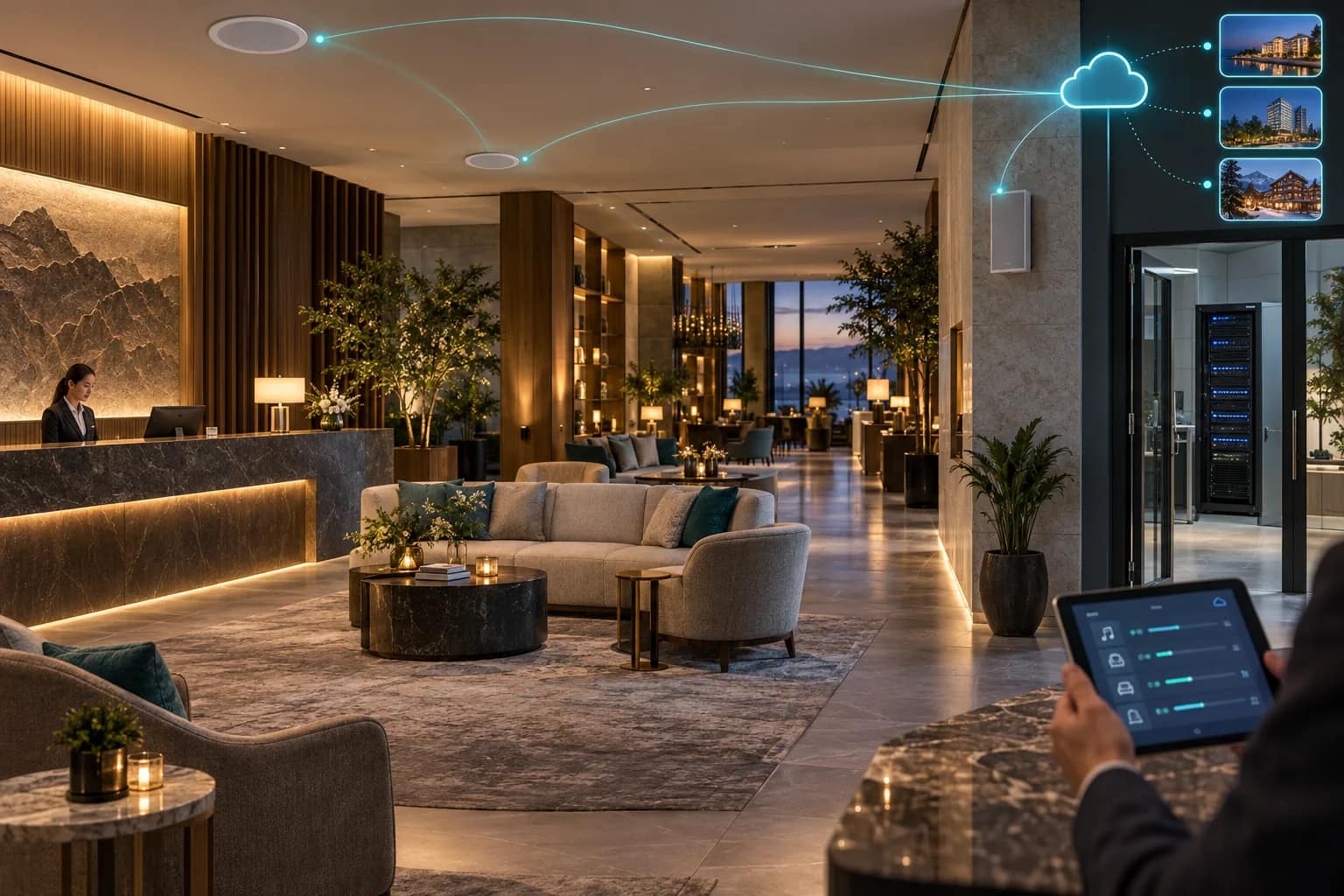
Illustration: conceptual hotel audio environment, not an NP21/NP81 product photograph or a JET client installation. Product facts are based on the linked manufacturer documents; hotel scenarios are illustrative.