
Hotel Internet Upgrades Are Never Just Internet: A Checklist for DIA, Guest Wi-Fi, and Free-to-Guest TV
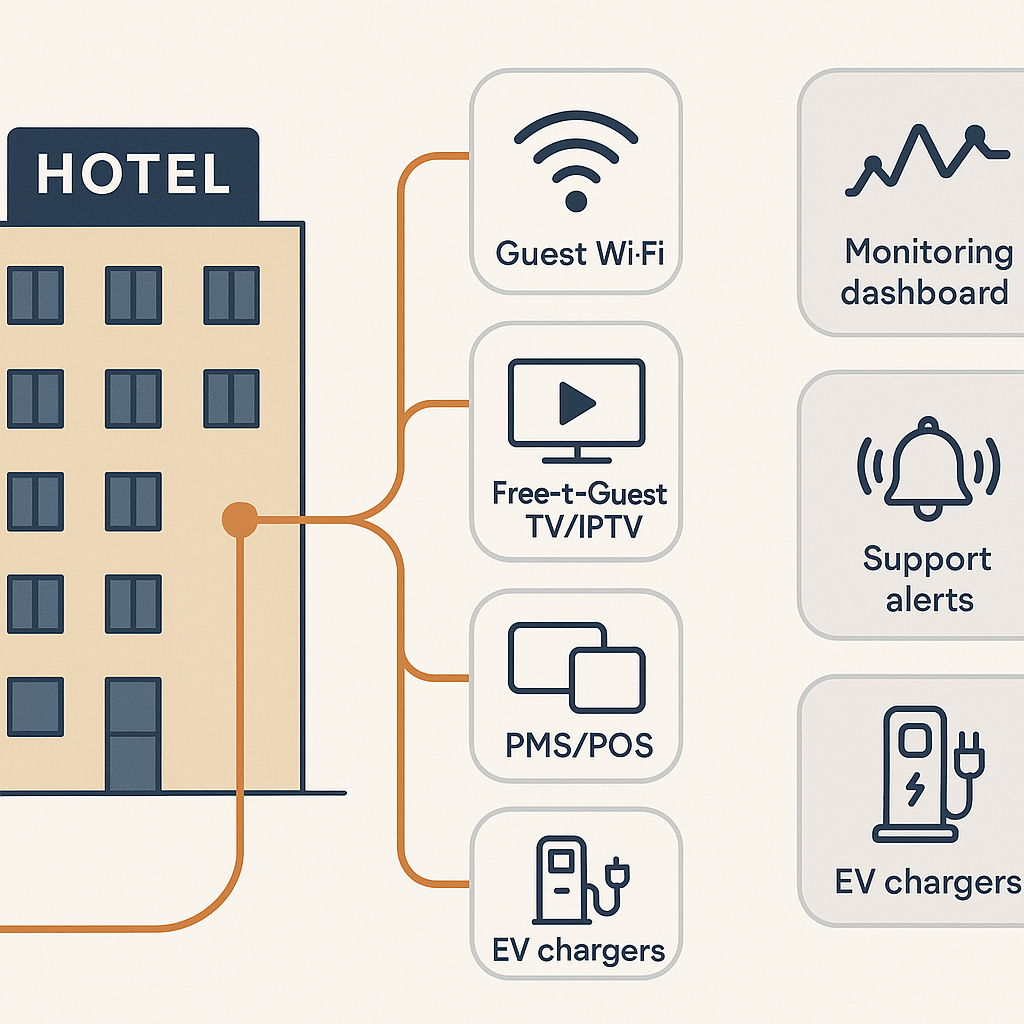
Hotel internet infrastructure is no longer a back-office line item. It is the layer that supports guest Wi-Fi, Free-to-Guest TV, IPTV, streaming expectations, PMS and POS traffic, staff safety devices, EV charging, monitoring, and the day-to-day tools your team needs to run the property.
That is why a hotel internet quote is rarely just an internet quote. Before an owner, GM, asset manager, or management company signs a new DIA, fiber, Wi-Fi, or TV agreement, the property needs a practical inventory of what the network already supports, what is being replaced, what contracts are still active, and what could break if the upgrade is treated as a single-provider price comparison.
In a recent hotel connectivity review, the discussion was not simply, “Which provider has the best monthly price?” The real scope included dedicated internet access, guest-room television, public-area screens, premium content, site-survey risk, existing redundant circuits, contract renewal timing, customer-owned network equipment, monitoring, and the downstream systems that depend on reliable connectivity.
That is the useful lesson for hotel operators: start with the stack, not the quote.
Quick Answer: What Should a Hotel Check Before Signing an Internet or TV Upgrade?
Before approving a hotel internet or TV upgrade, inventory every current circuit, contract term, redundancy role, survey requirement, construction risk, guest Wi-Fi demand, TV endpoint, content package, network handoff, monitoring requirement, and connected system. The best provider quote can still create problems if the property has legacy circuits, unclear failover, weak Wi-Fi planning, or TV infrastructure that depends on the same network.
Start With the Property Inventory, Not the Provider Quote
Provider pricing matters, but it should not be the first question. The first question is: what does this property actually need the network to do?
For many hotels, the answer is broader than “give guests Wi-Fi.” A single property may be supporting guest devices, business travelers on video calls, lobby and meeting-space usage, streaming or casting, Free-to-Guest TV, PMS and POS workflows, staff communication tools, panic-button or location devices, EV charging stations, security systems, and remote monitoring dashboards.
If those systems are not mapped before the upgrade, the hotel can end up buying a circuit that looks good on paper but fails in practice. The common failure is not always raw bandwidth. It is role confusion: nobody knows which circuit is primary, which one is backup, which one is still under contract, which one supports a specific vendor, or which one can be cancelled without breaking something else.
The inventory should answer five basic questions
- Which providers and circuits are active today?
- What does each circuit support?
- Which contracts are still in term, auto-renewed, month-to-month, or end-of-life?
- Which systems depend on the network beyond guest Wi-Fi?
- What must be true on installation day for the property to operate normally?
That inventory gives owners and operators leverage. It turns the conversation from “Provider A is cheaper than Provider B” into “This is the circuit, TV, Wi-Fi, redundancy, and support plan the hotel actually needs.”
What DIA Changes for a Hotel
Dedicated Internet Access, or DIA, is usually evaluated for reliability, symmetrical bandwidth, uptime expectations, monitoring, support, and cleaner business traffic. For hotels, those factors matter because connectivity demand spikes at the same time across many rooms and public areas.
Guests are not only checking email. They are streaming, taking work calls, messaging, using mobile keys, casting content, and connecting multiple devices. Staff are also using cloud-based systems, mobile workflows, and operational tools. If the property adds IPTV, EV charging, or more connected guest services, the network becomes even more central.
That is why a DIA decision should include more than speed. A hotel should ask about:
- Symmetrical upload and download performance.
- Service-level expectations and how uptime is measured.
- Monitoring, alerting, ticketing, and escalation paths.
- Whether the provider owns or controls the last-mile path.
- What equipment the customer must provide, such as router, firewall, or Layer 3 switch.
- Whether handoff is copper, single-mode fiber, or multi-mode fiber.
- How the circuit will interact with guest Wi-Fi, office traffic, TV, and back-of-house systems.
A low monthly price is useful only if the final design supports the property. If a hotel compares DIA quotes without comparing handoff, support, construction, redundancy, and contract exposure, it is not comparing the full cost of the decision.
Why Free-to-Guest TV and IPTV Belong in the Same Conversation as Wi-Fi
Free-to-Guest TV used to feel separate from internet service. In modern properties, that separation is weaker. IPTV, streaming, casting, content packages, guest-room TVs, lobby screens, gym screens, and network segmentation can all affect the same infrastructure conversation.
If a hotel is upgrading TV content or IPTV, the team should not treat it as a room-entertainment project only. It can touch bandwidth, VLANs, switches, Wi-Fi design, wired drops, PMS integration, content rights, guest support, and installation sequencing.
This is especially important when a property has more than a handful of endpoints. A hotel with 100+ guest-room TVs and public-area screens has a different planning problem than a small office buying internet service. The endpoint count matters. The content package matters. The network path matters. The support model matters.
TV planning questions operators should ask
- How many guest-room TVs and public-area TVs are in scope?
- Is the hotel using coax, IPTV, casting, streaming apps, or a mix?
- What premium content or brand-required packages must be included?
- Will TV traffic share the same network path as guest Wi-Fi?
- Does the property need VLAN separation or multicast planning?
- Who supports issues when a guest cannot stream, cast, or watch a channel?
- What happens during peak occupancy when Wi-Fi and TV demand rise together?
When TV and internet are planned separately, the guest often feels the gap first. The front desk hears about buffering, login problems, casting issues, channel gaps, and “the Wi-Fi is bad” even when the root cause is more specific.
The Contract Problem: Redundant, Auto-Renewed, EOL, and Mystery Circuits
Many hotel networks are built in layers over time. A circuit was added during a renovation. Another came with a TV package. A backup became a third backup. A legacy provider reached end-of-life but stayed active month-to-month. A contract auto-renewed before new management reviewed the stack.
None of that is unusual. But it becomes expensive and risky when nobody can explain the purpose of each service.
A property may be paying for redundancy that no longer matches the operational plan. Or it may be relying on a “random internet service” that quietly supports something important. Both are problems. Cancelling the wrong circuit can break operations. Keeping every old circuit can waste money and confuse support.
Before cancelling or replacing a circuit, document its role
- Primary guest internet.
- Backup or failover circuit.
- Business-office or admin internet.
- TV, IPTV, or content provider dependency.
- PMS, POS, payment, or back-office dependency.
- Staff safety, IoT, EV charging, or monitoring dependency.
- Phone, alarm, security, or vendor-specific requirement.
Once that role is clear, the hotel can decide whether to consolidate, replace, renegotiate, or keep the circuit. Without that map, the property is guessing.
The Install Problem: Surveys, Construction, Handoffs, and Timelines
Fiber upgrades can depend on site surveys, construction requirements, building access, handoff decisions, and customer equipment. That means the operational risk is not just the final monthly rate. It is whether the hotel can get installed on time without surprise construction costs or scope gaps.
If a provider says final pricing depends on a survey, operators should treat the quote as conditional. That does not mean the quote is bad. It means the hotel should not build a launch timeline, TV upgrade, or cancellation plan around a number that has not been confirmed.
Installation questions to ask before approval
- Has the site survey been completed?
- Is construction expected, and who pays if it is required?
- What is the realistic installation window?
- What rooms, closets, risers, pathways, or access points are needed?
- What equipment does the hotel need to provide?
- What handoff type will the provider deliver?
- What must remain active until the new service is tested?
- Who coordinates cutover, testing, and support escalation?
This is where many projects drift. The owner approves a quote, but the property still needs construction confirmation, equipment decisions, TV scope, support ownership, and a cutover plan.
The Connected-Property Problem: Guest Wi-Fi, Staff Safety, EV Charging, PMS/POS, and Monitoring
Hotel internet infrastructure supports more than guests. It increasingly supports the systems that make the property safer, easier to operate, and more valuable to guests.
Staff communication and safety devices may depend on reliable coverage and clear support ownership. EV charging can involve network subscriptions, access control, pricing policies, station health monitoring, reporting, and driver support. PMS and POS systems need dependable connectivity. IPTV and casting need planning. Monitoring dashboards need clean escalation paths.
When the network is weak, every connected system looks worse than it really is. Guests blame Wi-Fi. Staff blame the tool. Vendors blame the network. The property team gets stuck in the middle.
The better approach is to treat connectivity as the foundation for the property stack. That does not mean overbuying bandwidth. It means matching the circuit, Wi-Fi design, segmentation, redundancy, and support model to the systems the hotel actually runs.
Hotel Connectivity Checklist Before Approval
Use the hotel network infrastructure checklist to connect DIA, guest Wi-Fi, Free-to-Guest TV, IPTV, monitoring, support ownership, and closeout evidence before contracts are approved.
Use this checklist before approving DIA, fiber, guest Wi-Fi, Free-to-Guest TV, IPTV, or a major network change.
Current-state inventory
- List every active provider and circuit.
- Record the speed, monthly service, term, renewal date, and cancellation exposure.
- Define the role of each circuit: primary, backup, TV, admin, vendor-specific, or unknown.
- Identify any end-of-life, month-to-month, or auto-renewed services.
- Confirm whether any “mystery” service supports a critical system.
Guest and TV requirements
- Count guest-room TVs and public-area screens.
- List required content packages, premium channels, casting, or streaming expectations.
- Estimate peak Wi-Fi demand by occupancy, meeting space, and guest profile.
- Document whether TV/IPTV traffic needs wired paths, VLANs, multicast, or segmentation.
- Confirm who supports guest-facing TV and connectivity issues.
Network and equipment requirements
- Confirm handoff type and customer equipment responsibility.
- Review firewall, router, switch, and Wi-Fi controller readiness.
- Plan network segmentation for guest, back-office, TV, staff devices, EV charging, and vendor systems.
- Confirm monitoring, alerting, bandwidth visibility, ticketing, and escalation paths.
- Define cutover, test, rollback, and support responsibilities.
Install and business-risk requirements
- Complete site surveys before treating pricing as final.
- Identify construction requirements and possible customer contribution.
- Keep old services active until the new service is tested and accepted.
- Avoid cancelling redundant circuits until failover roles are confirmed.
- Compare provider quotes on total operating impact, not monthly price alone.
How to Compare Provider Quotes Without Missing the Real Cost
A clean comparison should include both commercial and operational factors.
| Question | Why It Matters |
|---|---|
| Is the price final or survey-dependent? | Conditional pricing can change after construction review. |
| What systems are being supported? | Guest Wi-Fi, TV, PMS/POS, staff safety, and EV charging may have different requirements. |
| Who owns support? | The front desk needs a clear escalation path when guests or staff report issues. |
| What is the contract exposure? | Auto-renewals and overlapping terms can erase savings from a cheaper quote. |
| What happens during cutover? | A bad cutover can affect check-in, payments, TV, guest Wi-Fi, and operations. |
The best quote is the one that fits the property stack and reduces operational uncertainty. Sometimes that means the lowest price wins. Sometimes it means the hotel needs better support, cleaner redundancy, faster install confidence, or a clearer TV and Wi-Fi design.
FAQ
What should a hotel check before signing a DIA contract?
A hotel should check existing circuit roles, contract terms, cancellation exposure, survey status, installation timeline, construction risk, handoff type, customer equipment responsibility, support model, monitoring, and every system that will depend on the new service.
Is dedicated internet access worth it for hotels?
DIA can be worth it when a property needs more reliable performance, symmetrical bandwidth, stronger support, clearer monitoring, or a better foundation for guest Wi-Fi, TV, back-office systems, and connected amenities. It should still be evaluated against the property’s actual network map and contract exposure.
Why does Free-to-Guest TV affect network planning?
Free-to-Guest TV, IPTV, casting, and streaming can depend on the same infrastructure that supports guest Wi-Fi and operational systems. TV endpoint count, content packages, VLANs, wired paths, multicast planning, and support ownership can all affect the network design.
How long can hotel fiber installation take?
Fiber installation depends on site survey results, construction requirements, building access, provider availability, equipment readiness, and cutover planning. Operators should not cancel existing services or commit dependent projects until the provider confirms the install path and timeline.
What hotel systems depend on network infrastructure besides guest Wi-Fi?
PMS, POS, payment systems, staff safety devices, staff communication tools, IPTV, casting, EV charging, security systems, monitoring dashboards, vendor portals, and back-office workflows may all depend on reliable hotel internet infrastructure.
Bottom Line
A hotel internet upgrade should make the property easier to run, not harder to support. The way to get there is to treat hotel internet infrastructure as a stack: circuits, contracts, Wi-Fi, TV, redundancy, equipment, monitoring, staff systems, guest systems, and connected amenities.
Before committing to the next circuit, Wi-Fi refresh, Free-to-Guest TV package, or connected-property upgrade, JET Hotel Solutions can help review the stack and identify what needs to be protected, replaced, consolidated, or clarified.