
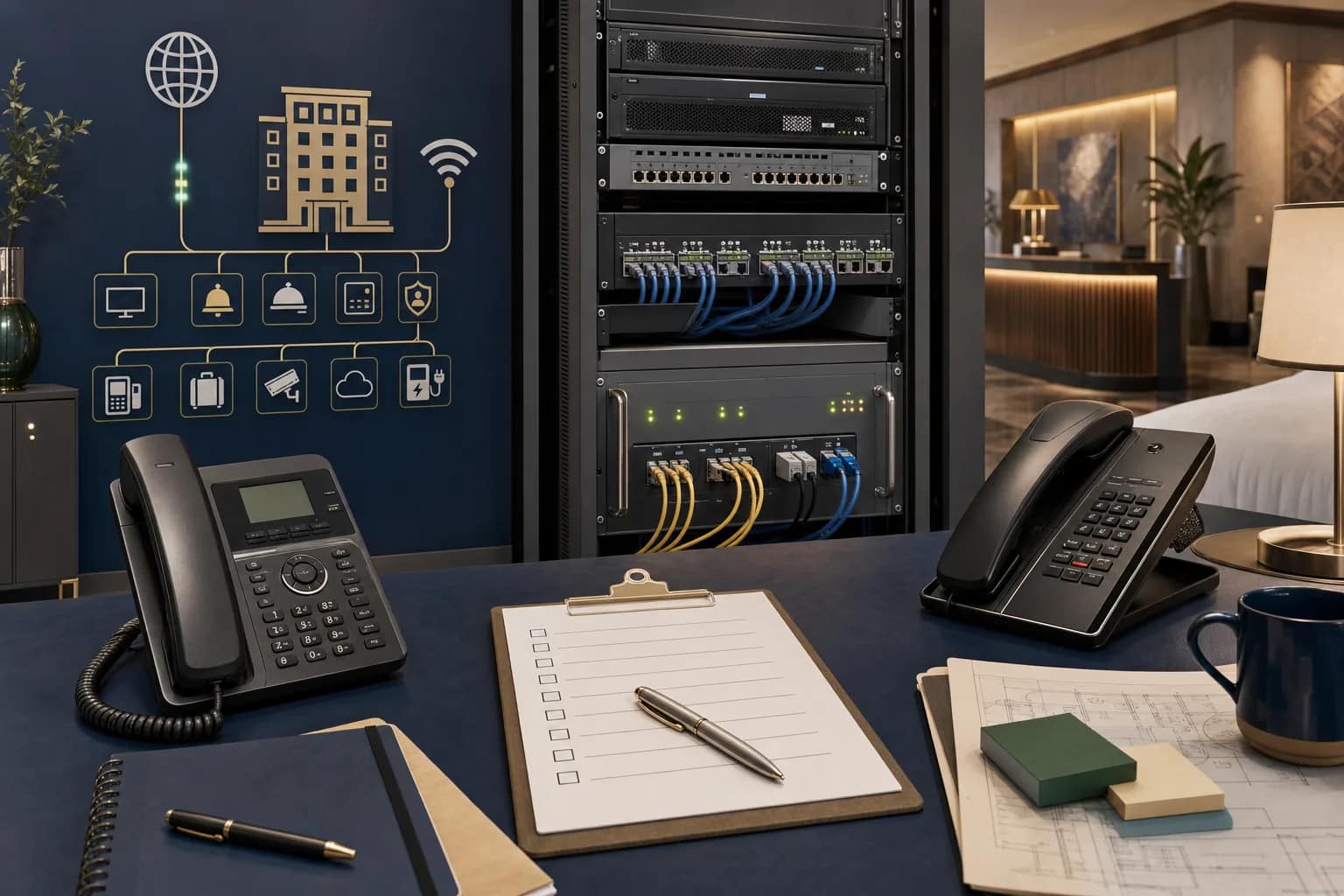
A hotel phone refresh sounds simple until the property starts asking what the old phone path still does.
The handset in the guest room is only the visible part. Behind it may be a PBX, SIP trunks, analog lines, elevator or emergency phones, front-desk routing, vendor support access, PMS integration, voicemail, call accounting, and a network path that was designed years before the current refresh.
That is why a hotel PBX or room-phone replacement should be planned as an operations project, not just a phone purchase.
JET Hotel Solutions works across PBX and phones, Network Access/DIA, guest Wi-Fi, low-voltage coordination, Free-to-Guest TV/IPTV, and vendor handoff. In real hotel projects, the phone scope often sits beside network, TV, cabling, and timing decisions. Treating it separately is how avoidable cutover problems get created.
If your hotel is replacing a PBX, moving voice service, or refreshing room phones, use this hotel phone system upgrade checklist before the vendor date is locked.
1. Start with what the phones still need to do
Not every hotel needs the same voice environment.
Some properties only need reliable front-desk and back-office calling. Others still rely on guest-room phones, wake-up workflows, emergency calling, analog endpoints, elevator phones, fax, alarm panels, or brand-required room-phone behavior. A refresh should start with those operating requirements before anyone compares hardware or monthly service fees.
Before the project moves forward, confirm:
- which room, front-desk, office, and back-of-house phones remain in scope
- which guest-facing functions still matter, such as front-desk dialing, wake-up calls, voicemail, or room-status workflows
- which analog lines or devices cannot simply move to a standard IP phone path
- which brand, ownership, or management-company requirements apply
If the team cannot explain the required behavior, the property is not ready to approve the replacement design.
2. Map the old PBX path before removing it
Legacy phone systems are rarely as isolated as they look.
A PBX may have been patched into analog room phones, front-desk phones, admin extensions, elevator lines, fax, fire or alarm-related paths, vendor support tools, and circuit handoffs that no one has documented recently. That does not mean the old system should stay. It means the removal plan needs a map.
Ask these questions before the old equipment is touched:
- where the PBX, gateways, trunks, and cross-connects physically live
- which lines are voice, fax, elevator, emergency, alarm, or vendor-specific
- which extensions or room ranges still route through the old equipment
- which vendor can validate the existing configuration before replacement
The worst time to discover an undocumented analog dependency is after the old system has already been disconnected.
3. Decide what can reuse existing cabling and what cannot
Phone refreshes often run into low-voltage reality.
A design may assume IP phones, analog adapters, existing room wiring, new network drops, or a hybrid path. Those choices affect cost, timing, room access, IDF/MDF work, switch capacity, power, and how disruptive the project becomes for the property.
Before approving the scope, the hotel should know:
- whether guest-room phones will reuse existing wiring or require new cabling
- whether IP phones need PoE switching, VLAN planning, or new network ports
- whether analog terminal adapters or gateways are part of the design
- whether any closets, patch panels, or cable labels need cleanup before cutover
This is where a phone project can quietly become a cabling, switching, and documentation project.
4. Check network and carrier dependencies early
Modern voice service often depends on the same infrastructure conversations as the rest of the hotel stack.
If the property is changing internet service, static IPs, firewalls, SIP trunks, or managed network vendors near the same time, the phone refresh should not be treated as a separate calendar item. Voice quality, remote vendor access, emergency calling, and support escalation may all depend on the network path being ready.
Confirm:
- which carrier or SIP trunk provides voice service
- whether static IPs, firewall rules, or whitelists are required
- whether the voice vendor needs access before and during cutover
- whether the network team has capacity, routing, and QoS assumptions documented
A phone replacement can look complete on paper and still fail if the network and carrier work are scheduled as someone else’s problem.
5. Include the front desk and emergency paths in testing
Guest-room phones get attention because they are visible. The higher-risk failures often sit at the front desk and emergency edge cases.
Build the validation plan around how the hotel actually operates:
- front desk inbound and outbound calling
- guest-room-to-front-desk dialing
- room-to-room rules, if allowed
- emergency calling and location behavior
- elevator, pool, lobby, admin, fax, and back-office lines
- after-hours routing and support escalation
Do not rely on a single test call from one phone. The hotel needs a property-specific phone validation checklist.
6. Coordinate the cutover like a hotel operations event
A phone cutover should have an owner, a timeline, and a rollback path.
Before the date is locked, document:
- who owns PBX or hosted-phone configuration
- who owns cabling, closets, phones, gateways, and room access
- who owns carrier, SIP, or number-porting coordination
- who validates guest rooms, front desk, admin, and emergency paths
- who is available if the first test pass fails
If the property cannot describe the first hour of testing after cutover, it is probably not ready to cut over.
7. Use a hotel phone system upgrade checklist before approval
Compare the full hotel phone system and PBX options before ownership locks the vendor, deployment, and support decision.
Before approving a PBX or room-phone refresh, operators should be able to answer yes to these questions:
- Do we know which phones, analog lines, and special endpoints remain in scope?
- Do we know what the old PBX still connects to?
- Do we know whether existing cabling can be reused?
- Do we know what the carrier, SIP, firewall, and static-IP dependencies are?
- Do we know how front-desk, guest-room, emergency, and back-office paths will be tested?
- Do we know who owns the cutover if one vendor’s step slips?
If the answer is no, the property may not need a different phone quote first. It may need a clearer dependency review.
Why this matters for hotel operators
A phone refresh is not just a handset decision. It is a guest-service, life-safety, network, cabling, carrier, and vendor-coordination decision sitting inside one project.
That is why owners, GMs, engineering teams, and property IT contacts should check the dependencies before approving the replacement scope. A small miss in the phone path can turn into front-desk disruption, room-phone confusion, emergency-call risk, or a long vendor dispute during a live hotel day.
If your hotel is planning a PBX, hosted-phone, or room-phone refresh, JET Hotel Solutions can review the phone, network, cabling, and vendor-cutover scope before the project date is locked.