
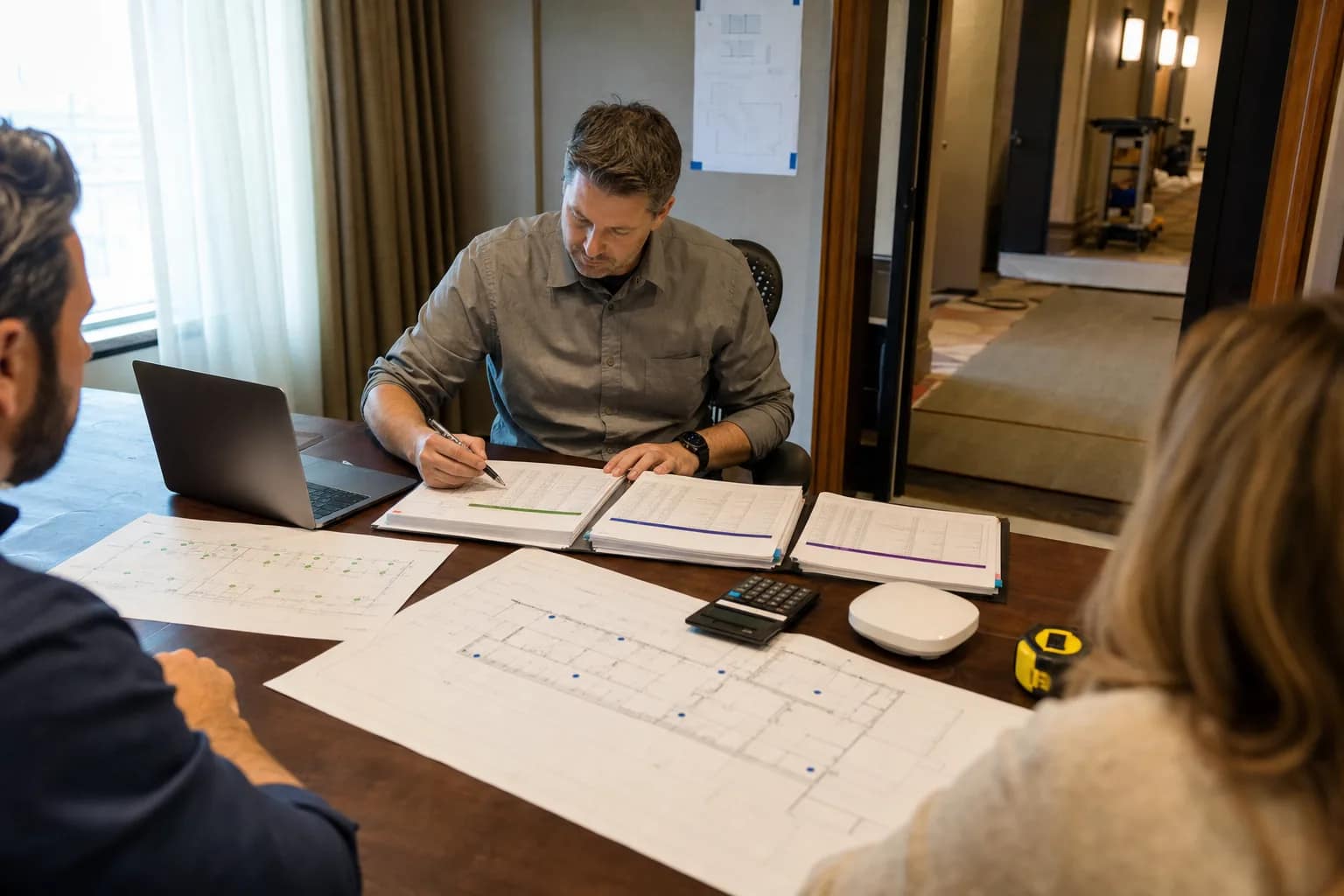
The lowest hotel technology proposal is not always the least expensive option. Sometimes it is not even pricing the same project.
One vendor may include installation and five years of support. Another may separate freight, tariffs, travel, licensing, and recurring service. A Wi-Fi proposal may use a different access-point count or placement plan. A low-voltage bidder may assume existing cable can be reused while another prices a full replacement. Each number can be valid, but the totals are not comparable until the underlying decisions are aligned.
This hotel technology bid comparison checklist helps owners, operators, developers, and project teams normalize proposals before approving Wi-Fi, low-voltage, network, television, phone, CCTV, or related infrastructure work.
The owner-side question is not “Which total is lowest?” It is “Which proposal delivers the approved operating result, on the same scope, with the fewest unresolved assumptions?”
1. Lock the controlling scope and revision
Start by identifying the documents every bidder was expected to price. That may include brand technology standards, drawings, room matrices, equipment schedules, survey notes, addenda, vendor markups, and answers to bid questions.
Record the title and revision date of each controlling document. Then ask each bidder to acknowledge the same set. If one proposal follows an older room plan or a different access-point layout, the price comparison is already compromised.
At minimum, confirm:
- The property, room count, public-area count, and project phase.
- The current architectural and technology drawing dates.
- The brand or system requirements included in the bid.
- Every addendum, clarification, and approved substitution.
- The boundary between owner-direct, general-contractor, and technology-vendor scope.
2. Normalize quantities and physical locations
A unit price tells you very little when the unit count is different. Put every major quantity into one matrix before comparing totals.
For a hotel technology project, that can include guest rooms, televisions, access points, cameras, phones, data outlets, fiber backbones, racks, patch panels, switches, controllers, circuits, and labor trips. For each system, compare both the quantity and the physical placement basis.
Placement matters because it can change the equipment model, cable pathway, labor, guest-room impact, and expected performance. For example, an access point located near the room entry is not automatically equivalent to one designed for a desk, television wall, ceiling, or corridor. The proposal should match the approved design rather than rely on “best effort” placement that will be decided after work begins.
3. Separate new work from reusable infrastructure
Reusing existing cable or equipment can reduce cost and disruption, but “reuse existing” is an assumption until someone verifies the condition.
Define what must be tested, who performs the test, what result is acceptable, and what happens when an item fails. For cabling, that may include the cable category, pathway, termination location, labeling, certification result, and compatibility with the intended device. For network equipment, it may include age, software support, licensing, capacity, power, and manufacturer support status.
Then show reuse as a separate decision line:
- Verified reusable quantity.
- Testing and retermination cost.
- Replacement unit price for failed items.
- Schedule allowance for field discoveries.
- Party responsible for the final reuse decision.
This prevents a low bid from becoming a sequence of replacement charges after walls, rooms, or project schedules are already committed.
4. Split one-time, recurring, and conditional costs
Hotel technology proposals often mix capital and operating costs. Separate them before comparing vendors.
Create three cost groups:
- One-time: equipment, installation, design, survey, configuration, freight, travel, training, testing, and project management.
- Recurring: circuits, content, cloud service, support, licenses, monitoring, maintenance, and managed service fees.
- Conditional: tariffs, taxes, after-hours work, lift rental, permits, failed-reuse replacement, additional trips, storage, and expedited shipping.
Use the same evaluation term for every proposal, often the contract term or five years. A proposal with a lower upfront number but a higher monthly fee may cost more over the ownership period. Conversely, a higher one-time investment may include work or support that another vendor has left outside the total.
5. Compare implementation, not just equipment
Two proposals can list similar equipment and still create very different project risk.
Check who owns the site survey, design review, submittals, procurement, staging, installation, configuration, carrier coordination, brand approval, testing, training, cutover, and final acceptance. Record the deliverable and due date for each step.
Also compare the schedule assumptions:
- Lead times and quote-expiration dates.
- Number and duration of site visits.
- Working hours and occupied-room constraints.
- Dependencies on power, pathways, racks, circuits, or other vendors.
- Pilot-room, floor-release, cutover, and opening milestones.
A complete implementation plan can be more valuable than a small difference in hardware price, especially in an operating hotel or a project approaching opening.
6. Make exclusions and change triggers visible
Exclusions should not live in fine print at the bottom of separate proposals. Move them into the comparison matrix.
For every exclusion, identify the party expected to provide the missing work and whether that cost is already carried elsewhere. Pay particular attention to pathways, sleeves, firestopping, power, blocking, racks, patching, painting, internet circuits, permits, lifts, demolition, disposal, and after-hours access.
Then list the events that can change the price: revised drawings, added rooms, changed device locations, unavailable products, failed existing cable, delayed site readiness, extra mobilizations, or work outside the quoted schedule. A useful proposal explains the unit rate or approval process for those changes before they occur.
7. Compare acceptance evidence and closeout
The project is not complete when equipment arrives or cable passes a basic continuity test. Define what evidence the owner receives before final acceptance.
Depending on the scope, closeout may include:
- As-built drawings and final device locations.
- Cable labels, port maps, and certification reports.
- Equipment inventory, serial numbers, and warranty dates.
- Configuration backups and approved access records.
- Room, public-area, phone, television, camera, and Wi-Fi test results.
- Training, escalation contacts, and support handoff.
If one vendor includes these deliverables and another does not, the totals should not appear equivalent.
8. Score operating fit and decision risk
Price belongs in the final decision, but it should not be the only scored field. Add a short owner-side evaluation for scope compliance, technical fit, implementation plan, support model, schedule confidence, exclusions, and unresolved assumptions.
A practical bid comparison can use these columns:
- System or decision line.
- Approved requirement.
- Vendor quantity and placement basis.
- One-time cost.
- Recurring cost and term.
- Included implementation and closeout.
- Assumptions, exclusions, and change triggers.
- Owner decision, responsible party, and due date.
Highlight open items rather than hiding them inside a score. A bid should not move to approval while a major room count, placement plan, reuse assumption, recurring fee, or scope boundary is still unresolved.
The final approval test
Before signing, ask whether another project team member could read the comparison and explain why the selected proposal is the best fit. They should be able to identify the controlling scope, quantities, locations, reuse decisions, total term cost, implementation owners, closeout evidence, and remaining risks.
If they can only point to the lowest total, the proposals have not been normalized yet.
JET Hotel Solutions helps hotel owners and operators build decision-ready technology budgets, compare vendor bids, coordinate low-voltage and infrastructure scope, and manage the handoffs across network access, guest Wi-Fi, PBX and phones, Free-to-Guest TV, CCTV, cabling, testing, and opening readiness. Bring JET into the comparison before unlike proposals become an expensive approval.