
A hotel technology proposal can have the lowest total and still be the most expensive decision.
The reason is usually not arithmetic. It is that the proposals are pricing different projects. One may include installation and closeout. Another may exclude freight, travel, tariffs, tax, or cabling. Equipment quantities may come from different room counts or plan revisions. Recurring services may use different billable units, contract terms, escalation assumptions, and support levels.
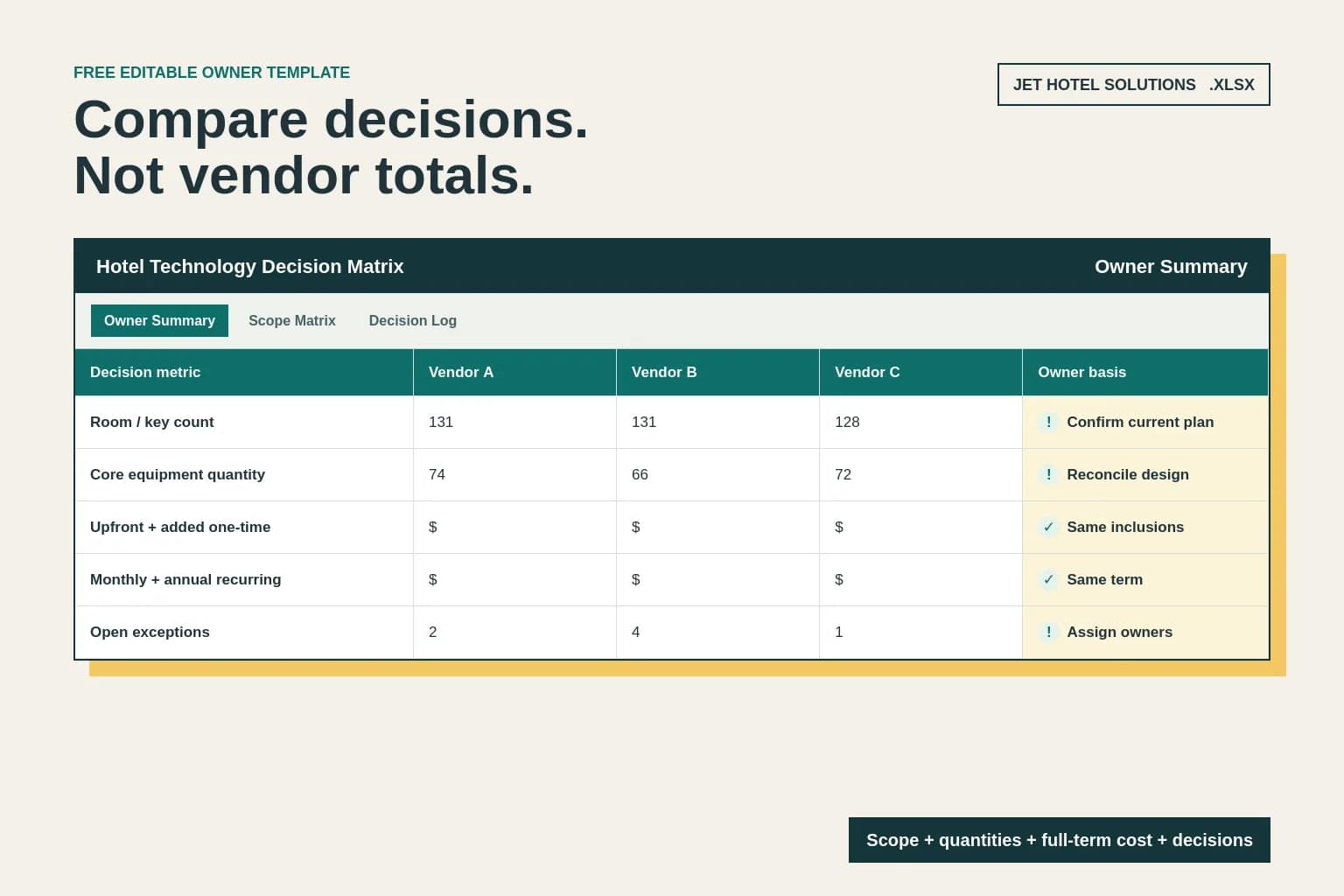
Ownership needs a comparison that makes those differences visible before a vendor is selected. JET created a practical, editable hotel technology decision matrix for that review.
Download the Hotel Technology Decision Matrix
If two quotes cannot be placed on the same row, the lowest total is not a decision yet.
What the decision matrix is designed to solve
Traditional bid tabs often start and end with vendor totals. That is useful only when every vendor used the same project basis, scope, quantity, commercial terms, and operating assumptions. Hotel technology rarely arrives that neatly.
A low-voltage proposal may depend on the current drawing set, pathway availability, cable-reuse assumptions, rack capacity, and work-hour restrictions. A Wi-Fi proposal may use a different access-point count, design method, support term, or billable-unit basis. PBX, television, CCTV, internet, audio-visual, panic-button, and other scopes can each carry their own one-time and recurring cost structures.
The matrix separates those inputs so ownership can see what is comparable, what is different, and what still needs a decision.
Sheet 1: Give ownership a one-page decision view
The Owner Summary is the front page. It is designed to answer the questions that should not require reopening three proposals:
- Which quote and plan revision did each vendor use?
- What room count, billable-unit count, and core equipment quantity did each vendor price?
- What is the upfront subtotal?
- What additional one-time cost must be carried?
- What repeats monthly or annually?
- What is the projected cost over the selected term?
- What warranty, service level, and open exceptions affect the decision?
The projected term-cost row is formula-driven. Enter the one-time, monthly, annual, and term inputs for each vendor, and the workbook calculates a normalized planning value. It is not an accounting forecast; it is a fast way to stop a low upfront number from hiding a high recurring commitment.
Sheet 2: Normalize the scope before comparing price
The Scope Matrix is where the real comparison happens. Use one row for each requirement or decision point, then record the owner basis and every vendor’s response on that same row.
The template begins with 18 common hotel-technology comparison items, including:
- Property, brand, room count, areas served, and controlling plan revision.
- Base scope, options, alternates, and allowances.
- Rooms, TVs, outlets, access points, devices, licenses, and circuits.
- Placement, coverage, mounting, and room-type assumptions.
- Existing cabling and equipment-reuse assumptions.
- MDF/IDF, rack, switch, power, pathway, and backbone capacity.
- Survey, design, installation, programming, cutover, and testing.
- Labeling, as-builts, training, warranty, support, and closeout.
- Freight, shipping, tariffs, taxes, travel, escalation, and other exclusions.
- Payment terms, price validity, renewal, SLA, and outage ownership.
Add or remove rows to fit the project. The goal is not to force every system into identical wording. The goal is to keep a vendor’s exception from disappearing inside a total.
Sheet 3: Turn exceptions into owned decisions
A comparison is not complete just because a variance has been found. Someone must decide what happens next.
The Decision Log gives every unresolved issue an ID, owner, due date, recommendation, status, and cost or schedule impact. Use it for items such as:
- A proposal based on an older room count.
- Different access-point, television, outlet, camera, or controller quantities.
- An allowance that has not been converted into a defined scope.
- Existing cabling assumed reusable without survey or test evidence.
- A required circuit, license, support tier, or closeout item omitted from one bid.
- A brand requirement that still needs written confirmation.
- A recurring term or escalation clause that changes the long-range cost.
The workbook includes dropdown statuses so the team can distinguish open items, issues under review, approved decisions, rejected options, and items placed on hold. That is much more useful than letting the latest email become the project’s unofficial record.
How to use the matrix on a live project
1. Freeze the project basis
Record the current property name, brand, key count, plan set, revision date, opening or renovation phase, and areas served. If vendors did not quote from that same basis, note the variance before comparing totals.
2. Enter quantities before prices
Compare the units that create the price: rooms, outlets, access points, televisions, cameras, phones, controllers, licenses, circuits, racks, switches, and labor assumptions. A lower total supported by fewer required units is not yet a saving.
3. Separate base scope from options and allowances
Do not combine required work, optional upgrades, and provisional allowances into one comparison line. Label each item. If a brand requirement or site condition has not been confirmed, assign it an owner and a deadline.
4. Normalize one-time and recurring cost
Keep equipment, installation, project services, freight, tax, travel, tariffs, and other one-time items visible. Then record monthly and annual services separately. Use the same planning term for every vendor so ownership can see both budget timing and longer-range cost.
5. Make exclusions and assumptions visible
Look for the items most likely to return as a change order or operational gap: cable and pathway work, power, demolition, patching, lifts, after-hours work, network equipment, public IPs, content fees, testing, training, warranty, support, travel, and closeout documentation.
6. Finish with a decision, not a spreadsheet
Assign every remaining exception. Record the disposition and update the budget, proposal, scope, and schedule that it affects. The final selection should be traceable to a common project basis, not just a highlighted total.
A practical owner-side review, not another vendor scorecard
This template does not automatically choose a vendor, and it does not assume that the cheapest or most comprehensive proposal is always correct. It gives owners, developers, asset managers, hotel operators, IT teams, and project managers a shared record for deciding what the hotel actually needs and what each option will deliver.
JET Hotel Solutions supports hotel technology budgeting, procurement, bid normalization, value engineering, low-voltage coordination, site surveys, vendor management, installation planning, and project closeout. If the proposals describe different projects, JET can help turn them into one owner-ready decision.