
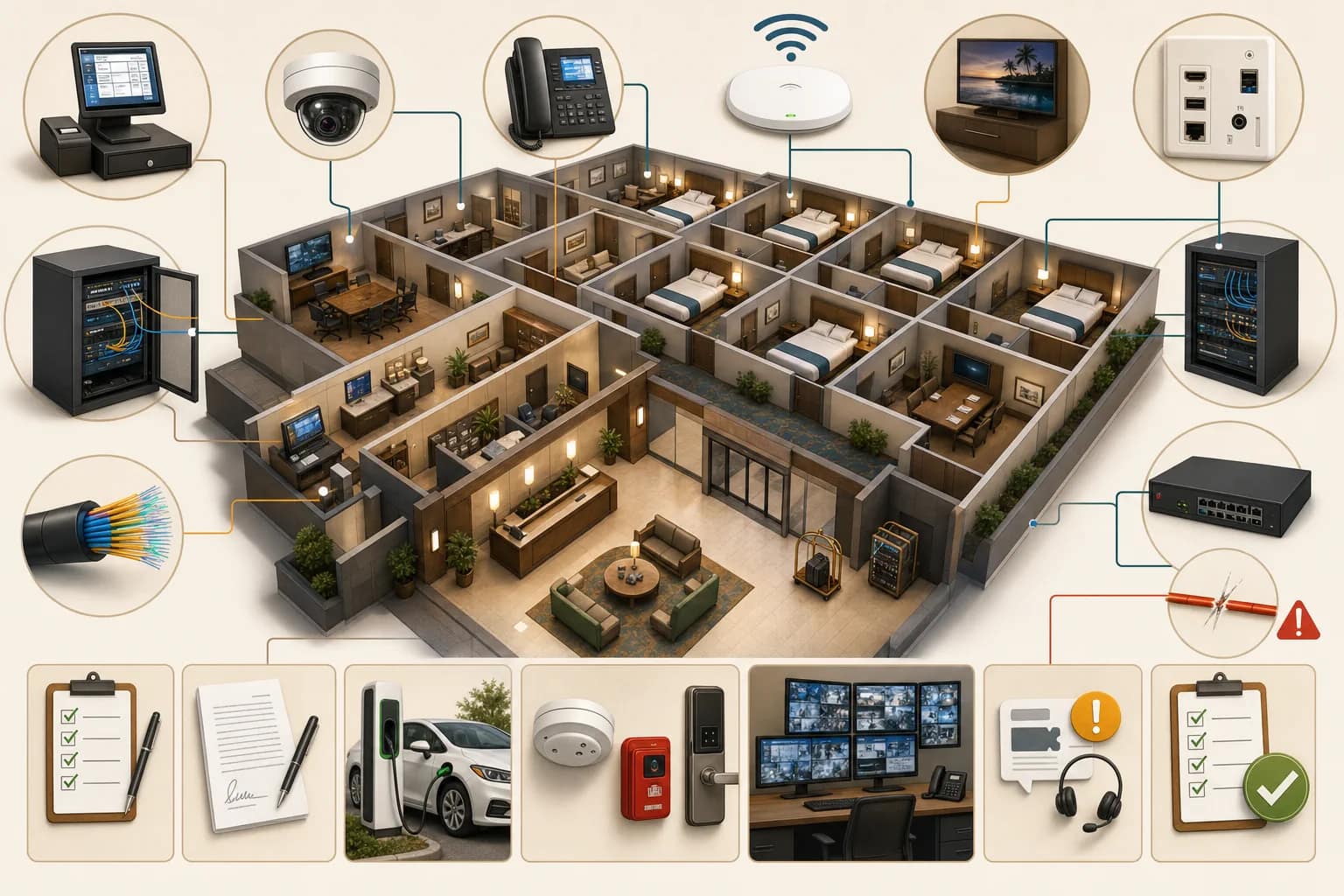
Short answer: before a hotel network cutover, remodel, or vendor refresh, the owner needs one shared map of vendors, circuits, IP blocks, rooms, closets, systems, timing, test owners, fallback steps, and cancellation dates. POS, phones, cameras, guest Wi-Fi, TV, AV, PMS, PBX, and old circuits may look separate on paper, but they often depend on the same low-voltage pathway, network closet, circuit, switch, firewall, or IP block.
That is where hotel technology projects get expensive.
Not because one vendor is bad. Not because the hotel picked the wrong access point. Not because a camera, TV, or POS terminal is complicated by itself.
The trouble usually starts in the space between vendors.
The Problem Is Not One Vendor. It Is the Space Between Vendors.
A hotel owner may think they are approving a Wi-Fi refresh, an ISP cutover, a POS update, a security camera change, or a low-voltage scope. On the property, those lines blur quickly.
A network refresh can turn into a question about approved vendors, current provider performance, floor plans, guest-room counts, monthly service fees, and whether a bid is actually comparable to another bid. A low-voltage update can turn into questions about fire-treated backboards, painting before punchdowns, ladder rack paths, conduit, HVAC clearances, ceiling close dates, TV locations, projector placement, mic jacks, audio jacks, and HDMI runs. An ISP cutover can suddenly involve DVRs or NVRs, Starbucks POS, TVs, phone systems, IP blocks, old circuits, and whether anything is still hanging off the previous service.
Those are real hotel problems. They are also the reason vendor coordination should happen before a truck rolls, a ceiling closes, or an old circuit is canceled.
Industry sources are seeing the same pattern. HospitalityNet recently described the hidden cost of hotels managing too many technology vendors across systems like PMS, POS, keys, CCTV, IPTV, HVAC, digital signage, and Wi-Fi. HFTP has also framed modern hotel IT as a broader operating stack, not just guest Wi-Fi. That tracks with what we see in the field: hotels do not run on one system anymore. They run on dependencies.
What Belongs on the Hotel Vendor Map?
Before IT, POS, security, phone, TV, Wi-Fi, or low-voltage vendors start changing things, the hotel needs one owner-facing map. It does not need to be fancy. It needs to be complete enough that every vendor can see what their work might affect.
1. Circuits and Internet Services
List every active circuit, provider, handoff, static IP block, managed router, firewall, backup link, and billing/cancellation date. Do not assume an old circuit is safe to cancel just because the new circuit is live.
Ask: what is still using the old service? POS? DVR/NVR? PBX? TVs? Back-office systems? A tenant space? A coffee shop? A brand system?
2. Network Closets and Pathways
Map MDF and IDF rooms, fire-treated plywood/backboards, rack locations, ladder racks, J-hooks, conduit, cable bundles, punchdown timing, ceiling close dates, paint/inspection requirements, and storage of shipped equipment.
This is where low-voltage work either becomes serviceable or becomes a future service call nobody enjoys.
3. POS and Payment Systems
POS should never be treated as just another device on the same loose network. Payment systems deserve special attention because they touch revenue, PCI scope, vendor support, and guest experience at the same time.
At minimum, confirm the POS vendor, payment processor, network path, IP needs, segmentation expectations, firewall rules, support owner, and cutover test. The hotel should know who signs off that payments work before the project is considered done.
4. Security Cameras, DVR/NVR, and Access Control
Cameras and access systems are easy to forget during ISP or firewall changes because they often sit quietly in the background. That silence can be misleading.
Map recorder location, camera VLAN or subnet, static IPs, cloud access, port requirements, remote viewing, retention needs, power, UPS, and who tests footage after the cutover.
5. Phones and PBX
Phones are another place where old circuits linger. A hotel can think a fiber or network migration is finished, then discover phone service, fax, elevator lines, emergency phones, or PBX equipment still depend on the old path.
Confirm PBX ownership, SIP/POTS/PRI status, emergency lines, analog adapters, VLANs, failover, E911 expectations, and who runs the live test.
6. Guest Wi-Fi, TV, IPTV, and AV
Guest Wi-Fi, Free-to-Guest TV, IPTV, streaming, meeting-room AV, and public-area displays often share pathways, closets, network planning, or timing. A moved TV, a projector wall, a missing HDMI run, or a ceiling that closes too early can become a real field problem.
Confirm guest-room counts, public-area displays, content provider, casting/streaming expectations, headend or IPTV requirements, VLAN needs, AV plate locations, power, cabling, and final walk-through ownership.
Six Coordination Misses That Create Real Hotel Pain
1. The old circuit is canceled before everything is off it.
This is the classic cutover problem. The new circuit works, but something quiet still lives on the old service. It might be a camera recorder, POS device, phone system, TV service, office machine, or tenant connection.
Owner check: ask every vendor to confirm what is still on the old circuit before cancellation.
2. POS, TVs, phones, and cameras share assumptions no one documented.
Hotels often inherit years of network decisions. Static IPs, old subnets, firewall rules, and vendor-managed equipment can stay invisible until something changes.
Owner check: require a simple dependency list before any firewall, router, or ISP change.
3. Ceilings or walls close before low-voltage work is ready.
If the cable path, conduit, room readiness, or field dimensions are not verified, the project can lose time fast. A small pathway detail can become a larger coordination issue once finishes are installed.
Owner check: low-voltage and construction teams should align before ceiling close, paint, inspection, and rack build-out.
4. The meeting-room AV scope changes late.
A TV location, projector screen, mic jack, audio jack, HDMI run, or power outlet may seem small. It is not small when the wall is finished and the room needs to open.
Owner check: every meeting-room wall plate, display, projector, audio input, and power location should be marked and approved before rough-in is complete.
5. Vendor bids are compared without matching scope.
A lower bid is not always better, and a higher bid is not always wrong. The hotel needs to know whether each proposal includes the same rooms, access points, switches, licenses, support, cabling assumptions, brand requirements, monthly service fees, and project timeline.
Owner check: normalize the scope before comparing price.
6. No one owns the final test.
Each vendor may test their piece. The hotel needs a cross-system test: check-in, POS, phones, guest Wi-Fi, TV, cameras, back office, remote access, staff systems, and support escalation.
Owner check: assign a final test owner and make the test list visible before work begins.
The Pre-Cutover Checklist
Use this before an ISP cutover, Wi-Fi refresh, POS update, security change, remodel, opening, or vendor switch.
- List every vendor touching IT, POS, phones, cameras, TV, Wi-Fi, AV, PMS, PBX, circuits, and low voltage.
- List every active circuit, old circuit, backup connection, static IP block, router, firewall, and managed device.
- Identify what systems live on each circuit or VLAN: POS, phones, cameras, TV, staff systems, guest Wi-Fi, back office, and tenant systems.
- Confirm MDF/IDF readiness: backboards, paint, inspection, rack location, ladder rack, conduit, power, cooling, and cable pathway.
- Confirm ceiling/wall close dates before cable pulls, AV plates, TV moves, AP locations, camera locations, and phone/POS drops.
- Normalize vendor proposals so pricing is compared against the same room count, scope, hardware, licenses, support, and monthly fees.
- Document test owners for POS, phones, cameras, guest Wi-Fi, TV, PMS/back office, remote access, staff systems, and support escalation.
- Create a rollback plan before the change window starts.
- Do not cancel old service until every dependent system is tested and signed off.
Who Needs to Be in the Room?
For a serious hotel technology change, the call should include more than the vendor selling the new system.
| Role | Why They Matter |
|---|---|
| Owner or asset manager | Confirms business priority, budget tradeoffs, and vendor accountability. |
| GM or operations lead | Knows guest-impact timing, staffing, and operational risk. |
| Property IT or IT contractor | Understands current circuits, IP blocks, network equipment, and legacy dependencies. |
| Low-voltage contractor | Owns pathways, cabling, closets, terminations, labels, and room readiness. |
| POS/payment vendor | Confirms payment network requirements, testing, support, and segmentation expectations. |
| Security/camera/access vendor | Confirms recorder access, static IPs, retention, cloud access, and camera testing. |
| Phone/PBX vendor | Confirms voice cutover, emergency lines, analog paths, and failover. |
| Wi-Fi/TV/IPTV/AV vendors | Confirm guest-facing systems, content/casting needs, public-area displays, and room-level endpoints. |
| General contractor or construction lead | Controls room readiness, paint, inspection, ceiling closure, and field access. |
Questions to Ask Each Vendor
- What systems do you depend on that another vendor controls?
- What IPs, VLANs, firewall rules, ports, or static assignments do you require?
- What must be ready before your technician arrives?
- What cannot be changed during the cutover?
- Who tests your system, and what does a successful test look like?
- What is the rollback plan if your system fails?
- What can the hotel safely cancel after the cutover, and when?
What JET Looks for During a Property Walkthrough
JET Hotel Solutions helps hotel teams see the whole property technology stack before the work becomes expensive. In a walkthrough or vendor review, the goal is not to make the hotel buy more technology. The goal is to prevent surprises.
That means looking at the low-voltage plan, network closets, guest Wi-Fi, circuits, phone/PBX, POS/payment readiness, security/camera dependencies, Free-to-Guest TV or IPTV, staff safety devices, EV charging network needs, monitoring, support, and the old services that may still be quietly doing work.
A good vendor map gives the owner one view of the project. It also gives each vendor less room to say, ‘That was not my part.’
FAQ
What is hotel vendor coordination?
Hotel vendor coordination is the process of mapping every technology vendor, system dependency, circuit, room, closet, test, and handoff before work starts. It helps the property avoid gaps between IT, POS, security, phones, Wi-Fi, TV, AV, construction, and low-voltage teams.
Why should POS, phones, cameras, and Wi-Fi be planned together?
They may depend on the same circuit, switch, firewall, IP block, closet, cable pathway, or change window. If one vendor changes the network without understanding the others, the hotel can create payment failures, phone issues, camera access problems, TV outages, or guest Wi-Fi complaints.
What should a hotel check before a network cutover?
Check all active circuits, old circuits, static IP blocks, routers, firewalls, POS systems, phones, cameras, TV/IPTV, guest Wi-Fi, back-office systems, tenant systems, support owners, rollback steps, and post-cutover tests. Do not cancel old service until every dependent system is verified.
When should old hotel circuits be canceled?
Only after the new service is live, every dependent system has been tested, the support owner has signed off, and the hotel has confirmed no POS, phone, camera, TV, PBX, guest Wi-Fi, back-office, or tenant system still depends on the old circuit.
Need a second set of eyes before a hotel technology cutover or remodel? Ask JET Hotel Solutions to review the vendor map before the next circuit, POS, security, phone, TV, Wi-Fi, or low-voltage change. It is much easier to fix the plan before the wall closes or the old service disappears.
Related sources: HospitalityNet on hotel tech vendor overload; HFTP on the modern hotel IT stack; PCI Security Standards Council for payment-security context.