
Walkie Talkies with Long Range: Ensuring Worker Safety
A large resort was able to map their entire 800+ room property with a worker safety solution in just 6 hours. This rapid deployment is just one example of how technologies like walkie-talkies with long range and duress alarms are revolutionizing worker safety across industries like hospitality, healthcare, warehousing and more.
When it comes to staying safe and connected on the job, especially over large properties or challenging environments, having reliable communication tools is absolutely essential. This is where long range walkie-talkies really shine. The best models on the market today, like the Rocky Talkie Mountain Radio, provide an impressive 1-5 miles of range even in urban areas or dense forests.
But it’s not just about the range. Durability, usability, and battery life are also key. Look for walkie-talkies with rugged construction and an IP rating for water and dust resistance. Simple, glove-friendly controls are important too, as are conveniences like USB-C charging and compatibility with headsets. Cheaper models like the Midland T10 X-Talker are surprisingly capable if weight and cost are top priorities.
Where walkie-talkies really become a safety game-changer though is when they are part of a complete panic alert system. Innovative solutions like those from JET Hotel Solutions combine long range communication with instant location alerts and real-time monitoring.
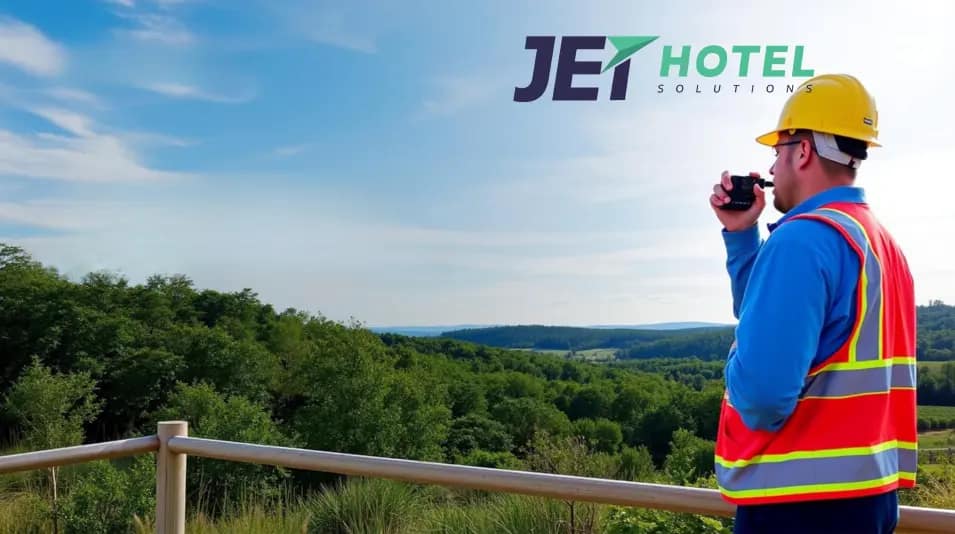 Here’s how it works: Staff carry compact devices with a panic button. When activated, an alert with their precise location is instantly sent to responders, who can then communicate with the employee via push-to-talk. Additional capabilities like geofencing, voice translation, asset tracking and more are also available. It’s a dramatic upgrade over standard walkie-talkies.
The JET Hotel Solutions system uses the RelayX panic alert device which includes nationwide 4G/5G connectivity, GPS location, a durable, water resistant design, and all-day battery life. Installing beacons enables room-level accuracy indoors. Importantly, the solution is scalable and offers redundant connectivity for superior reliability.
Large hotel brands, airports, hospitals, stadiums and industrial sites have deployed this solution with great results. Beyond enabling fast responses to incidents, the detailed reporting and workflow tools help organizations proactively identify risks and improve processes. Staff feel safer and more supported too.
 So while a good set of long range walkie-talkies is a smart investment for any business with workers on the move, consider leveling up to a full-fledged panic alert system like the one from JET Hotel Solutions. Rapid deployment, flexible configuration, and a proven track record make it one of the best ways to protect your people.