
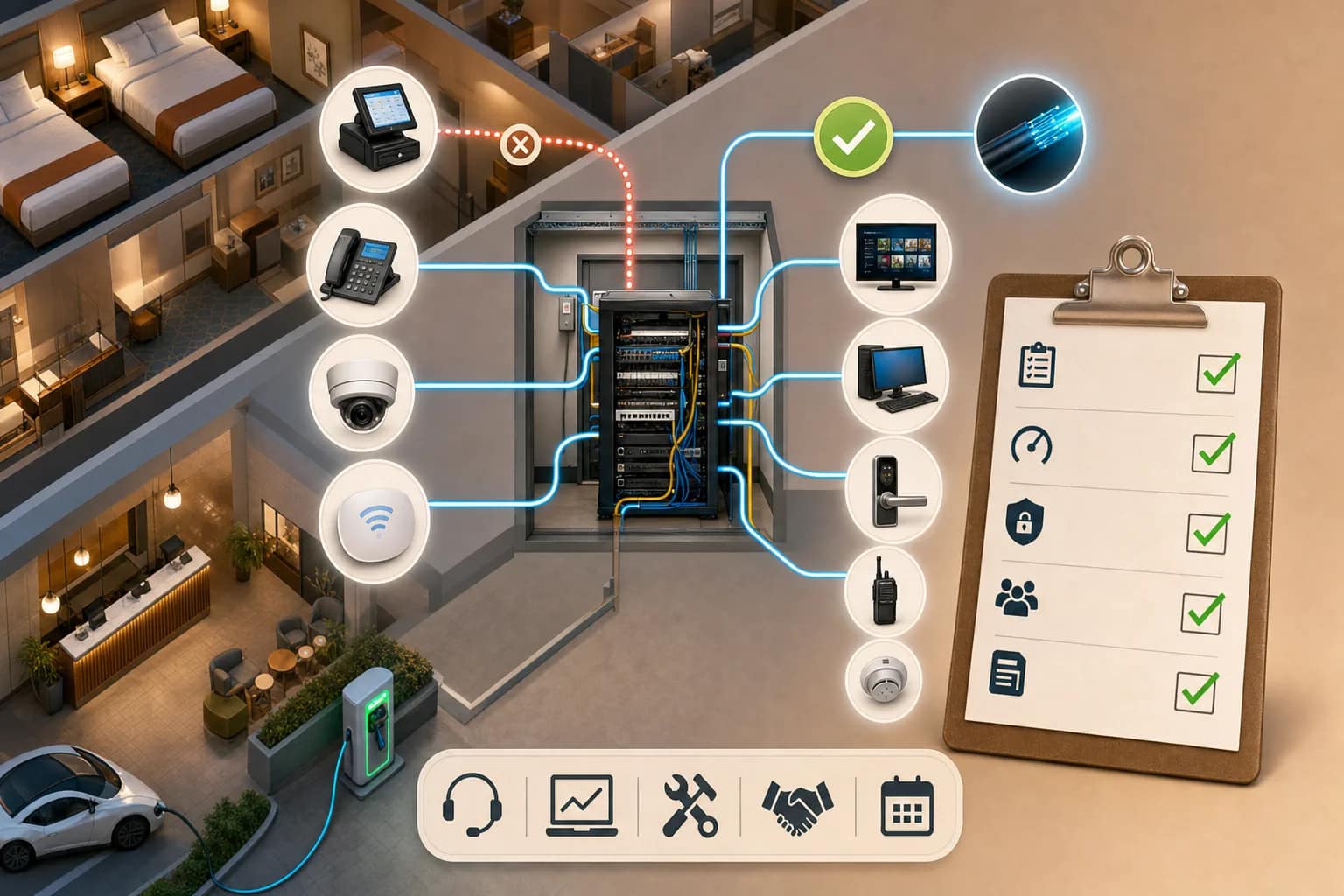
Short answer: before a hotel network cutover, do not only ask whether the new circuit, vendor, or system is ready. Ask what the old service, old number, old IP block, old cable path, or unfinished closet is still supporting. The missed dependency is usually where the pain shows up.
Yesterday’s vendor-coordination article covered the big map: IT, POS, security, phones, TV, guest Wi-Fi, AV, circuits, low voltage, test owners, and rollback steps. Today’s version is the operator checklist: the five things hotels most often miss before a vendor cutover.
This matters because a hotel cutover is rarely one clean handoff. A property may be changing internet service, porting phones, updating POS, keeping cameras online, installing guest Wi-Fi, moving TV/IPTV equipment, and trying not to delay construction at the same time.
On paper, those are separate vendors. On property, they often meet in the same closet.
Why Cutovers Get Messy In Hotels
Hotels run on quiet dependencies. A fax line may still matter. A DVR or NVR may still be reachable through an old path. A POS terminal may need a network rule that only one vendor remembers. A phone port may depend on a CSR, LOA, date request, on-site technician, and cross-connect. A circuit quote may look final until someone realizes the construction cost changes under a 36-month versus 60-month term.
That is not theory. In current hotel work, the recurring pattern is the same: the business decision sounds simple, but the field execution depends on timing, access, paperwork, old services, and several vendors agreeing on what “done” means.
HospitalityNet recently called out the hidden cost of managing too many hotel technology vendors, including systems such as PMS, POS, keys, CCTV, IPTV, HVAC, digital signage, and Wi-Fi. Payment systems also need extra care because the PCI Security Standards Council exists for a reason: the payment environment is not just another device network.
The practical takeaway for hotel owners is simple: before the change window starts, find the dependencies no one is talking about.
1. The Old Circuit Gets Treated Like It Is Already Dead
The most dangerous circuit is the one everyone thinks they are finished with.
A new service may be live. Speed tests may pass. The vendor may say the installation is complete. But the old circuit might still support a camera recorder, analog adapter, PBX path, back-office device, tenant service, TV/headend equipment, or a static IP block someone forgot to document.
Before canceling old service, ask every vendor one blunt question:
What still depends on this circuit?
Do not accept “nothing should” as an answer. Ask for the actual test. If the cameras still stream, POS still processes, phones still ring, remote access still works, TVs still receive service, and staff systems still operate after the old service is disconnected from the test path, then the hotel can make a cleaner cancellation decision.
2. Phone, Fax, and Porting Details Get Shrugged Off
Phones can look old-fashioned until they stop working. Then they become urgent.
A port may require a letter of authorization, customer service record, number inventory, date request, on-site technician, and a physical cross-connect. A number may appear on a port list even though it is disconnected. A fax line may be sitting on a block that still has to be moved. Emergency lines and analog devices may not fit neatly into the new phone plan.
Before a phone or carrier cutover, the hotel should confirm:
- which numbers are active, disconnected, or no longer needed;
- which numbers are voice, fax, emergency, elevator, alarm, or back-office lines;
- who signs the LOA;
- who confirms the CSR;
- who must be on site on the port date;
- who tests live inbound and outbound calls;
- who confirms the hotel can remove old lines from the plan.
This is not glamour work. It is the kind of work that keeps the front desk, back office, and life-safety systems from becoming a surprise.
3. POS And Payments Are Treated Like Regular Network Devices
POS should not be treated like a printer someone can just plug into a different port.
Payment systems touch revenue, guest experience, support, and compliance scope. If the network changes and the POS vendor is not part of the plan, the hotel may discover the issue only when a card will not process, a terminal cannot reach its processor, or support points back to “the network.”
Before a POS-impacting cutover, confirm:
- which vendor owns POS support;
- which payment processor is involved;
- what VLAN, subnet, firewall, static IP, or DNS requirements exist;
- whether segmentation expectations change;
- who tests transactions before the project is closed;
- who has authority to call support if payments fail.
The goal is not to turn the owner into a PCI engineer. The goal is to make sure POS is treated with the seriousness it deserves before the network changes underneath it.
4. Cameras And Access Control Are Quiet Until They Are Not
Cameras are easy to forget during an internet, firewall, or switch change because they often sit quietly in the background. That silence can fool a team.
A camera system may rely on static IPs, remote-viewing rules, cloud access, recorder paths, a VLAN, PoE switches, UPS coverage, or a vendor account no one has opened in months. Access control can have the same problem, with the added issue that door hardware and staff workflows are involved.
Before changing the network, verify:
- where the DVR/NVR or cloud gateway lives;
- how remote viewing works today;
- whether cameras have static IPs or reserved addresses;
- whether recorder retention is working before and after the change;
- whether access-control doors still behave correctly;
- who tests footage and remote access after the cutover.
The worst time to find a camera dependency is after an incident.
5. Room And Closet Readiness Is Assumed Instead Of Verified
A hotel cutover does not only happen in software. It happens in rooms, ceilings, racks, closets, backboards, pathways, punchdowns, labels, ladder racks, conduit, and field access.
That is why low-voltage timing matters. If a ceiling closes too soon, if a wall plate is missing, if the MDF or IDF is not ready, if equipment ships before storage is planned, or if the rack has no clean pathway, the vendor plan starts to fray.
Before the work starts, the hotel should confirm:
- MDF and IDF readiness;
- backboards, paint, inspections, power, and cooling;
- cable pathway and labeling expectations;
- camera, AP, TV, phone, POS, AV, and data-drop locations;
- ceiling and wall close dates;
- where shipped equipment will sit;
- who owns the final as-built documentation.
A clean closet is not just pretty. It makes future service faster and makes ownership clearer when something breaks.
The 15-Minute Owner Checklist
Before a network cutover, phone port, POS change, camera update, Wi-Fi refresh, TV/IPTV change, or remodel milestone, run this checklist.
- List every active circuit and old circuit.
- List every system that could still depend on each circuit.
- Confirm phone, fax, emergency, elevator, alarm, and analog lines.
- Confirm POS/payment vendor requirements before the network changes.
- Confirm camera, recorder, remote-viewing, and access-control requirements.
- Confirm static IPs, VLANs, firewall rules, DNS, and support owners.
- Confirm MDF/IDF, low-voltage, and room readiness.
- Confirm construction dates that affect cable pulls, wall plates, ceilings, and closets.
- Assign one final test owner for cross-system signoff.
- Do not cancel old service until every dependent system has passed testing.
What JET Looks For Before A Cutover
JET Hotel Solutions helps hotel teams see the whole dependency map before the work turns into a support scramble.
That means reviewing network access, internet circuits, guest Wi-Fi, low-voltage readiness, POS/payment network needs, phone/PBX, security cameras, access control, TV/IPTV, AV, staff safety, EV charging network needs, monitoring, support ownership, and the old services that may still be quietly doing work.
The purpose is not to add more meetings. It is to prevent the one meeting everyone hates: the emergency call after the cutover when each vendor says the same thing.
“That is not our part.”
FAQ
What is a hotel network cutover checklist?
A hotel network cutover checklist is a practical list of circuits, systems, vendors, numbers, IPs, rooms, closets, test owners, and fallback steps that must be verified before changing internet service, phone service, POS, cameras, Wi-Fi, TV, AV, or low-voltage infrastructure.
When should a hotel cancel an old circuit?
A hotel should cancel an old circuit only after every dependent system has been tested on the new path. That includes POS, phones, fax, emergency lines, cameras, access control, guest Wi-Fi, TV/IPTV, back-office systems, tenant systems, and remote access.
Why does POS need to be part of a network cutover?
POS needs to be part of a network cutover because payment systems may depend on specific firewall rules, segmentation, static IPs, DNS, processors, support paths, and compliance expectations. If the network changes without POS testing, revenue can be affected immediately.
What should be tested after a hotel vendor cutover?
After a hotel vendor cutover, test check-in workflows, POS/payment processing, phones, fax or emergency lines, cameras, access control, guest Wi-Fi, TV/IPTV, back-office systems, remote access, staff systems, and vendor escalation paths.
If your property is changing circuits, vendors, phones, POS, cameras, Wi-Fi, TV, or low-voltage work, ask JET Hotel Solutions to review the vendor map before the old service disappears or the wall closes.
Related reading: Hotel Vendor Coordination: The IT, POS, and Security Checklist Before a Cutover. External context: HospitalityNet on hotel technology vendor overload; PCI Security Standards Council for payment-security context.