
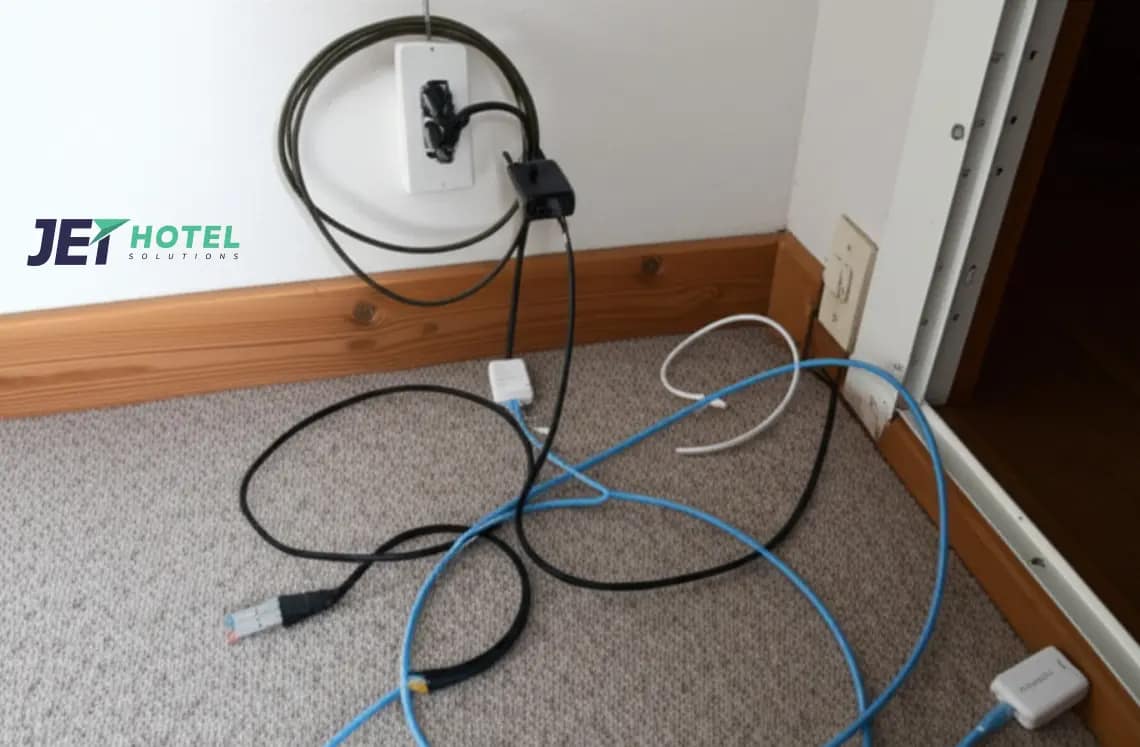
Ethernet over coax carries network traffic over a building’s existing coaxial cable. For a hotel renovation, it can preserve useful room wiring while adding IP connectivity. New category cabling takes a different approach: install a dedicated structured cable path designed around the planned network. Neither approach wins simply because one reuses cable and the other is newer. The useful comparison is between complete room-to-core designs, with realistic capacity, power, service compatibility, and renovation constraints.
This comparison updates our existing coax Ethernet guide for hotel owners and technology teams. It replaces broad savings and performance promises with the distinctions that matter when choosing an architecture. The discussion is vendor-neutral; a technology family alone does not establish brand approval or a suitable design for a particular building.
What Ethernet over coax actually replaces
The coax link usually addresses an in-building distribution problem. It does not replace the hotel’s internet circuit, wireless design, security policy, or every network switch. A room endpoint may connect an access point, television, or another IP device, depending on the chosen equipment. The room device still needs an appropriate path through the rest of the hotel network.
The AHLA HTNG Next Generation Infrastructure Technology Guide treats coax, traditional category cabling, and fiber as architecture choices. It distinguishes coax technologies including DOCSIS, G.hn, and MoCA, and calls for inspection of the existing cable plant. Those families and their products should not be treated as interchangeable adapters.
JET’s hotel low-voltage services provide the relevant project context: cabling choices have to fit pathways, equipment locations, construction access, and the systems that will use them.
Reuse has a different cost structure from rewiring
In an occupied hotel, the cost of a new cable includes more than the cable itself. Access to guest rooms, ceiling work, firestopping, finishes, testing, and the sequence of taking rooms out of service can affect the decision. Reusing a tested coax path may reduce some of that work. It also adds endpoints and a technology-specific distribution system that must be powered, managed, and supported.
For a renovation already opening walls and replacing ceilings, the balance may shift. Installing new cable while access is available can be more attractive than preserving an awkward existing route. A useful proposal therefore separates construction work from electronics and recurring support, then compares them over the intended ownership period. No universal percentage saving applies to every property.
Compare the architecture, not the advertised speed
| Dimension | Reuse coax for Ethernet | Install new category cabling |
|---|---|---|
| Building fit | Useful when existing room routes test well and access is disruptive. | Useful when new routes are practical or construction already exposes them. |
| Capacity | Depends on product, topology, shared segments, and uplinks. | Depends on cable installation, switch ports, endpoints, and uplinks. |
| Room equipment | Usually includes a compatible coax endpoint or bridge. | Can connect compatible Ethernet devices directly to the designed switch path. |
| Power | Local or remote power varies by the system. | PoE capability depends on the switch, device, and cable design. |
| Support | Includes both RF/coax and Ethernet fault domains. | Uses the installed structured-cabling and Ethernet fault domains. |
A headline throughput figure is not a guarantee of simultaneous internet speed in every room. Ask which portion is shared, where traffic converges, and what remains available under the expected busy-hour load. A fast room link cannot cure an undersized upstream circuit. Our hotel internet services guide explains the separate roles of the circuit, Wi-Fi, cabling, and support.
Power delivery is product-specific
A coax wall plate does not by itself establish how an access point will receive power. Some bridges need a local power supply. Other hospitality systems support centralized power over coax and may provide a powered Ethernet connection at the room endpoint. That capability belongs to a specific engineered system, not to every product described as Ethernet over coax.
For example, Belden’s hospitality Ethernet over Coax offering describes remotely powered room modems. This is an example of an available architecture, not a recommendation that it fits every hotel. Compare the selected endpoint’s output power, the attached device’s demand, the distribution limits, and backup-power behavior before treating a room as fully supported.
Residential MoCA is not a complete hotel design
The MoCA Alliance describes coax as a wired backhaul for Wi-Fi. That helps explain the basic idea: an access point can use a wired connection instead of relying on a wireless hop for its upstream traffic. A hotel’s multi-room design still needs deliberate capacity planning, management, and separation between guest and operational traffic.
A consumer product’s node limit or automatic pairing behavior does not describe how to serve an entire hotel. As one concrete example, TRENDnet publishes specifications for its TMO-312C adapters. Those specifications apply to that product. They should not be generalized into a property-wide deployment method, nor assumed to apply to other coax technologies.
Existing television service changes the migration
Retaining television service during a network upgrade can be valuable. Whether TV and data can share a particular coax plant depends on the selected system, frequency plan, splitters, amplifiers, and existing provider equipment. The presence of coax in both systems is not proof that they can coexist. A hotel can otherwise discover during the cutover that a network improvement disrupts room entertainment.
For planning purposes, separate the transport decision from the entertainment migration. A property may reuse suitable coax today and move selected services later. Another may replace cabling as part of a larger room renovation. The comparison should name what remains operational during each phase and identify the exact evidence needed to accept that phase.
Three renovation situations, three useful starting points
Occupied rooms with difficult cable access: investigate reuse early, alongside a physical survey and a representative-room demonstration. The strongest benefit may be avoiding disruptive construction rather than achieving a particular link speed.
Rooms already open for major work: compare new category cabling and fiber as well as reuse. The construction window may be a rare opportunity to improve pathways and equipment locations for the next upgrade.
A mixed property with several building generations: consider whether a phased design can use different access technologies while maintaining consistent management and service expectations. One building’s wiring condition should not dictate an untested assumption for every wing.
Turn the comparison into a property-specific decision
JET’s recommended starting point is a short architecture comparison based on the real building: surveyed routes, proposed endpoints, shared capacity, power, television coexistence, outage behavior, and construction sequencing. This is a planning approach, not a claim of measured savings or a completed JET installation.
If your next renovation includes guest connectivity, discuss the cabling and network options with JET. Bring the existing drawings and intended room services so the discussion can compare complete designs rather than isolated adapter prices.