
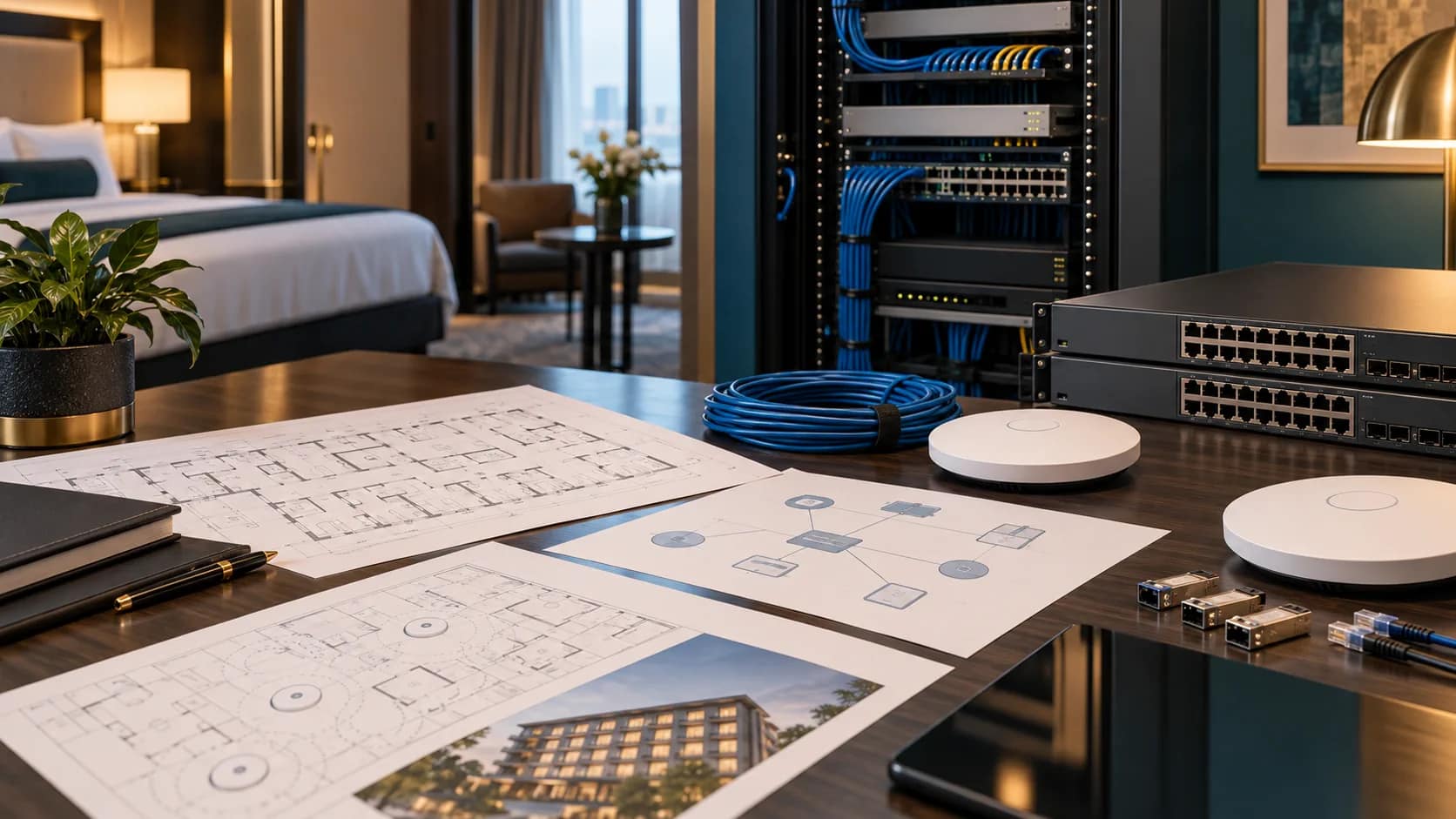
Hotel internet services should be evaluated as an operating system for the property, not just a monthly bandwidth line. A quote may promise fast service, managed Wi-Fi, support, installation, monitoring, or guest login tools, but the hotel still needs to know what is included, what is excluded, who owns each handoff, and how performance will be accepted after go-live.
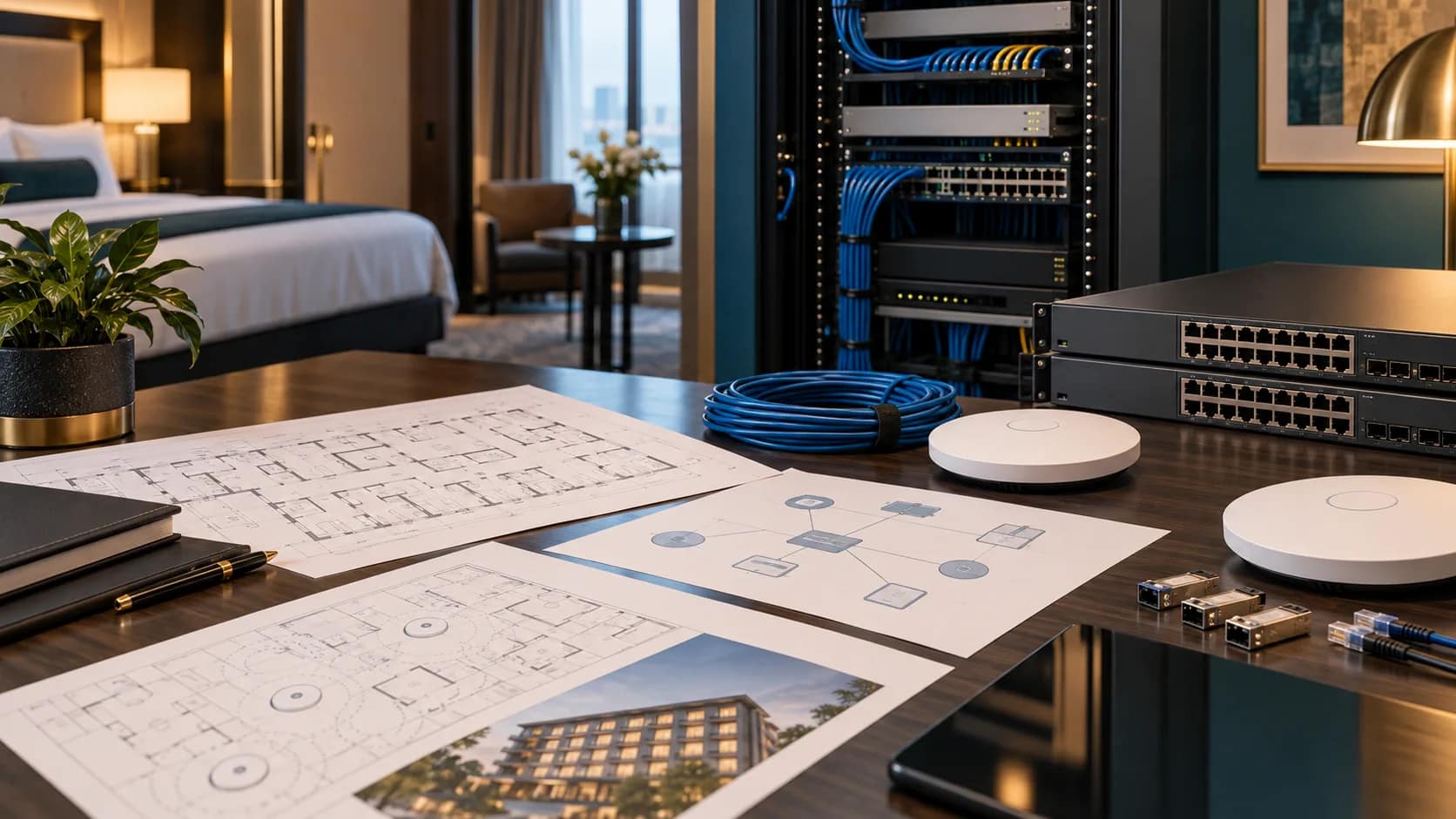
For most hotels, internet service now touches guest Wi-Fi, staff devices, PMS and POS access, IPTV or casting, phones, cameras, key systems, EV charging, monitoring, vendor remote access, and back-office work. When the internet scope is unclear, every outage becomes a debate about whether the issue belongs to the carrier, Wi-Fi vendor, cabling contractor, firewall provider, MSP, brand help desk, or property team.
This checklist gives owners and operators a practical way to compare hotel internet providers before signing a renewal, upgrade, opening package, or renovation scope.
Start with the guest and staff outcome
Do not start with the advertised speed. Start with the hotel experience the service must support. A select-service property, resort, conference hotel, extended-stay hotel, and luxury independent property can all need different internet and Wi-Fi expectations even if their room counts are similar.
List the outcomes first: guest browsing, streaming, casting, conference traffic, loyalty app use, staff mobile devices, payment terminals, PMS access, back-office work, digital signage, cameras, phones, and any brand-required guest technology. Then ask each provider to map its service to those outcomes.
JET’s guest Wi-Fi service work starts with that operating view because a circuit upgrade alone does not prove the guest experience will improve. The owner needs a service model that connects bandwidth, Wi-Fi design, support, monitoring, and documentation.
Separate circuit, Wi-Fi, cabling, hardware, and support
The phrase “hotel internet services” can hide several different scopes. One provider may include the DIA or broadband circuit only. Another may include managed switches, access points, firewall, captive portal, monitoring, support desk, cabling coordination, guest analytics, or on-site dispatch. A third may rely on separate contractors for installation and support.
Ask for a responsibility matrix that separates at least these items:
- Carrier circuit, demarc extension, IP block, router, and installation date
- Firewall, VLANs, guest/staff segmentation, and remote access rules
- Switches, PoE capacity, access points, controllers, and licensing
- MDF and IDF readiness, rack space, power, UPS, cooling, and patching
- Low-voltage cabling, labeling, as-built drawings, and test results
- Guest portal, splash page, authentication, terms, and support path
- Monitoring, alerts, escalation, dispatch, and after-hours coverage
- Training, closeout records, warranties, and renewal dates
If the provider quote does not name the boundary, the hotel will discover it during installation or the first outage. That is too late.
Compare bandwidth against real property demand
Speed matters, but it is only one part of the decision. Compare the proposed bandwidth to occupancy patterns, meeting space, streaming expectations, conference events, back-office use, staff systems, and peak-hour behavior. A hotel that rarely fills meeting rooms can have a different bandwidth profile than a property with ballroom events, group arrivals, and high guest streaming demand.
Also ask what happens when usage spikes. Is there headroom? Is burst capacity available? Are there rate limits, throttling rules, content-filtering issues, or fair-use policies that can affect guests? Does the provider monitor utilization and recommend upgrades before complaints rise?
Owners should review current traffic data when it exists. If there is no reliable historical data, the service comparison should include a conservative assumption and a defined review point after launch.
Use the existing network infrastructure as the reality check
For renovation options, compare Ethernet over coax versus new hotel cabling before assuming the existing room wiring must be replaced.
For properties combining two flags, review this dual brand hotel technology briefing before racks, risers, network rooms, and support boundaries are locked.
A strong proposal should describe how the service reaches the guest and staff endpoint. The circuit may terminate cleanly, but the hotel still depends on closets, switches, pathways, cabling, wireless coverage, VLANs, power, UPS, and support ownership.
The broader hotel network infrastructure plan should be the reality check for every service proposal. If a provider says the service includes managed Wi-Fi, confirm whether it also includes IDF cleanup, switch replacement, PoE capacity review, rack labeling, AP placement validation, cabling defects, and acceptance testing.
If those items are not included, the quote may still be valid. It just should not be treated as a complete hotel internet outcome.
Review security and traffic separation without overcomplicating it
Hotel internet service must separate guest traffic from staff and operational systems. It should also define who can remotely access equipment, how credentials are stored, what logs are available, and what the provider will do if suspicious activity or a misconfiguration appears.
Owners do not need every technical detail in the contract, but they do need clear operating rules. Which networks exist? Which systems are isolated? Who can change firewall or Wi-Fi settings? What requires owner approval? How is access removed when a vendor relationship ends?
AHLA’s HTNG program provides hospitality technology resources and industry collaboration around hotel technology systems at AHLA HTNG. The owner-side lesson is simple: the hotel should not let each vendor make isolated network decisions without a shared operating record.
Confirm installation work before signing
Many internet-service projects stumble because the proposal assumes the building is ready. Before signing, confirm the installation path. Where is the demarc? Who extends service to the MDF? Are conduits, sleeves, pull paths, access panels, firestopping, permits, lifts, ceiling access, and room-entry rules accounted for?
For renovations and occupied hotels, also confirm noise, downtime, staging, room access, after-hours work, front-desk communication, and cutover rollback. If provider installation depends on the electrician, low-voltage contractor, GC, brand team, or existing MSP, name those dependencies in the plan.
The best time to discover a missing pathway is before the contract is signed. The most expensive time is after the technician is on site and the hotel expects service to go live.
Ask what support actually includes
Support is often where proposals sound similar and perform differently. Ask whether support covers only the carrier circuit, or also Wi-Fi, switches, firewall, guest portal, captive portal, VLANs, cabling evidence, AP hardware, and property communication.
Owners should ask for the exact escalation path:
- Who answers first when the front desk reports guest Wi-Fi complaints?
- What evidence is required before dispatch?
- What is monitored automatically?
- What is the after-hours process?
- Who contacts the carrier if the circuit is impaired?
- Who communicates status to the GM or property team?
- What is outside the support scope?
If the support boundary is vague, the property may end up coordinating multiple vendors during every incident. That is exactly what a good service comparison should prevent.
Require acceptance evidence before go-live is considered complete
A hotel internet project should not close because equipment is installed. It should close because the agreed outcomes are proven. Acceptance evidence may include circuit test results, coverage validation, AP inventory, switch and port records, guest login testing, staff network testing, speed and utilization snapshots, monitoring setup, alert routing, escalation contacts, as-built drawings, and training notes.
Keep the evidence in a form the hotel can use later. A screenshot buried in a vendor portal may not help the next GM, engineer, owner rep, or support provider. The record should answer: what was installed, where it lives, how it is supported, who owns each component, and what was tested.
Without acceptance evidence, the hotel is buying confidence instead of proof.
Compare contract terms alongside technical scope
Internet-service contracts can include installation credits, long terms, automatic renewals, early termination language, equipment ownership rules, managed-service bundles, service-level terms, support exclusions, and price changes after the initial period. Compare those terms alongside the technical proposal, not after the preferred vendor is selected.
A low monthly number can become expensive if the hotel later pays separately for cabling cleanup, AP replacement, firewall work, after-hours support, additional public IPs, guest portal changes, or on-site dispatch. A higher number can be reasonable if it includes a complete operating scope with monitoring and accountable support.
The comparison should show total cost, scope, risk, and owner responsibilities on one page.
Owner checklist before approving hotel internet services
Before approving a provider, confirm these items in writing:
- The guest, staff, and back-office outcomes are defined.
- The proposal separates circuit, Wi-Fi, cabling, hardware, support, and monitoring.
- Bandwidth is compared against real occupancy, meeting, streaming, and system demand.
- MDF, IDF, power, UPS, cabling, rack, and pathway readiness are reviewed.
- Guest, staff, vendor, and operational traffic boundaries are documented.
- Installation dependencies and downtime risks are assigned to owners.
- Support hours, escalation, evidence requirements, and dispatch rules are clear.
- Acceptance evidence is required before final approval.
- Contract terms are compared with the actual operating scope.
When those answers are visible, hotel internet services become easier to compare. The owner can see whether the proposal is only a connection, a managed guest Wi-Fi service, a full infrastructure refresh, or a support model that will survive the first busy weekend.
Make internet service a hotel operating decision
JET Hotel Solutions helps hotel owners coordinate internet, guest Wi-Fi, network infrastructure, vendor scopes, low-voltage readiness, monitoring, support paths, acceptance testing, and closeout records. The goal is not to make the owner manage every technical detail. The goal is to make the service boundary clear enough that the property knows what it bought and who owns the result.
If you are comparing provider quotes, planning a renewal, opening a property, or trying to fix recurring guest internet complaints, JET can help turn the proposal into an owner-ready decision record.