
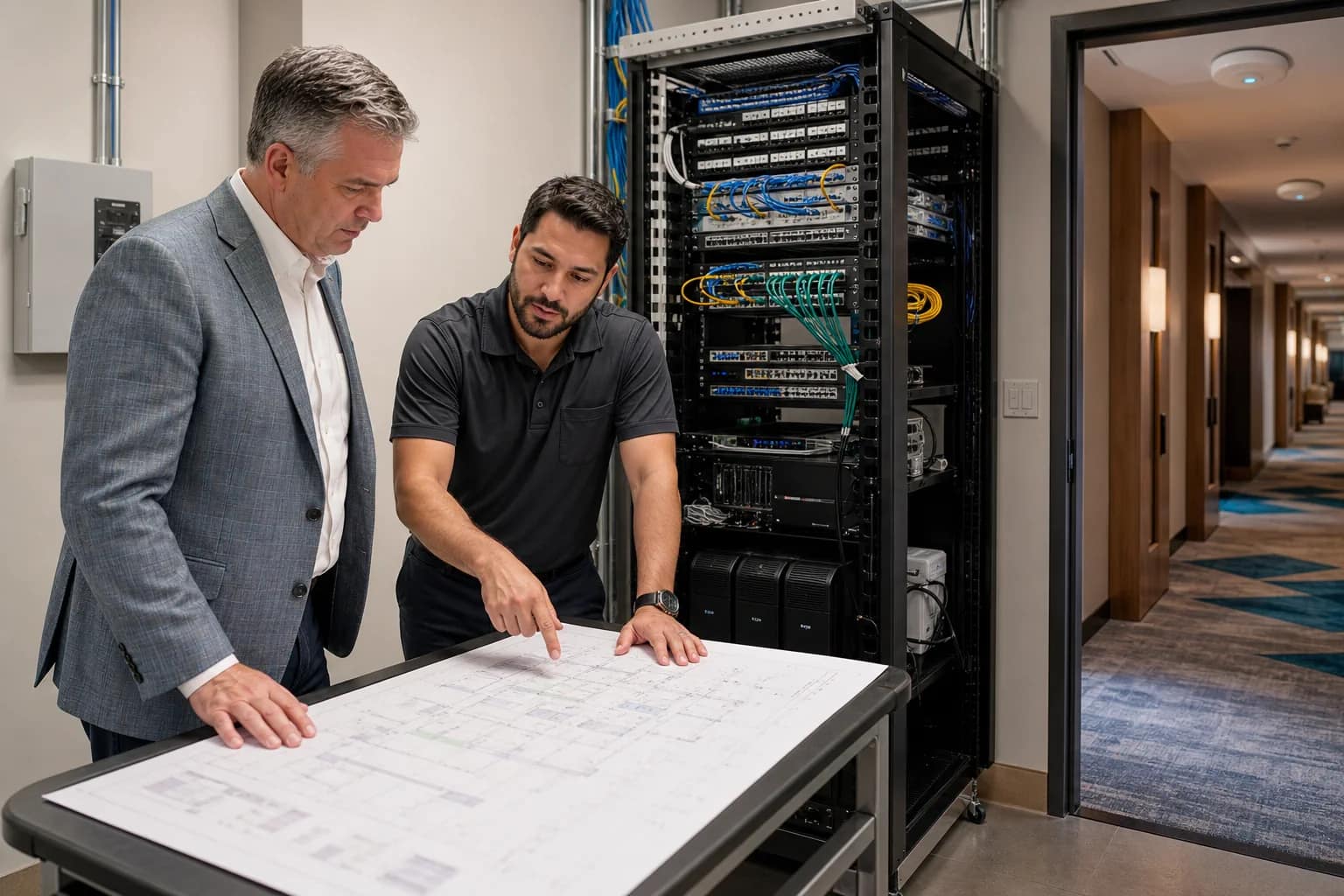
A hotel network can look complete on a proposal and still fail as an operating system. The circuit may be ordered, the switches may be sized, and the access points may be shown on plans, yet nobody has reconciled how service enters the building, moves through closets and pathways, reaches guest and staff devices, stays separated, gets monitored, and transfers to hotel operations.
A useful hotel network infrastructure plan connects those decisions before equipment is purchased. It gives the owner one record for scope, responsibility, dependencies, acceptance, and support—not five vendor diagrams that only make sense when read separately.
The blueprint below is designed for hotel owners, developers, asset managers, management companies, and IT leaders planning a new build, renovation, conversion, or network refresh.
Start with operating outcomes, not an equipment list
Network design should begin with what the property must operate. Guest internet, front desk systems, staff devices, phones, television, security, access control, building systems, meeting spaces, payment environments, and vendor remote access do not have identical availability, security, or support needs.
Create a service schedule before approving quantities. For each system, record the users, locations, critical operating hours, bandwidth sensitivity, outage impact, brand or application dependency, and support owner. This prevents a familiar scope gap: every vendor prices connectivity, but no one owns the complete path.
JET’s current hotel work repeatedly connects internet agreements, Wi-Fi delivery, low-voltage pathways, technology standards, and project management. The practical lesson is that carrier, construction, technology, and operations decisions belong in the same owner review.
Map the full path from carrier handoff to endpoint
Before approving a carrier or Wi-Fi proposal, this hotel internet services checklist helps owners compare the service promise against the actual property infrastructure.
The network starts before the firewall and ends after the switch. The owner record should show:
- carrier demarcation, service entrance, circuit type, bandwidth, handoff, and activation dependencies;
- firewall, gateway, core switching, and any redundant or backup path;
- backbone routes between the MDF and each IDF;
- horizontal cabling, patching, labeling, and endpoint responsibility;
- access points, phones, televisions, cameras, controls, and other connected devices;
- cloud services, remote-management paths, and vendor access boundaries.
A single-line diagram is useful, but it should be paired with a responsibility matrix. One shows how traffic moves; the other shows who supplies, installs, configures, tests, documents, accepts, and supports every part of the path.
Make the MDF and IDFs buildable and serviceable
Closets are not leftover square footage. Rack position, clearance, pathway entry, grounding, power, backup power, cooling, moisture protection, access control, lighting, and construction protection can determine whether the installed system is stable and maintainable.
Owners should release each closet only after the architectural, electrical, mechanical, low-voltage, and network requirements agree with field conditions. JET’s hotel MDF and IDF readiness checklist provides a focused release walk for that decision.
Also reserve capacity deliberately. Spare rack units, fiber strands, switch ports, patch-panel positions, power, and cooling should follow the documented growth plan rather than an arbitrary percentage copied from another property.
Coordinate cabling with the final room and device plan
For a service-door endpoint, map the network, answering device and lock-control dependencies in hotel entrance intercom call paths rather than treating a working call as proof of a complete door-release system.
A network diagram cannot correct an endpoint installed in the wrong location. Reconcile guestroom layouts, public-space ceilings, back-of-house work areas, exterior coverage, cameras, phones, televisions, controls, and staff devices against the current architectural and technology plans.
For renovations, survey the routes that drawings cannot prove. Confirm cable type and condition, pathway capacity, concealed obstructions, firestopping, ceiling access, shutdown limitations, and spaces that must remain in service. Record which existing infrastructure may be reused and what test evidence is required before it is accepted.
The output should be more than a cable count. It should connect every endpoint to an approved location, cable or wireless path, closet, switch port, power method, network segment, and acceptance test.
Design Wi-Fi from use cases and field evidence
Access-point quantity alone does not define guest or staff experience. The plan should identify coverage zones, expected device density, roaming paths, challenging materials, exterior areas, event spaces, back-of-house needs, and applications that depend on reliable wireless service.
Predictive design establishes a starting point. Field validation confirms whether the installed building, furniture, doors, finishes, neighboring interference, channel plan, power levels, and device behavior support the intended result. Keep the predictive model, installation record, post-install survey, exceptions, and remediation plan together.
Acceptance should test representative rooms and operating conditions—not one lobby speed test. Record coverage, roaming, capacity, latency-sensitive behavior where relevant, authentication, guest isolation, staff access, and recovery after a service interruption.
Separate traffic according to risk and operating need
Guest devices should not inherit trust simply because they are inside the hotel. The same is true for vendor-managed devices, building systems, cameras, staff endpoints, and administrative services.
NIST’s enterprise-network guidance describes segmentation and modern access controls as architectural tools for separating resources and applying policy. For a hotel project, the owner does not need to prescribe every firewall rule in the budget brief, but the design record should name the required zones, permitted communication paths, identity and access expectations, vendor remote-access method, logging responsibility, and approval owner.
Document exceptions. A device that needs to cross a boundary for a valid integration should have a named business purpose, source and destination, required protocol, responsible vendor, approval, and test. “It needs to see the network” is not a usable rule.
Build monitoring and escalation into the scope
Owners can also use this hotel technology monitoring checklist to define who sees alerts and who acts on them after go-live.
Translate those requirements into a hotel network monitoring operating plan that defines signals, thresholds, ownership, escalation, and evidence.
Carry the same ownership model into an opening-week hotel IT support path so the property knows who receives, diagnoses, escalates, and closes cross-system incidents.
A network is not operationally ready if the hotel learns about failure from a guest complaint. Define what is monitored across circuits, firewalls, switches, access points, critical endpoints, power, and cloud services. Then define what an alert means, where it goes, who acts first, and how the issue crosses vendor boundaries.
The monitoring plan should record:
- assets and services covered;
- health, availability, capacity, and configuration signals collected;
- alert thresholds and maintenance windows;
- hotel, management-company, carrier, and vendor contacts;
- response targets and escalation sequence;
- reporting, retention, and change-history expectations.
Monitoring is not a substitute for support ownership. It supplies evidence. The support matrix still needs to tell hotel staff who owns the first diagnosis, who can change configurations, who opens carrier tickets, and who coordinates a problem that spans more than one provider.
Make commercial boundaries visible
Separate one-time and recurring costs. Carrier construction, installation, licensing, cloud management, support, monitoring, hardware replacement, software subscriptions, managed services, and after-hours work may sit in different documents and begin billing at different times.
Use JET’s hotel technology solutions framework to compare the complete scope across connectivity, Wi-Fi, low voltage, voice, television, security, and project coordination. The purpose is not to force every system into one contract. It is to make exclusions, dependencies, and owner-retained responsibilities visible before approval.
Record quote validity, lead times, assumptions, construction allowances, taxes and freight, activation dates, renewal and notice terms, service levels, warranty boundaries, and the party authorized to approve change.
Accept the network with evidence the hotel can keep
“Online” is not an acceptance standard. Build an acceptance matrix that names the test, expected result, responsible performer, witness, evidence, exception process, and signoff authority for each infrastructure layer.
| Layer | Owner acceptance evidence |
|---|---|
| Carrier | Correct handoff, activated service, documented circuit details, escalation path, and measured service result. |
| MDF/IDF | Approved rack, power, grounding, cooling, access, labels, and current elevations. |
| Backbone and cabling | Test results, routes, identifiers, patching records, firestopping closeout, and approved exceptions. |
| Switching and routing | Current configuration backup, port map, addressing record, software/license status, and management ownership. |
| Wi-Fi | Installed AP record, post-install validation, representative-use tests, and remediation closure. |
| Segmentation and access | Approved zone/policy record, required communication tests, remote-access control, and logged exceptions. |
| Monitoring and support | Asset coverage, alert test, contact matrix, escalation test, reporting access, and handoff training. |
The final package should be usable after the project team leaves. Require current diagrams, IP and VLAN records where appropriate, rack elevations, port maps, cable test results, configuration backups, licenses, warranties, approved credential transfer, vendor contacts, open exceptions, and training records. Protect sensitive network records with controlled access rather than attaching them casually to general closeout folders.
Use one owner blueprint across design, bid, build, and support
The strongest hotel network infrastructure plan is not the most technical document. It is the one that keeps the business outcome, field condition, supplier boundary, configuration decision, acceptance evidence, and operating owner connected through the life of the project.
JET Hotel Solutions helps hotel teams coordinate carrier service, guest Wi-Fi, low-voltage infrastructure, technology scopes, proposals, schedules, field verification, acceptance, and support handoff across new builds, renovations, and refreshes.
Primary reference: NIST SP 800-215, Guide to a Secure Enterprise Network Landscape.