
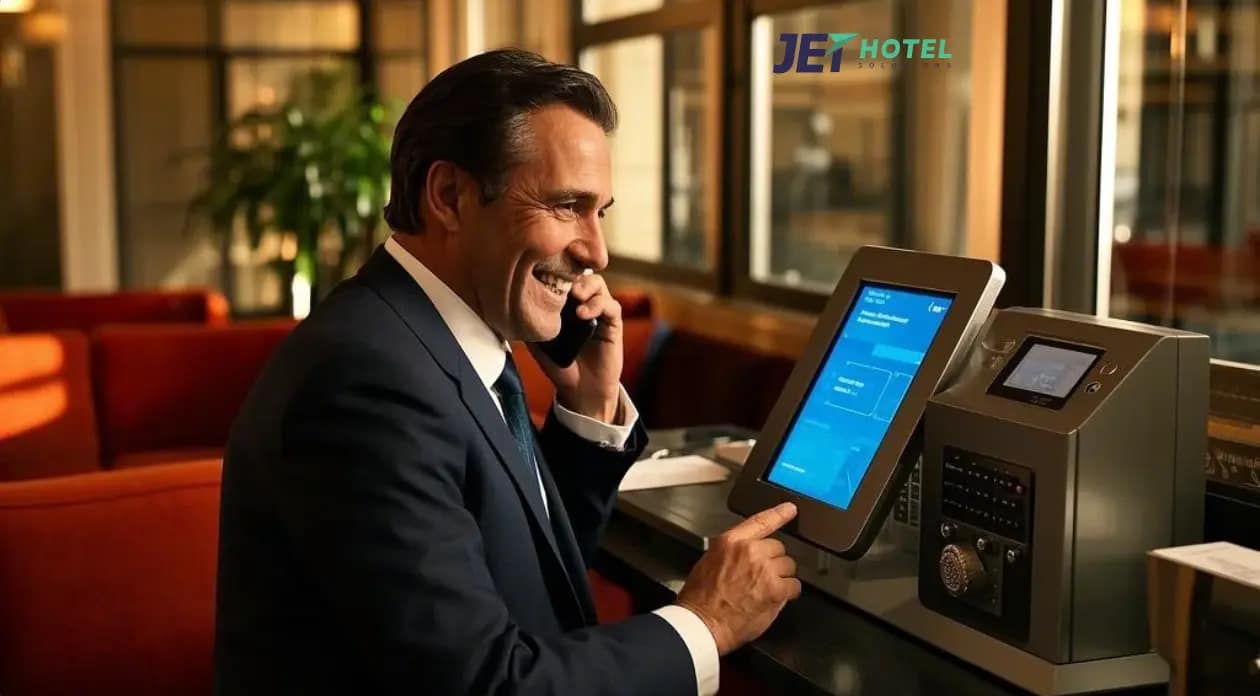
A hotel intercom system connects a visitor at a specific entrance with a configured staff answering point. Using the 2N IP Verso 2.0 as a concrete example, a service-door call might reach reception through the hotel’s compatible local phone system or reach an authorized employee through My2N mobile cloud calling. Those paths have different dependencies even though both involve IP communications.
Consider a delivery driver arriving at a locked service entrance while the front desk is busy. The design must carry the call, provide usable audio or video, and permit an authorized release of the correct door. A camera, an app and a network connection are not automatically a complete working access system.
How does the 2N IP Verso 2.0 door call work?
The 2N IP Verso 2.0 is a modular IP intercom, available with a camera or in an audio-only variant. The installed modules and configuration determine the entrance’s capabilities; a reader or keypad shown in a product photograph should not be assumed to be included in every assembly.
In the proposed hotel scenario, pressing the configured call button starts communication with the chosen destination. The person answering can speak with the visitor and, where the complete arrangement supports it, see video and operate an authorized door-release control. The intercom does not automatically verify a hotel reservation or synchronize with a property-management system. Such integration would require separate, documented compatibility and implementation.
Reception-desk answering through a local phone system
2N documents SIP support and possible PBX integration for this model. A local reception route can therefore be evaluated around the hotel’s actual PBX, phone or answering station: registration, destination routing, audio/video negotiation and the required unlock command all need to work together. “SIP compatible” is a starting point, not proof that every feature passes through every phone system.
An audio-only desk phone may answer speech without showing the intercom camera. A video-capable phone can still need compatible codecs and configuration along the call path. A call that connects successfully but cannot deliver the expected picture is a different result from a completed video-entry installation.
A fully local path can avoid dependence on a cloud answering service, provided its LAN, local PBX or answering device and power remain operational. That conditional advantage must be tested, not advertised as guaranteed operation during every outage. Review the surrounding hotel PBX scope when entrance calls are expected to use existing desk phones.
The hotel network infrastructure guide maps the carrier, closet, switch and endpoint dependencies around that call path. Treat the desk phone, door station and lock-control arrangement as distinct parts of the installed system, rather than assuming that one successful call proves them all.
My2N mobile answering when staff are away from the desk
The My2N App provides remote door answering and video calling. For the service-entrance example, that creates another possible destination when an authorized employee is moving around the property rather than sitting beside a dedicated station.
This is not “SIP versus cloud”: My2N’s documented calling infrastructure includes SIP servers too. The practical comparison is a locally arranged desk route versus a managed cloud/mobile answering route. The latter depends on working Internet access, permitted service traffic and a reachable mobile device. Test calls with the phone locked and on the networks staff actually use; a foreground-app demonstration alone does not establish the operating result.
Commercial entitlement matters. 2N’s subscription rules distinguish residential from non-residential projects, with paid cloud calling to smartphones or tablets in non-residential installations. Do not transfer a residential free-calling offer into a hotel proposal. Confirm the appropriate site type and device subscriptions without assuming that purchasing the intercom includes every cloud service.
Answering a visitor is not the same as releasing a door
The answering device and the lock-control path are related but separate. 2N’s answering-unit configuration guidance specifically addresses switch codes and DTMF settings when a call is used to activate a switch. The configured method must be supported through the selected answering route; hearing a visitor does not prove that the unlock command reaches the intended output.
Physical placement also matters. An optional 2N Security Relay is designed to sit inside the secured area between the outside intercom and the electric lock and respond to a valid opening code. Its suitability, lock power, controller connections and required release behavior belong in the installer-designed door arrangement, not an improvised wiring shortcut.
Power, codecs and network permissions change the result
The version 3.3 technical manual lists PoE 802.3af and external DC supply options, SIP transports and separate video-call versus camera-streaming codecs. Its video-call list includes H.264 and MJPEG; H.265 in the streaming list does not establish H.265 video-call support through a reception phone.
Check the assembled modules’ power requirements and the actual network design. For My2N, use the manufacturer’s service connectivity guidance rather than treating access to a website as proof that signaling and media are permitted. Record the installed firmware and enabled functions, and keep the entrance system appropriately separated from an open guest network. Encryption mechanisms require matching configuration; no blanket security outcome follows from a feature list.
Prove the entrance scenario before changing hotel operations
Run one real sequence: the visitor calls from the service entrance; reception or the assigned mobile recipient answers; two-way speech and any required video work; an authorized release opens only the intended door. Repeat with reception busy, the mobile phone locked and the relevant network or power dependency unavailable. Record which functions remain available rather than assuming automatic fallback.
For holiday deliveries or event arrivals, pilot this defined entrance before expanding the design. JET’s hotel low-voltage project planning can place that entrance within the wider cabling, phone and access-control scope. Contact JET with the door location, existing PBX and phone models, desired answering destinations and current lock/controller details to discuss a bounded project.