
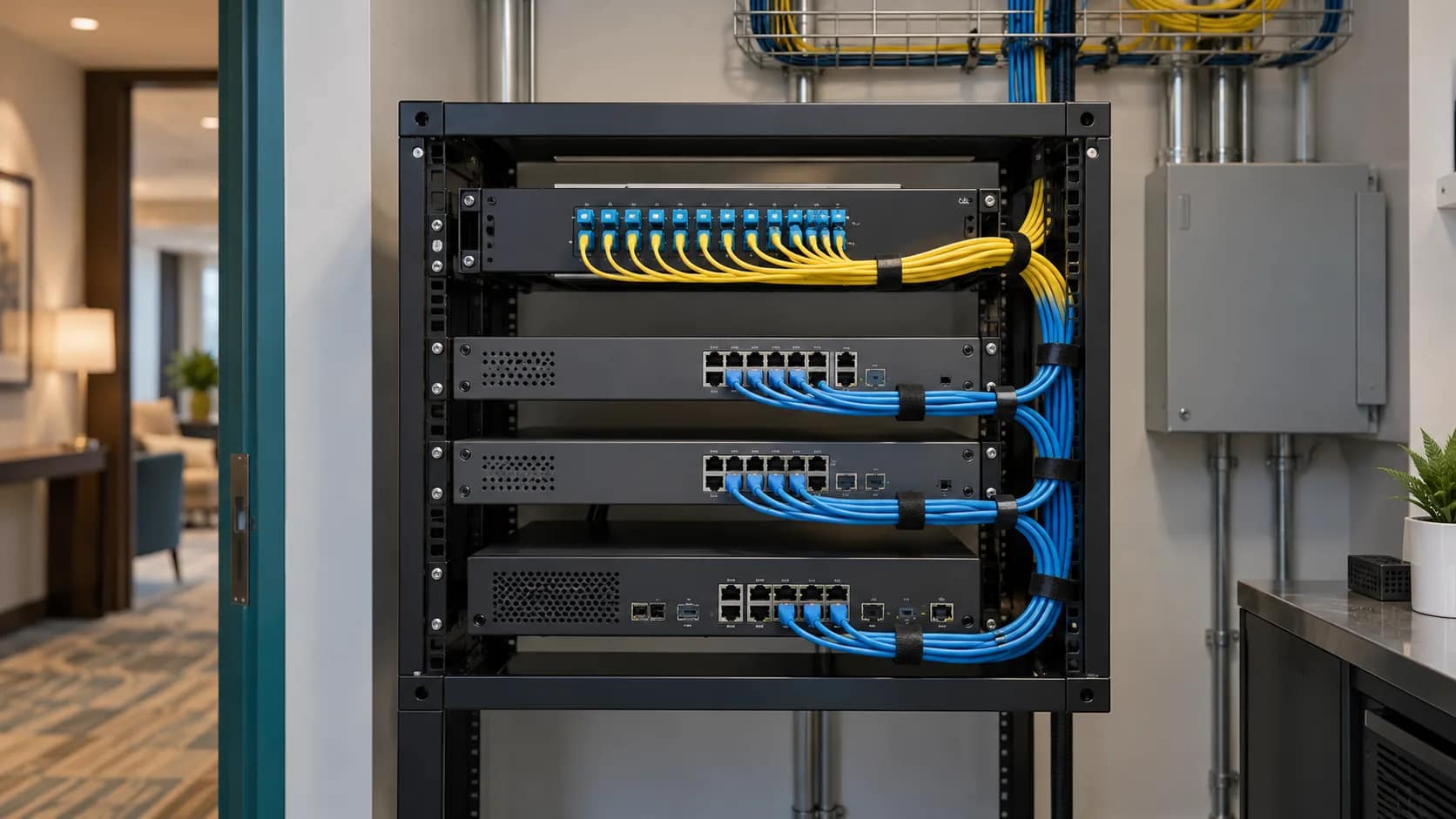
Dedicated internet vs broadband is a comparison of service architecture and commitments, not simply fast versus slow. A hotel can buy a broadband connection with a higher advertised download rate than a dedicated circuit. The important differences are the capacity available in each direction, the provider’s contractual performance boundary, and how the property’s applications behave when the connection changes.
That makes this a useful technical comparison for conference hotels, select-service properties and resorts with cloud applications. Dedicated internet access, or DIA, and business broadband can both have a place in a hotel network. Neither label describes the entire guest experience, and neither removes the need for a well-designed local network.
What is actually dedicated?
DIA allocates an agreed amount of access bandwidth to a customer rather than offering a share of a local broadband access pool. AT&T’s dedicated-internet explanation describes a private last-mile connection to the provider that still reaches the public internet. This is not a private end-to-end path to every cloud application or website.
Broadband generally uses shared access capacity. That does not mean it is always congested or unsuitable for hotels. It means the advertised maximum and the service commitments need to be understood in their own terms. Fiber describes a transmission medium; it is not, by itself, proof that a product is DIA. Both shared broadband and dedicated services can use fiber.
Inside the building, guests still share the hotel’s access points, switching and internet capacity. Replacing the circuit will not automatically correct poor radio coverage, an overloaded uplink between floors or a configuration problem. JET’s hotel connectivity and technology solutions place the carrier connection alongside those property-side systems, rather than treating it as the whole network.
Upload capacity can change the comparison
Many DIA products offer symmetrical upload and download rates. Verizon’s Internet Dedicated documentation lists symmetrical service alongside dedicated capacity and contractual performance commitments. Those are product-specific features, not a claim that every internet product with a business label has the same characteristics.
Hotel demand travels in both directions. A guest downloading entertainment mainly consumes downstream capacity. A conference attendee presenting over a video call, a property sending files to a cloud service, or a supported security system uploading video also uses the upstream path. Some broadband products are symmetrical; others have substantially different upload and download rates. The quoted service specification is more informative than the headline number alone.
For an illustrative example, a 1,000 Mbps download service with 50 Mbps upload is not equivalent to a 500/500 Mbps service for an upload-heavy workload. These are hypothetical capacities, not provider quotes or a recommendation for a particular room count. The appropriate capacity depends on measured simultaneous demand, application behavior and the hotel’s internal bottlenecks.
An SLA has a measurement boundary
A service-level agreement, or SLA, defines performance commitments and remedies for a particular service. It is not a promise that a hotel’s reservation application, guest phone call or video meeting can never fail. Availability, latency, packet loss and repair commitments may have different measurement points, qualification rules and exclusions.
AireSpring’s published Internet Access SLA, revised August 2020, is a useful example of those boundaries. It separates internet service from other services, defines network measurements, and includes conditions for service credits. Its listed exceptions include customer-premises equipment and wiring beyond the minimum point of entry. This example must not be substituted for the agreement governing another carrier or a specific order.
Lumen’s service-level agreement likewise describes credits, request procedures and excused outages. A credit is a contractual remedy after a qualifying event; it is not redundant capacity that keeps a hotel online during that event. The useful comparison is the applicable service commitment and its coverage, not an isolated uptime percentage lifted from marketing.
A second circuit and automatic recovery are different things
DIA and redundancy solve different problems. A dedicated primary circuit can improve the access service’s predictability, while a second connection offers another route when the first is unavailable. A hotel can pair DIA with broadband, two suitable broadband services, or a wired connection with cellular backup. Each design has different capacity, addressing and failure behavior.
Two provider names do not prove that the physical paths are independent. Shared building entrances, cable routes, local facilities, routers or power supplies can leave common failure points. Route diversity is a design question to verify for the actual site, not a property of the billing arrangement.
Routing recovery also does not guarantee that every application continues uninterrupted. Cisco Meraki’s VPN failover documentation explains that a non-Meraki IPsec peer needs the secondary public address configured as a backup peer to re-establish that tunnel. This is one model-specific example of why a reachable backup WAN and a recovered application are separate milestones. The hotel’s internet cutover and addressing guide covers the related migration context.
Where each architecture fits
DIA can suit properties whose operations benefit from committed access capacity, substantial upstream demand, documented carrier performance or more predictable service support. Business broadband can suit properties whose measured workloads, available service and tolerance for variability fit that product. A smaller hotel is not automatically a broadband case, and a large hotel is not automatically a particular DIA speed.
The operating model also matters during an outage. A backup link may be sized for essential hotel applications while guest downloads are limited. Alternatively, a property may require broader continuity. These are different designs, with different costs and user experiences. The carrier product does not decide the hotel’s traffic priorities by itself.
Compare the complete connectivity design
The lasting distinction is between access capacity, contractual service assurance and application continuity. Buying more of one does not automatically deliver the others. The internet circuit, property network and failover policy work together, but they remain separate layers with separate constraints.
For a renovation or carrier change, JET’s hotel internet services guide connects this comparison to the broader property scope. There is no universal savings figure, brand requirement or circuit size in this comparison: the right architecture follows the actual hotel’s workloads and available services.
Discuss your hotel’s internet architecture and migration options with JET.