
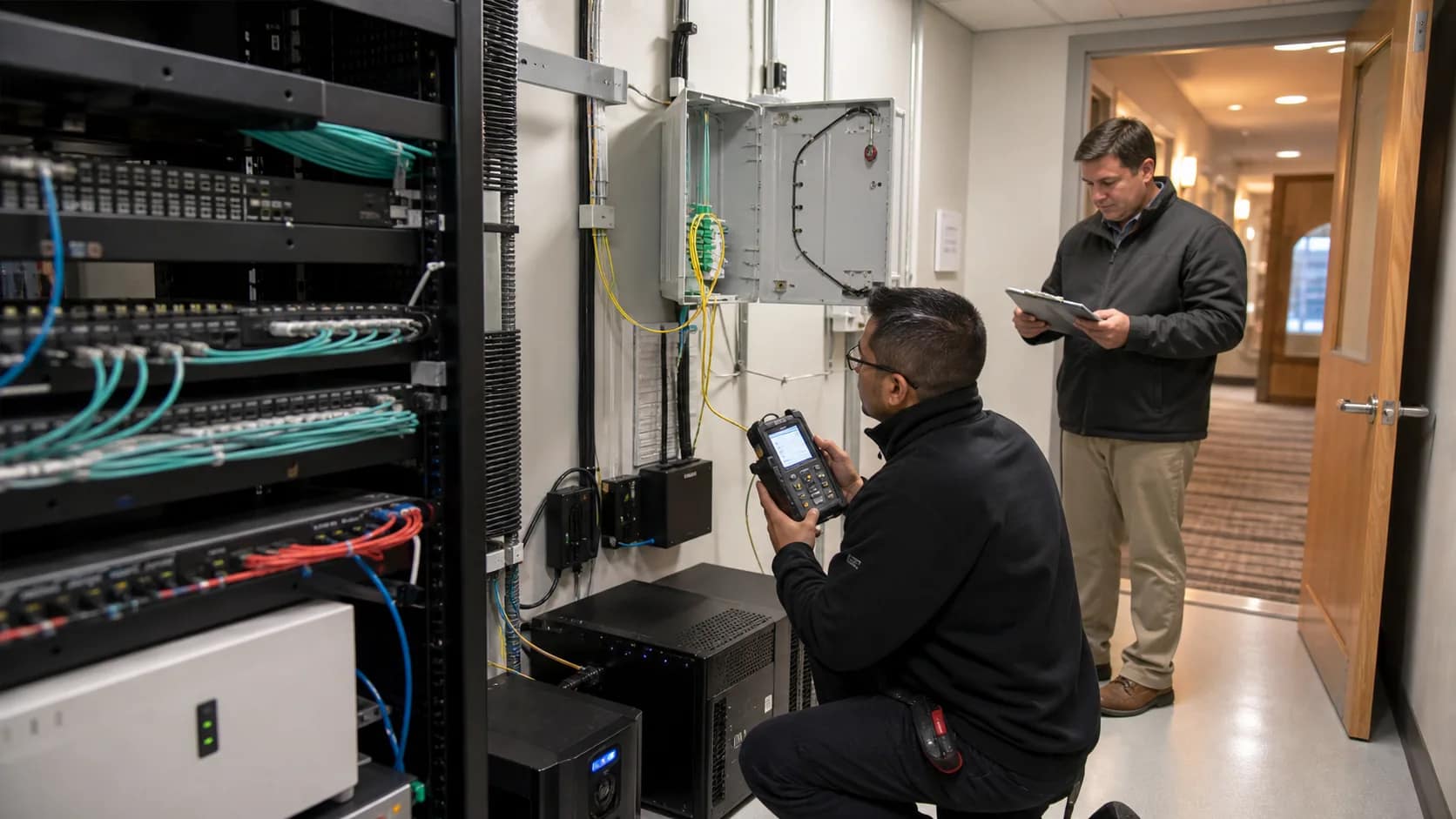
Quick answer: Before a hotel internet circuit is activated, ownership should have nine records in one cutover packet: the approved order, service-address confirmation, demarcation and pathway plan, handoff specification, IP and routing plan, hotel dependency map, activation runbook, test-and-rollback plan, and support/closeout record. A carrier completion notice proves that one part of the service is ready. It does not prove that the hotel can safely move guest, staff, voice, payment, security, and cloud traffic onto it.
Internet activation is often treated like a final appointment: the carrier arrives, a light turns green, and the project is complete. In a hotel, that moment is only the boundary between the carrier network and a larger operating system.
The handoff still has to reach the correct MDF or firewall. Static IPs, routing, DNS, monitoring, and failover must match the approved design. Guest Wi-Fi, PBX, PMS-connected services, payment systems, television platforms, cameras, staff applications, and remote support may all depend on the change. If the team cannot prove those dependencies before the cutover, it is testing them on guests.
A circuit is ready for hotel use only when the physical handoff, network configuration, operating dependencies, acceptance tests, and fallback path agree.
Why the carrier completion date is not the hotel go-live date
A dedicated internet order can involve serviceability review, construction, permits or property access, a carrier demarcation, a building extension, customer equipment, static IP assignments, and a separate activation step. The exact responsibilities vary by order and provider.
Lumen’s current Dedicated Internet Access guidance, for example, distinguishes the carrier service from an optional building extension between the demarcation point and the customer’s operating location. Its activation-readiness guide says that many reported faults are actually demarcation-connectivity or customer-patching issues and calls out the LOA, cross-connect, optic type, interface settings, final patch, and activation ticket.
Comcast’s Dedicated Internet overview describes static IP, routing, monitoring, and support as service decisions, while its technical description places several site obligations on the customer, including pathway, power, access, routing equipment, and an installation/activation contact. That is why a hotel owner should reconcile the signed order with the field condition instead of assuming the last mile includes the last 50 feet.
1. Approved order and commercial baseline
Start with the final, signed service record rather than the latest quote in an email chain. The cutover team should be able to identify:
- Legal customer and billing entity.
- Exact service address, suite, building, and property contact.
- Service type, committed bandwidth, term, recurring charges, and one-time construction charges.
- Required static IP allocation, managed router, firewall, BGP, failover, or other options.
- Order number, carrier circuit ID, target delivery date, and acceptance/billing trigger.
- Any construction, landlord, easement, permit, or customer-responsibility condition.
This baseline prevents a common late-stage problem: the field team is activating a technically valid circuit that is not the service ownership thought it bought.
2. Service-address and site-access confirmation
Confirm the service location in the carrier’s system and in the building. Similar hotel names, phased developments, dual-brand properties, new street records, and separate ownership parcels can create order ambiguity.
The site record should include a verified address, entrance instructions, loading and parking rules, approved work hours, local contact, after-hours contact, access authorization, required insurance or badging, and the rooms the technician must reach. If the carrier needs a landlord, general contractor, utility, or local permitting authority to complete work, name that dependency and its owner.
A confirmed appointment without confirmed access is not a cutover plan.
3. Demarcation, pathway, and building-extension plan
Mark the carrier’s proposed demarcation and the hotel’s required handoff location on a current plan. Then walk the route between them. Record:
- Exterior entry point, conduit, pull rope, sleeves, riser, ceiling route, and firestopping requirements.
- Demarcation room, rack position, mounting space, grounding, environmental condition, and power/UPS.
- Who provides and installs the building extension or cross-connect.
- Fiber type, strand count, connector type, patch panels, and optic ownership.
- Any landlord letter of authorization, carrier LOA, final-patch request, or cross-connect ID.
- Photos and a simple route drawing that a different technician could follow.
Do this before the activation date. A carrier can complete its facilities to the demarcation while the hotel remains unable to reach the firewall.
4. Carrier handoff specification
Request the handoff or welcome packet and translate it into the exact settings the hotel’s network owner will use. At minimum, confirm:
- Media and connector: copper or fiber, single-mode or multimode, and connector/optic type.
- Port speed, duplex, auto-negotiation, VLAN tagging, and MTU as applicable.
- Carrier equipment make/location and the physical customer-facing port.
- WAN IP, subnet, gateway, usable addresses, DNS, and routed blocks.
- BGP details only when the approved design actually requires them.
- Carrier test status and the point from which service levels are measured.
Attach the final packet to the project record. Do not leave the only copy in one installer’s inbox.
5. IP, routing, firewall, and failover plan
Identify who owns every configuration change between the carrier handoff and the hotel systems. The plan should show the carrier device, customer router or firewall, WAN interface, public IP use, NAT, DNS, VPNs, remote-management paths, monitoring, and backup circuit.
For a replacement circuit, inventory anything tied to the old public IPs. Typical examples include vendor allowlists, site-to-site VPNs, remote support, cloud controllers, PBX/SIP services, payment or security integrations, and monitoring platforms. Decide which parties need the new address before cutover and which changes can wait until validation.
Record configuration backups and the approved change ticket before touching the live interface. CISA’s configuration and change-management guidance recommends testing changes, planning stakeholder communication, rolling back unsuccessful changes, and validating the restored state. The same discipline belongs in a hotel WAN cutover.
6. Hotel dependency map
Do not describe the impact as simply “internet.” List the services and operating owners that use the current path:
- Guest Wi-Fi and captive-portal or authentication services.
- Property management, payment, point-of-sale, reservations, and accounting access.
- PBX, SIP trunks, cloud voice, voicemail, and remote phone support.
- Hotel TV, IPTV, casting, content, and remote management.
- CCTV, access control, staff alert, building systems, and cloud dashboards.
- Corporate VPN, brand applications, employee Wi-Fi, and back-office services.
- Vendor remote access, monitoring, backups, and support tools.
For each dependency, name a test owner and a pass condition. A device responding to ping does not prove the front desk can post a charge, a guest can cast, or the support team can reach the PBX.
7. Activation runbook and contact bridge
Build a timed runbook that starts before the carrier technician arrives. It should identify the approved maintenance window, occupancy and event conflicts, guest/staff communication, on-site escort, carrier order and ticket numbers, network engineer, hotel operations lead, vendors on standby, decision authority, and escalation contacts.
The sequence should state who will:
- Verify power, rack space, patching, optics, and link state.
- Confirm the delivered handoff against the carrier packet.
- Capture the current production baseline and configuration.
- Move or enable traffic.
- Run network and hotel-application tests.
- Make the go, hold, or rollback decision.
- Notify hotel departments and close the change.
Do not make the local GM discover the escalation path after the lobby loses connectivity.
8. Acceptance test and rollback plan
Write the pass/fail script before the window. Capture a baseline on the existing service, then repeat the same tests on the new circuit. Depending on the design, the packet may include:
- Physical light levels and interface status.
- Assigned IP, gateway, DNS, routing, and public-IP verification.
- Latency, packet loss, throughput, and sustained-load tests from agreed locations.
- Primary and backup path behavior, including a controlled failover test when approved.
- Guest Wi-Fi authentication and real application use.
- Front desk, payment, PBX, TV, security, remote-support, and brand/corporate workflows.
- Monitoring, alerting, and support visibility.
Define the rollback trigger, deadline, responsible person, and steps. Keep the former service and configuration available until the new path passes the owner-approved test set. When parallel service is not possible, document the specific continuity option the hotel will use during a failed change.
9. Support and closeout record
Before the project closes, give hotel operations and the support team one durable record containing:
- Carrier, account, order, circuit, and billing identifiers.
- Service address, demarcation location, rack/port, and route photos.
- Handoff and IP information stored in the appropriate secured system.
- Carrier support number, portal, SLA, escalation path, and authorized contacts.
- Router/firewall owner, monitoring owner, and vendor support contacts.
- Final configuration, diagram, test results, exceptions, and acceptance date.
- Old-service disconnect owner and the earliest approved disconnect date.
Then open a test ticket or confirm portal access before an outage makes that information urgent.
A compact owner control table
| Gate | Owner question | Minimum evidence |
|---|---|---|
| Commercial | Are we activating the approved service at the correct property? | Signed order, address, circuit ID, charges, options |
| Physical | Can the handoff reach the operating network? | Demarc/path plan, LOA or cross-connect record, power and access signoff |
| Technical | Do both sides agree on the interface and routing? | Handoff packet, IP plan, firewall change, configuration backup |
| Operational | Can the hotel prove its critical workflows? | Dependency map, test owners, acceptance script |
| Recovery | What happens if acceptance fails? | Rollback trigger, former path/configuration, decision deadline |
| Closeout | Can the next support person find and operate the service? | Support record, diagram, test results, acceptance and disconnect status |
The owner-ready result
A good cutover packet lets ownership answer four questions without assembling another emergency email thread:
- What exactly did the carrier deliver, and where?
- Who owns the path and configuration from that handoff into the hotel?
- What hotel services prove the new circuit is ready?
- How will the team recover and escalate if it is not?
JET Hotel Solutions helps owners compare carrier options, coordinate internet service delivery with low-voltage and network work, manage vendor dependencies, and turn activation into an accountable hotel-operations handoff. For adjacent planning, review JET’s MDF/IDF readiness checks and hotel Wi-Fi acceptance framework.