
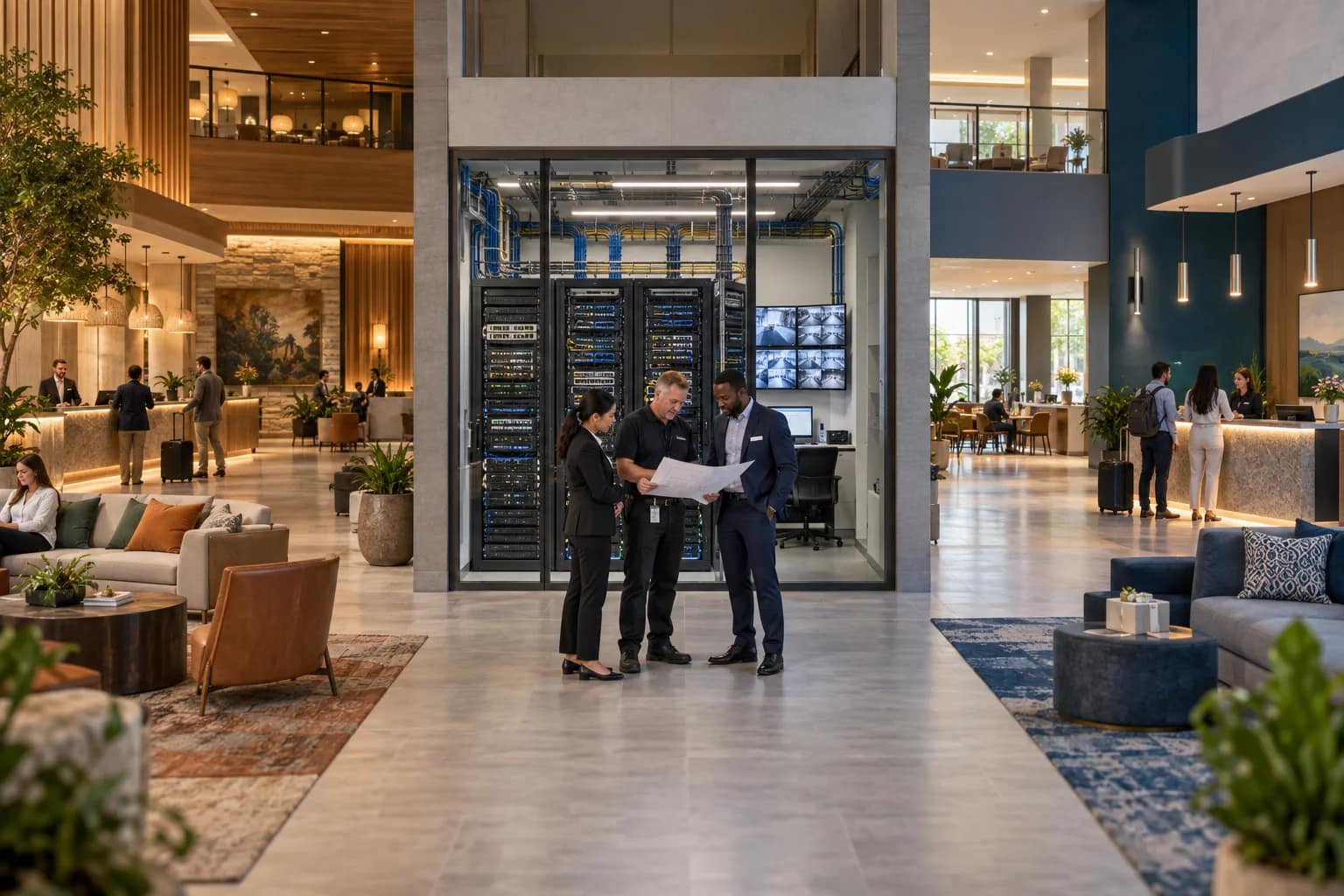
Dual brand hotels are becoming a repeatable development model, not a niche experiment. The commercial logic is clear: two brands can address different demand segments while sharing a building envelope, selected amenities, labor, and operating costs. The technology logic is less automatic. A project can share pathways, rooms, and hardware without forcing two brand experiences into one undifferentiated system.
That distinction matters early. A decision made on a riser diagram, network-room layout, or low-voltage bid can determine whether the property opens with a clean operating model or spends its first year untangling support boundaries. JET’s hotel new-build coordination starts with those cross-system dependencies before individual vendor scopes become fixed.
The development pipeline makes this a current technology question
The growth signal is visible across major hotel groups. Hilton reported in 2025 that it operated more than 125 dual-brand properties globally and had more than 100 additional locations under development. Marriott’s development site says it has approved more than 200 dual-branded projects. In July 2026, IHG opened a 288-room EVEN Hotel and Staybridge Suites property near Universal Orlando, combining 120 EVEN rooms and 168 Staybridge Suites rooms with shared amenities.
These projects are not identical, but the development direction is consistent: owners are using one physical asset to serve multiple stay patterns and price points. The technology plan has to preserve those distinct guest promises while capturing the efficiency that justified the shared building.
Shared spaces do not mean every system should be shared
A dual-brand property may have one loading dock, one engineering team, one main equipment room, shared meeting space, a common pool, or a combined fitness center. Those shared functions create obvious infrastructure efficiencies. They do not answer which systems should have a single tenant, database, support contract, or administrative boundary.
The useful question is not “Can this be shared?” Most modern systems can be. The better question is “What operational failure or brand conflict would sharing create?” Guest identity, folio routing, room assignment, loyalty features, brand reporting, content rights, and digital-key workflows may need separation even when the switches, fiber, pathways, power, and internet circuits are common.
Build one physical backbone with documented separation
The physical layer is where owners can usually capture the cleanest shared value. Common telecommunications rooms, fiber backbone, cable pathways, grounding, rack standards, labeling, spare capacity, and power protection can support both flags. JET’s hotel low-voltage planning connects those building decisions to the systems that will use them.
Shared infrastructure should still be partitionable. Drawings need to show which floors, rooms, public spaces, offices, and back-of-house areas belong to each brand or to the combined operation. Switch ports, VLANs, patch panels, wireless zones, camera names, phone extensions, and support documentation should follow the same map. Without that discipline, “shared” becomes shorthand for “nobody can isolate the problem.”
Guest identity must remain clear across shared networks
Guest internet is a good example. One managed network platform may serve the entire building, but the guest experience can still require separate SSIDs, captive portals, brand artwork, loyalty recognition, bandwidth policies, analytics, and support routing. Conference space or a shared lobby may need rules that work for guests from either flag without confusing the login journey.
The design should also decide how internet circuits, firewalls, controllers, switches, access points, monitoring, and billing are allocated. JET’s overview of hotel internet-service scope explains why the service, network, guest experience, and escalation path must be treated as connected decisions.
Some guest systems may need two operating domains
Property-management systems, key systems, IPTV platforms, guest messaging, digital signage, payment environments, and loyalty integrations may have brand-specific requirements. Even when both brands use the same vendor family, they may require separate configurations, interfaces, room inventories, content, or reporting.
This is where a dual-brand design should distinguish shared hardware from shared administration. Two systems may sit in the same rack and use the same upstream network while remaining separate operational domains. Conversely, separate contracts can sometimes use a common monitoring or support layer. The boundary should be intentional and documented, not discovered during commissioning.
Security and staff systems need property-wide rules
CCTV, access control, panic buttons, radios, paging, background music, PBX, and staff communications often cross the line between the two brands. A shared garage, corridor, kitchen, pool, or loading area does not belong cleanly to one flag during an incident. The hotel therefore needs a property-wide response model even if certain devices, views, or phone numbers remain brand-specific.
Role-based access is essential. Engineering may need visibility across the building, while front-desk teams should see only the functions required for their brand and shared spaces. Ownership and management may need portfolio-level reporting without giving every local user full administrative control. The operating model should drive permissions before accounts are created.
Cost allocation should follow the architecture
Shared infrastructure can reduce duplication, but it also creates allocation questions. Owners need a consistent method for dividing internet service, licenses, support, monitoring, replacements, and capital reserves between the two operations. A 50/50 split may not fit when room counts, public spaces, meeting demand, or brand requirements differ.
The technology schedule should identify each item as shared, Brand A, Brand B, or mixed with an allocation rule. That classification belongs beside the scope and budget—not in an accounting conversation after opening. A neutral hotel technology coordination process can normalize vendor proposals and expose gaps between shared infrastructure and separate brand responsibilities.
Commission one building through two acceptance paths
A dual-brand opening needs both property-wide testing and brand-specific acceptance. The shared backbone should be tested for capacity, redundancy, labeling, monitoring, power, and documentation. Each flag should then validate its rooms, guest journey, system integrations, support contacts, and required reports.
The sequence matters. Testing brand applications before the shared network, pathways, and power are stable produces misleading failures. Testing only the shared core can miss a broken interface or guest-facing configuration on one side of the building. The commissioning plan should show dependencies, owners, evidence, and retest conditions for both layers.
The owner needs one technology map
Dual-brand hotels work because they combine selected functions without erasing the brands. The same principle should govern technology. One owner-facing map should show the shared backbone, the separated operating domains, the interfaces between them, and the support path after opening.
That map gives architects, brands, integrators, vendors, management, and operations the same picture before procurement and commissioning. It also gives ownership a practical way to evaluate future changes: will a proposed upgrade affect the whole property, one brand, or the boundary between them?
Request a dual-brand technology scope review to align low voltage, networks, security, communications, guest systems, commissioning, and support before the shared building turns into two separate troubleshooting problems.
Sources: IHG’s July 2026 dual-brand opening announcement, Hilton’s dual-brand development overview, and Marriott’s hotel-development overview.