
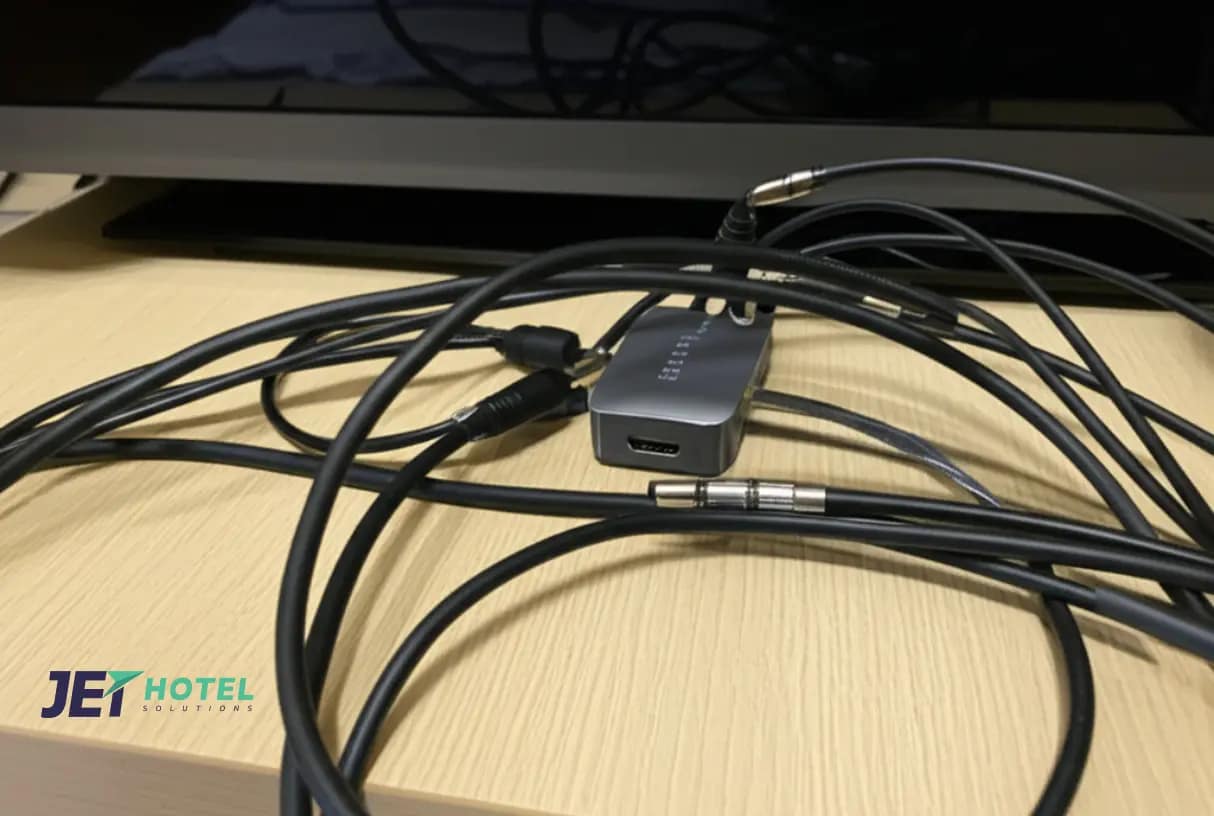
HDMI to coax for hotels is a signal-design question, not a search for a passive adapter. A hotel adding a shared welcome channel to its existing room-TV lineup needs a different system from a property sending one media player to a distant lobby display. Reusing coax for Ethernet is a third task. QAM modulators, matched HDMI extenders and MoCA adapters can all involve coax, but they do not do the same job.
The best HDMI-to-coax solution for a hotel depends on the result required:
- Shared room-TV channel: Evaluate an encoder/RF modulator with the TV provider.
- One distant HDMI display: Evaluate a matched extender for that route.
- Ethernet over existing coax: Evaluate a network-over-coax design, not an HDMI converter.
Ask bidders to identify which result they are pricing before comparing equipment.
Which HDMI-to-coax architecture fits the hotel?
Shared room-TV channels: HDMI encoding and RF modulation
A headend encoder/modulator takes an authorized HDMI source, compresses its video and audio, and creates an RF television channel. A hotel-owned welcome video or event-information feed can then join a compatible coax TV lineup. Several centralized sources can become several channels that guests select with their room remotes.
The ZeeVee HDbridge3000 3KHVE2R module has two HDMI inputs up to 1080i/1080p and MPEG-2 RF output configurable for QAM or DVB-T/C. The HDbridge3000 chassis supports up to 24 HD RF channels when appropriately populated, while optional IP streams depend on the selected modules.
For a smaller source count, Thor H-1HDMI-QAM-IPLL combines one HDMI input with RF, IP and ASI outputs, with MPEG-2 or H.264 encoding options. Its documented North American QAM option is J.83 Annex B, while the exact output format, firmware and television decoding support still need to match.
This is shared-channel distribution, not an individual streaming session in every room. If a headend receiver changes its selected program, TVs tuned to that distributed source see the change. A modulator alone does not provide guest-specific casting, an interactive guide or a return-control path. Compare the wider hotel cable TV distribution system, not just the encoder.
One distant display: matched HDMI-over-coax extension
A point-to-point extender is different: its receiver recreates an HDMI output for the display rather than creating a channel for the television’s RF tuner. This can suit a defined lobby-signage run where an existing coax route connects the media player and screen.
The MuxLab 500465 datasheet documents a transmitter/receiver system with a 1080p reach of up to 250 feet over RG59 or 300 feet over RG6 under its stated conditions. Its installation guide explains the HDMI-to-SDI-to-HDMI transport and specified receiver cascading.
That is not permission to connect an ordinary CATV splitter tree or every existing amplifier between the endpoints. This older documented model illustrates the architecture, not a new-product or stock recommendation. Confirm the actual transmitter, receiver, resolution and cable route before selecting a current solution.
Ethernet over existing coax: MoCA networking
A MoCA adapter bridges Ethernet across suitable coax; it does not accept HDMI or create a television channel. The ScreenBeam ECB7250, for example, is a MoCA 2.5 adapter with a 2.5GbE port and support for up to 16 MoCA nodes. Its home-network positioning and node limit should not be mistaken for an engineered 100-room hotel network.
IP-based television would still need compatible room endpoints and a correctly designed network. The manufacturer warns of satellite-network incompatibility and possible DOCSIS 3.1 frequency overlap. Throughput depends on the plant; advertised speed is not a guaranteed per-room result. Assess spectrum, splitters, amplifiers, security and segmentation rather than assuming that any working TV coax also supports the proposed data network.
Will the existing guest-room TVs receive the new channel?
The RF connector is only the start. Each TV or set-top box must support the configured modulation standard, channel plan, video codec and audio format. North American QAM, DVB-C and terrestrial formats are not interchangeable labels. A television that tunes one RF format may not decode another encoder’s video or audio.
Coax is not inherently analog-only: it can carry digital RF television or, in a compatible design, network traffic. Equally, an HD encoder does not turn a source into 4K. Check encoded output resolution and frame rate separately from accepted HDMI input; they are not necessarily identical. Test the intended source on the actual guest-room TV models, including channel selection, audio, captions and recovery after a power cycle.
What changes when the coax plant is reused?
A welcome channel must coexist with the existing lineup without frequency collisions or unsuitable signal levels. Cable condition, connector quality, splitters, taps and amplifiers affect that result. Test both nearby and distant room drops; a successful screen beside the headend is not proof that the entire property works.
Content permission is a separate boundary. An HDMI socket or a manufacturer’s HDCP statement does not itself establish hotel redistribution rights. Protected subscription sources need provider-approved equipment and confirmation of the commercial use and distribution arrangement. JET’s Free-to-Guest TV services are the relevant starting point for a broader programming discussion; this article does not recommend bypassing DRM.
Compare the complete HDMI-to-coax retrofit quote
Ask bidders to price the same result and document these four items:
- Source-to-screen scope: Identify authorized HDMI sources, simultaneous channels or displays, retained TV models and room count.
- Equipment and installation: List headend modules, required receivers, power, coax repairs, splitter/amplifier changes, programming and room access. Mark exclusions.
- Compatibility proof: Name the proposed models and formats. Require a pilot using the actual HDMI source, guest-room TVs and representative coax routes—not just a brochure.
- Cost and ownership: Separate survey, installation and commissioning from recurring programming, licensing or support. Identify who fixes failed tests and supports the complete path.
Compare reuse and replacement against the same service requirement. A cheaper converter may still require cable repairs or room visits. Include those costs in the hotel low-voltage scope.
Accept the new channel before property-wide rollout
For an RF-channel addition, agree on a pilot and rollback plan. Check the new feed and existing lineup on representative nearby and distant drops. Record the source/encoder/TV models, picture, audio, required captions, channel selection, restart behavior, agreed signal measurements and unresolved defects.
Personalized menus or casting require a wider design: see the hotel IPTV system checklist. For a retrofit scope review, request a free hotel IT budget with your plans, room count and TV inventory. JET will confirm the delivery timeline after reviewing the project.