
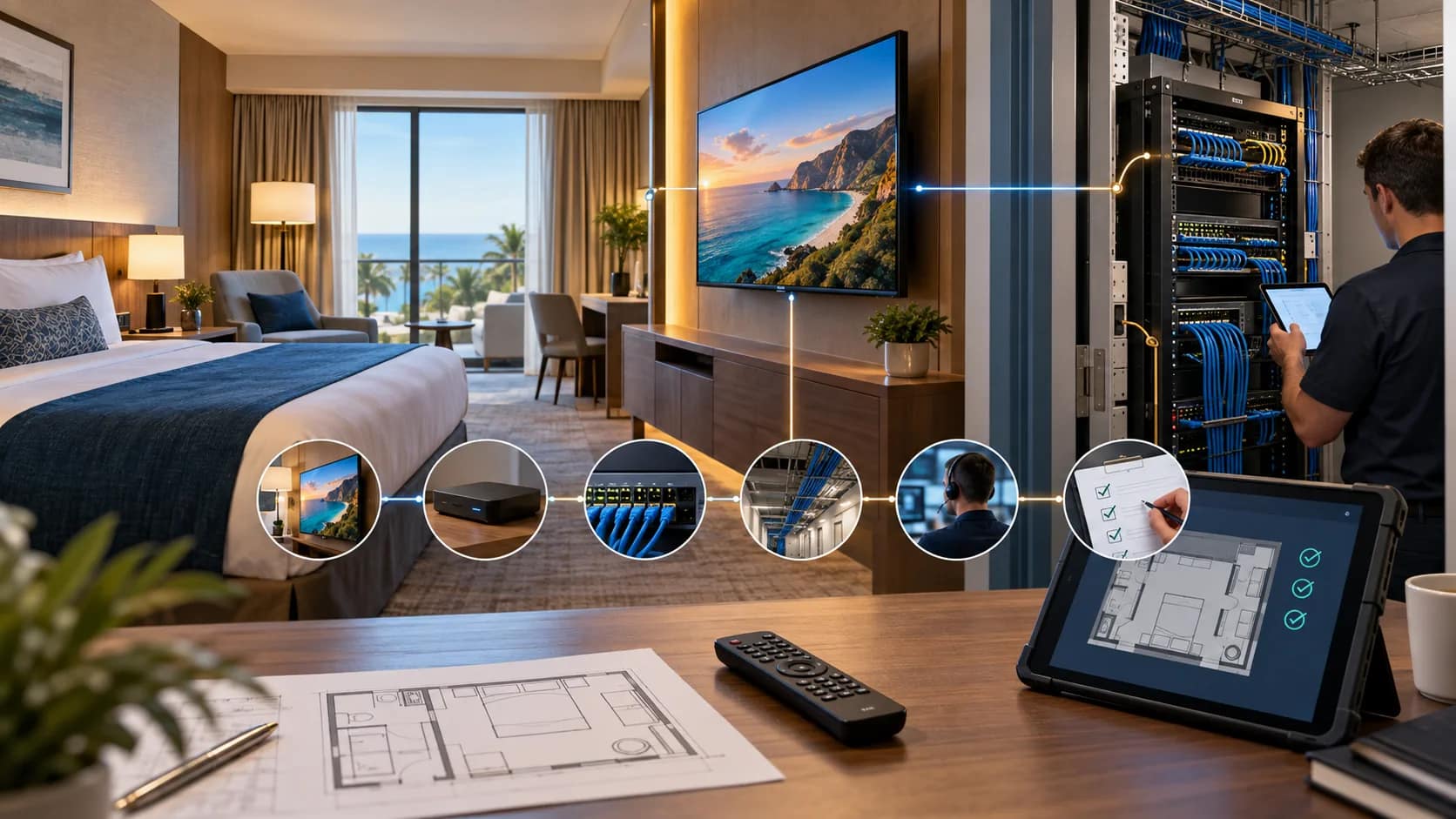
Hotel IPTV system decisions should be reviewed as a full guest-room operating path, not just a television feature or a middleware line item. A platform may promise live channels, guide data, welcome screens, casting, messaging, apps, analytics, or remote management, but the hotel still has to prove that the network, room hardware, privacy reset, support model, and acceptance test all work together.
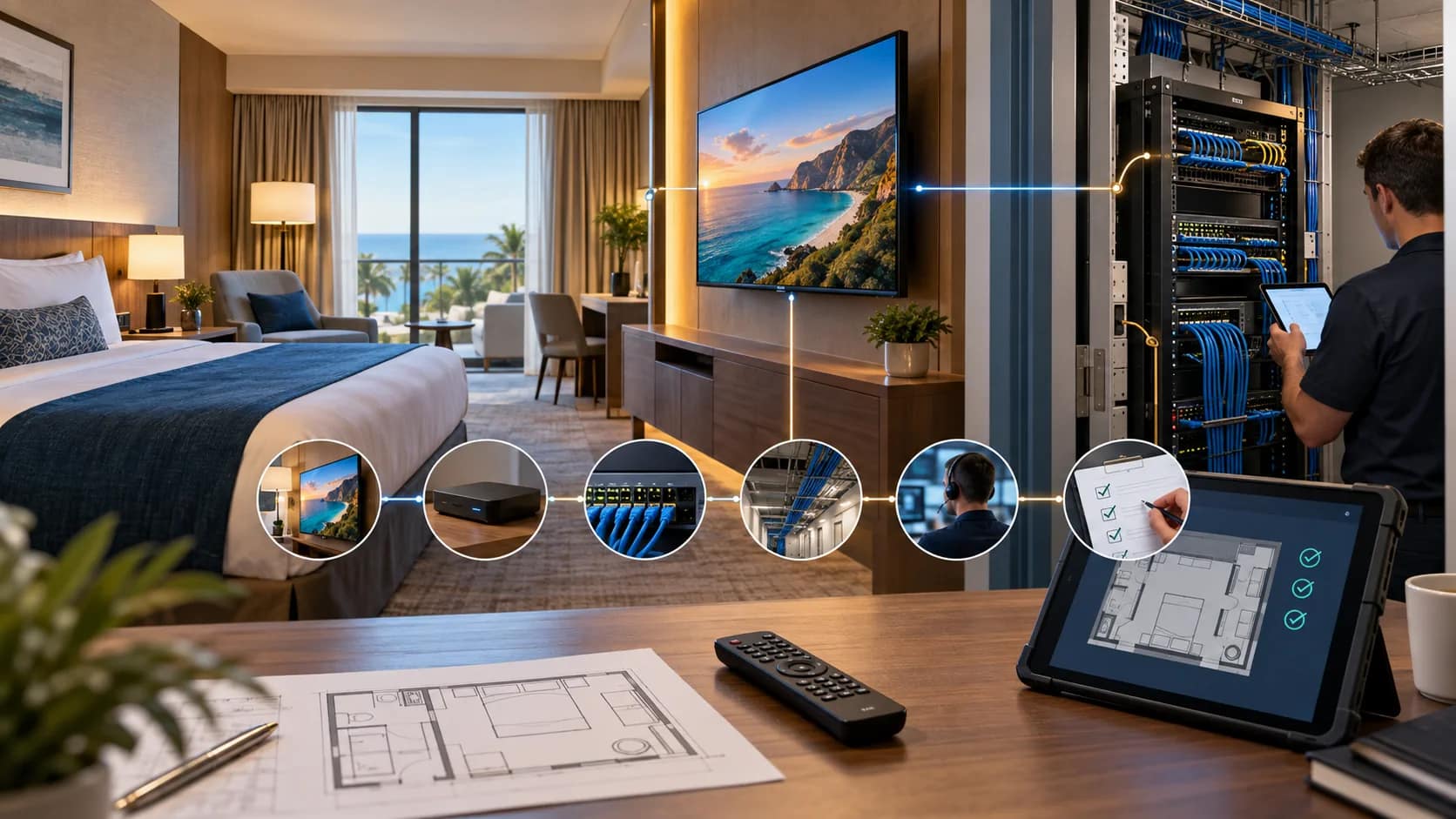
That matters because hotel television projects are no longer isolated screen purchases. IPTV can touch guest Wi-Fi, wired network ports, switches, VLANs, internet capacity, FTG content, casting privacy, PMS or guest-app integrations, room controls, remote support, brand standards, low-voltage pathways, and front-desk troubleshooting. If those dependencies are not named before the contract is signed, the hotel may end up with a working demo and a difficult rollout.
This checklist gives owners and operators a practical way to compare IPTV proposals before a refresh, renovation, brand conversion, or new opening.
Start with the guest-room outcome
Do not begin with the feature list. Begin with what the guest and property team need the room to do. Will the room offer only linear television, or will it include an interactive guide, property messaging, casting, streaming app access, language options, group or event content, local information, checkout prompts, or service requests?
Write the desired room experience in plain language before evaluating vendors. Then ask each provider to show which parts are included, which require integrations, which depend on brand approval, and which depend on the property’s network or cabling. A clean proposal should connect every guest-facing promise to the equipment, configuration, content source, and support owner behind it.
JET’s Free-to-Guest TV services are reviewed from that operating view because content delivery, television hardware, network readiness, and support ownership have to work as one system once guests occupy the room.
Separate IPTV, FTG, casting, and smart TV scope
The words IPTV, FTG, casting, and smart TV are sometimes used as if they describe the same project. They do not. Traditional Free-to-Guest television focuses on reliable channel delivery. IPTV usually adds an IP-based content and control path. Casting lets guests use their own devices. Hospitality smart TVs may include built-in apps, management tools, or brand-specific features.
Before approving a proposal, separate the scope into clear categories:
- Live channel delivery, guide data, local channels, and premium-content authorization
- IPTV middleware, server, cloud platform, set-top box, or boxless architecture
- Casting, pairing, checkout reset, and guest-device isolation
- Hospitality TV model, firmware, remote, mounts, and room configuration
- PMS, guest app, welcome screen, messaging, or room-control integrations
- Remote management, monitoring, alerting, and help-desk visibility
- Licensing, subscriptions, support, warranties, and renewal dates
Once the categories are visible, owners can compare proposals honestly. A lower television price may exclude the platform, content path, room testing, or support work that actually determines whether the guest experience succeeds.
Prove the network path before the room rollout
A hotel IPTV system usually depends on the property’s network design. That can include the internet circuit, headend or cloud path, MDF and IDF switches, room drops, VLANs, multicast or unicast assumptions, bandwidth headroom, Wi-Fi support for casting, firewall rules, and remote vendor access.
Ask the provider to draw the path from content source to guest screen. The drawing should show where the service enters the property, what equipment lives in the closet, how rooms connect, what traffic is separated, what depends on Wi-Fi, and who can see or change the system remotely. The goal is not to overcomplicate the decision; it is to avoid approving a TV platform that the building cannot reliably support.
The same room-readiness discipline applies to the broader hotel guest room TV readiness checklist. The owner needs one acceptance path that covers the television, content, network, privacy reset, remote, room documentation, and support workflow.
Check guest privacy and checkout reset early
Guest privacy is one of the easiest areas to under-test. Casting and app-based experiences can be useful, but the property needs to prove that device pairing, account access, viewing history, and room association reset after checkout or room move. It is not enough for the feature to work in a demo room.
Build a test case for checkout reset before approving the rollout. Pair a device, cast content, simulate checkout, verify the reset, move to a new reservation state, and confirm the next guest cannot see or control the previous guest’s session. Also confirm what the front desk should do if a guest reports a pairing problem, lost remote, app issue, or content-access error.
AHLA’s HTNG program provides hospitality technology resources and industry collaboration around hotel systems at AHLA HTNG. For owners, the practical lesson is to treat integrations, privacy, support, and operating standards as part of the technology decision instead of leaving them to separate vendors.
Use a pilot room before releasing the full order
A pilot room should use the same TV model, mount, remote, network path, content source, casting method, configuration, room signage, and support process planned for the full deployment. A bench test or vendor demo is useful, but it cannot replace a representative hotel room.
The pilot should test at least these items:
- Power, mount, cabling, wall plate, and remote behavior
- Channel lineup, guide, local channels, and content authorization
- IPTV interface loading speed and recovery after reboot
- Casting pairing, guest-device isolation, and checkout reset
- Wi-Fi and wired performance during peak assumptions
- Front-desk troubleshooting steps and escalation path
- Remote management, firmware updates, and monitoring visibility
- Brand or owner signoff evidence before the full order is released
If the pilot fails, the hotel still has time to adjust the design, scope, schedule, or commercial terms. If the issue appears after hundreds of rooms are installed, every fix is slower and more expensive.
Name the support owner for each failure mode
When a guest says the TV is not working, the front desk does not care whether the root cause is content authorization, network congestion, Wi-Fi pairing, a bad remote, middleware, PMS integration, firewall rules, or a television firmware issue. The property needs a simple first response and a clear escalation path.
Ask vendors to name ownership for common failure modes. Who answers first? What can the property team fix locally? What evidence does support need? What is monitored automatically? Who contacts the content provider, network provider, TV manufacturer, casting vendor, or low-voltage contractor? What is the after-hours process?
The best IPTV proposal is not the longest feature list. It is the one that helps the hotel keep rooms in service, reduce guest frustration, and avoid vendor finger-pointing when something breaks.
Compare total cost beyond the screen
Owners should compare the full system cost, not only television unit price or platform subscription. Include mounts, remotes, spare stock, headend or cloud equipment, network upgrades, cabling fixes, switch ports, licenses, content fees, casting licenses, professional services, room labor, training, warranty, support, and renewal terms.
Also review timing. A project can fail financially when equipment arrives before rooms are ready, when the network upgrade slips, when licensing terms start before opening, or when the installer cannot access rooms in the sequence the hotel expected.
A practical commercial review should answer: what are we buying, what does it depend on, what is excluded, when does billing start, who supports it, and what evidence proves the room is accepted?
What JET reviews before a hotel IPTV system approval
JET Hotel Solutions helps hotel owners and operators review the technology foundation behind guest-room television decisions. For a hotel IPTV system, that typically means checking FTG and IPTV direction, hospitality TV model fit, room infrastructure, network readiness, Wi-Fi or casting assumptions, content path, low-voltage readiness, procurement timing, support ownership, and acceptance evidence.
The goal is not to make the project more complicated. The goal is to make the decision clear before purchase orders, room work, and vendor schedules are locked.
If your hotel is comparing IPTV, FTG, casting, or a hospitality TV refresh, request a hotel IPTV and guest-room TV readiness review before the proposal becomes the operating plan.