
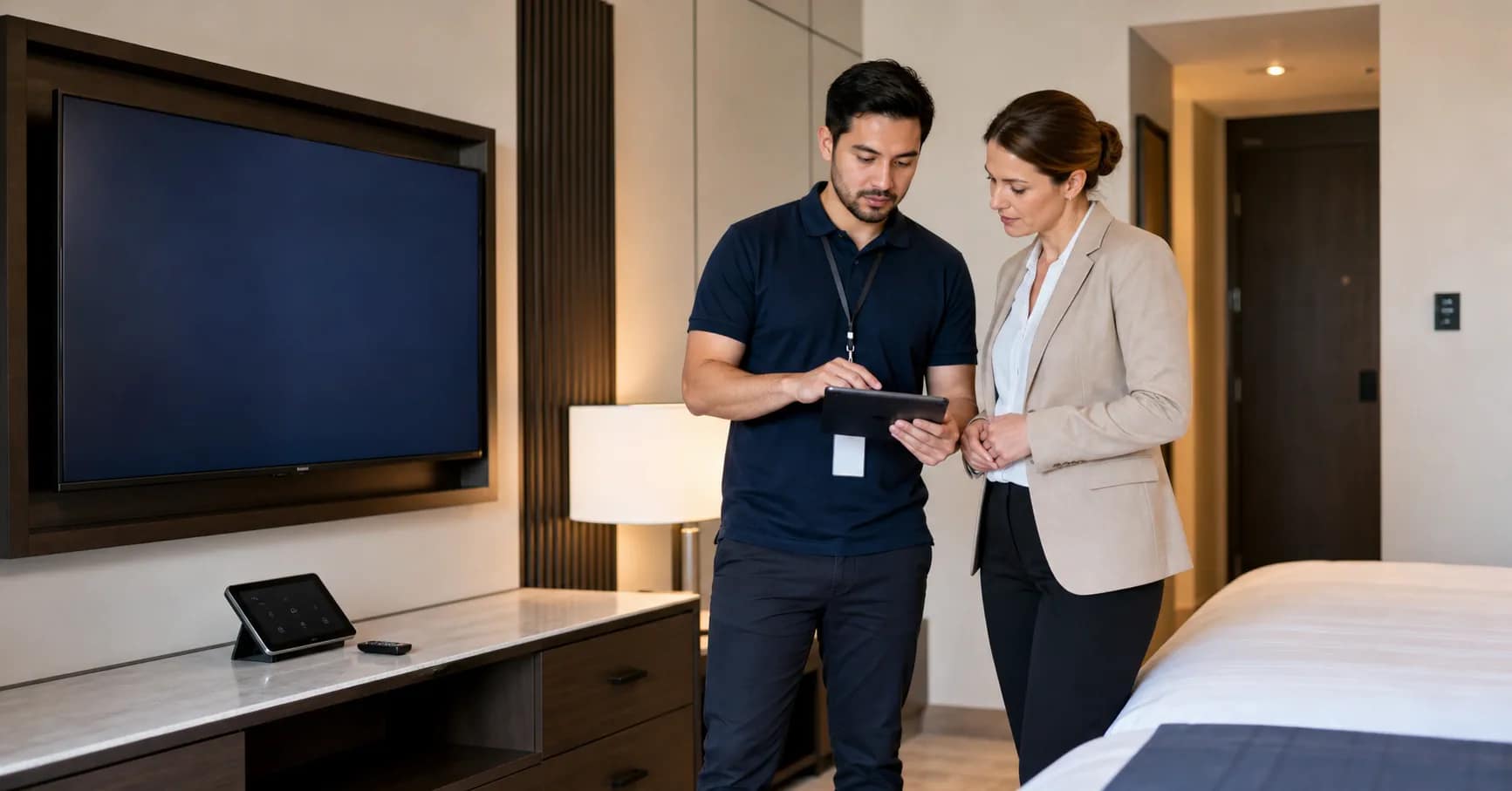
A hotel guest room TV readiness checklist should prove more than power, picture, and a remote that changes channels. The guest-room screen now sits inside a larger operating path: free-to-guest TV, IPTV, casting, network access, PMS or guest-app dependencies, welcome messaging, privacy reset, remote support, and the first front-desk response when something fails.
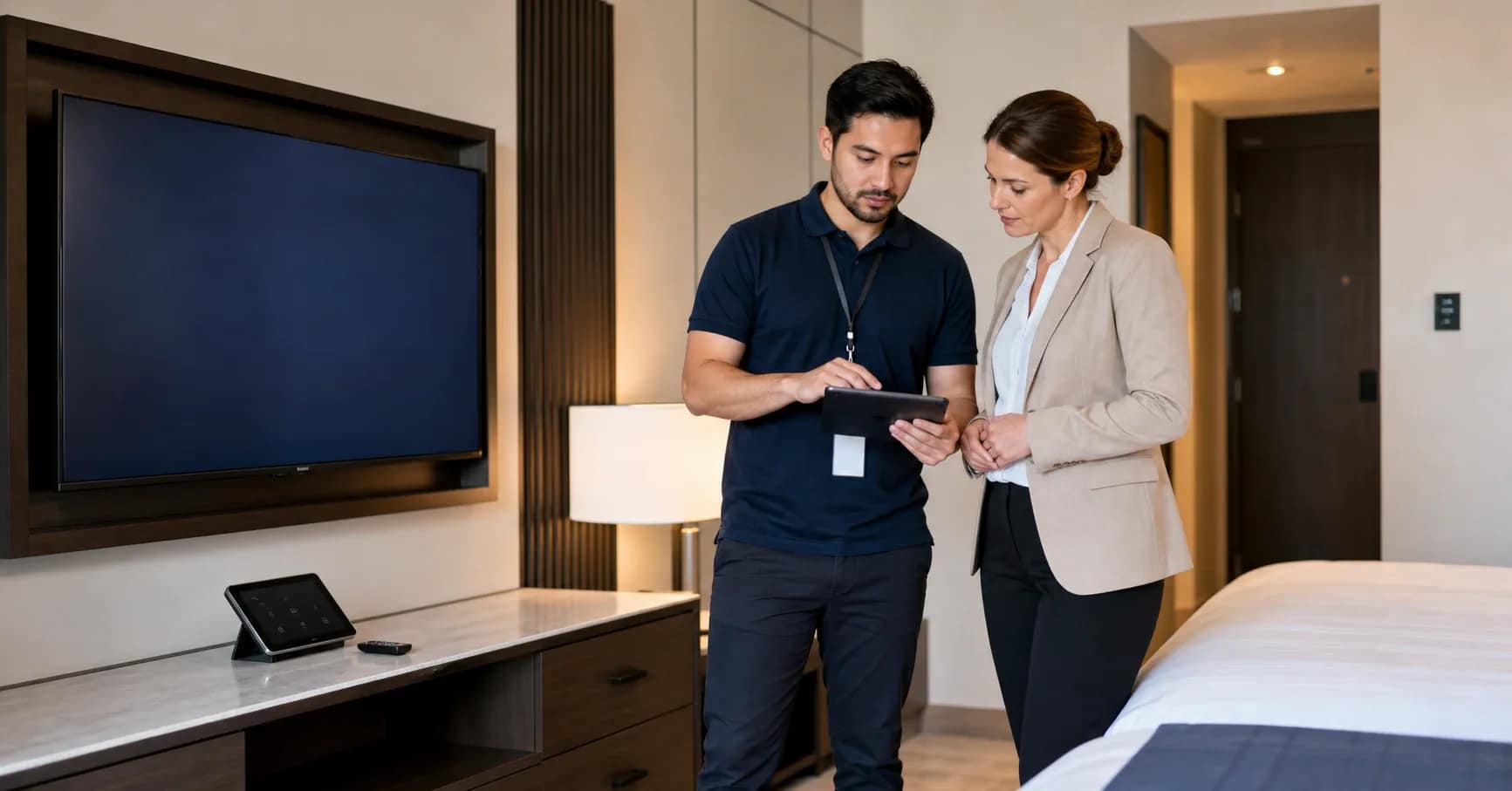
That is why the best acceptance question is not, “Does the TV turn on?” It is, “Can the property release this room knowing the guest experience, privacy state, and support path are all ready?”
For hotel owners and management teams, this matters before a renovation closeout, brand inspection, new-build opening, guest-room refresh, or vendor transition. If the room is accepted only by checking the screen, the hotel may inherit problems that do not appear until the first guest tries to cast, opens the wrong app, sees the previous guest’s session, or calls the front desk after checkout turnover.
Start with the guest-room TV path, not the device
If the property is evaluating IPTV, this hotel IPTV system checklist helps owners compare platform scope against the real room, network, and support path.
The TV is the visible endpoint. The operating path includes the signal source, channel lineup, IPTV app, casting gateway, network segment, room mapping, remote-control behavior, support owner, and reset logic. Owners should require one room-ready record that connects those pieces before releasing rooms in batches.
If the property is using a traditional free-to-guest TV model, acceptance should confirm the approved channel lineup, headend or provider handoff, guide behavior, emergency or brand-required channels, and the support path when a channel goes missing. If the property is using IPTV or casting, acceptance also needs to prove that the room, guest device, TV endpoint, and network rules match the intended guest journey.
AHLA has highlighted guest-room entertainment as a real guest-experience category, not a back-office technology footnote. Its hospitality guest-room entertainment research notes that streaming, mobile devices, and changing home entertainment habits affect what travelers expect when they are in a hotel room. That context is useful for owners because the operational standard has moved beyond “the television works.”
Confirm the room loads the right entertainment experience
Begin with the basics, but document them. The TV should power on cleanly, land on the correct welcome state, show the right property or brand experience, load the expected channel lineup or IPTV application, and respond consistently to the approved remote. If the room uses a casting portal, the guest should be able to reach the correct pairing flow without confusion or extra staff intervention.
The team should test from the guest’s normal position in the room, not from the rack room or a vendor laptop. Use the same Wi-Fi network, device type, remote control, QR code, welcome screen, and in-room instructions that a guest will see. Record the room number, TV endpoint, network name, test device, result, exception, and owner for each failed step.
Prove casting resets after checkout
Privacy reset is one of the most important checks in a modern room-TV acceptance plan. A guest should not be able to see another guest’s account, watch history, paired device, app session, room code, or welcome-state information. The hotel should test checkout, room move, and power-loss scenarios before accepting the system.
A simple field test is useful: pair a device, stream content, stop the session, simulate checkout or room turnover, then confirm the next arrival sees a clean room state. If a guest moves from one room to another, the original room should no longer expose the prior session, and the new room should become eligible for the correct guest. If power is removed and restored, the TV or casting receiver should return to the approved hotel state.
This is where room entertainment connects directly to the property’s guest Wi-Fi design. Casting and IPTV often depend on correct segmentation, isolation, DNS behavior, gateway rules, and room mapping. A clean TV test without the real guest network is not enough.
Check the support path before the first guest call
Even a well-installed room system will fail somewhere. The practical question is whether the front desk, engineering team, IT contact, and vendor know what happens first. Before rooms are released, the hotel should define what the front desk asks, what engineering checks, what evidence gets captured, when the vendor is contacted, and who confirms the issue is closed.
For example, if a guest says the TV will not cast, the first response should separate common failure paths: wrong network, stale pairing code, incorrect room mapping, isolated endpoint, app problem, or larger network issue. If the guest says channels are missing, the first response should separate TV endpoint, provider lineup, headend, app, and room-specific issues. Without that decision tree, every complaint becomes a slow handoff.
Use a representative-room acceptance record
One representative-room release walk can prevent a lot of rework. Pick a real room, use real guest instructions, and move through the entire path: power-on, welcome state, channel lineup or IPTV app, casting, checkout reset, remote behavior, front-desk support script, engineering evidence, vendor escalation, and closure. Then repeat exceptions in a second room type if the property has meaningful differences in layout, network path, TV model, or content source.
The record does not need to be complicated. It should answer six questions:
- What room and TV endpoint were tested?
- Which source, app, casting path, or channel lineup was expected?
- What device and network were used for the guest test?
- Did checkout or room-move reset remove prior guest state?
- Who owns the first response when the room fails?
- What exceptions remain before more rooms are released?
Do not let separate proposals hide one operating problem
Guest-room TV projects often cross several proposals: television hardware, low-voltage cabling, network access, IPTV platform, casting system, brand standards, PMS integration, remote management, and support. Each vendor may complete its assigned work while the hotel still lacks one verified guest-room experience.
That is why JET treats room technology as an operating path, not a pile of line items. The owner needs enough evidence to know the room is ready for guests and enough documentation to know who responds when it is not.
If your hotel is refreshing TVs, adding casting, moving to IPTV, opening a new property, or cleaning up a vendor handoff, talk with JET about reviewing the guest-room TV readiness plan before rooms are released.