
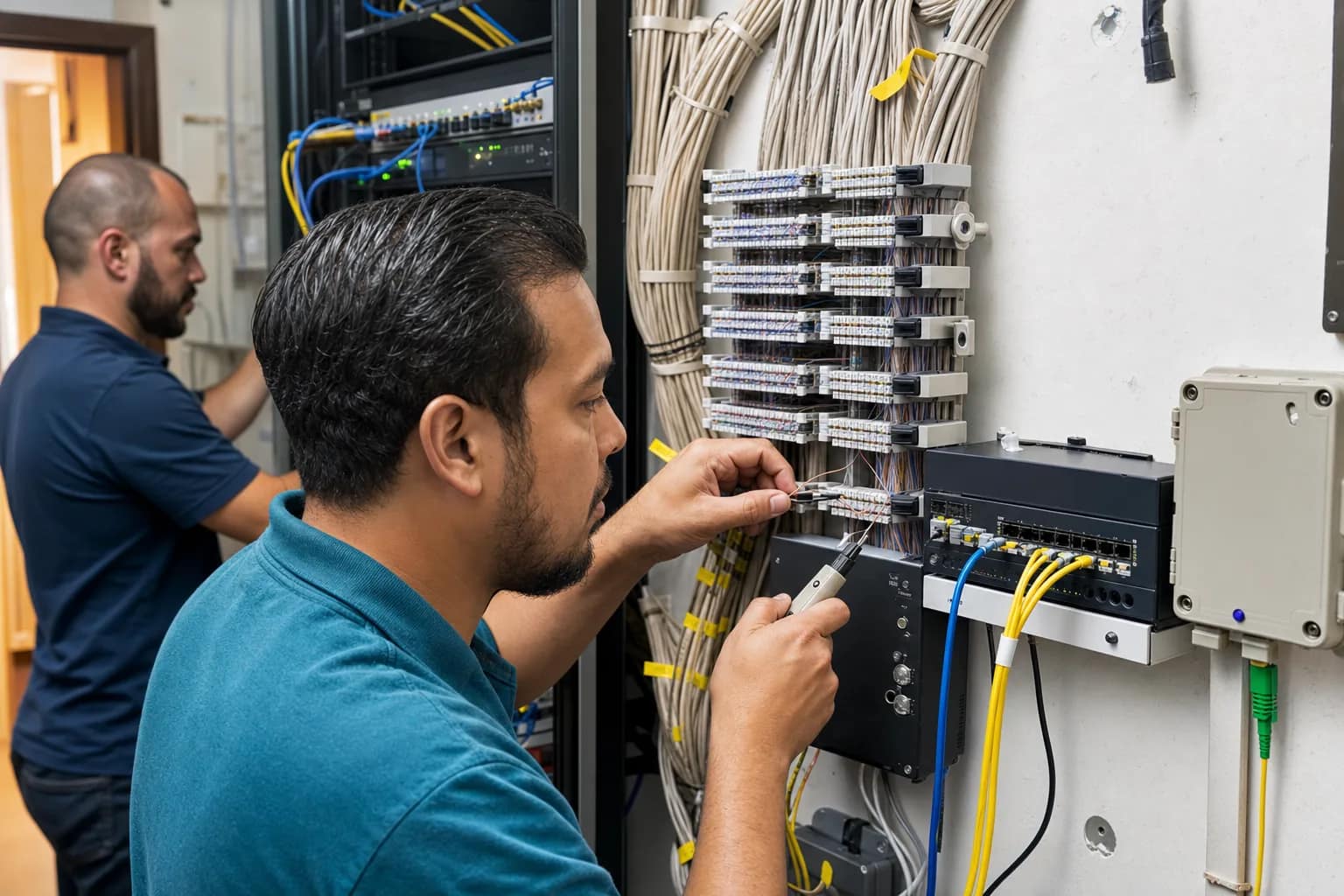
A hotel PBX cutover can look ready because the phones are on-site and the vendor has a date.
That is not the same as being ready to go live. The schedule can still depend on number ownership, carrier work, SIP or internet service, E911 location records, analog devices, MDF and IDF cross-connects, PMS integration, room access, and a property team that knows exactly what to test.
The most useful cutover document is therefore not a product list. It is a dependency register with one owner, one due date, and one acceptance result for every item that can interrupt hotel operations.
Do not lock the PBX cutover date until every external dependency has a named owner and an evidence-based signoff.
Why hotel PBX cutovers carry unusual operating risk
A hotel voice environment touches more than guest-room handsets. It can support the published hotel number, front-desk call routing, back-office extensions, wake-up calls, voicemail, message-waiting indicators, room status, elevator and pool phones, fax, emergency calling, and other property-specific endpoints.
Those functions may be split across the PBX vendor, carrier, internet provider, network team, low-voltage contractor, PMS vendor, elevator or life-safety vendors, brand, management company, and hotel staff. A task can be technically complete for one party while the end-to-end hotel workflow is still untested.
This hotel PBX cutover checklist is designed as an owner-side go-live gate. It does not replace the detailed implementation plan from the selected vendors. It gives ownership and hotel operations a practical way to decide whether the date is genuinely ready.
9 PBX dependencies to clear before go-live
1. Freeze the complete number inventory
Start with every number and service that the property expects to retain, replace, reroute, or disconnect. Include the main published number, direct inward dial numbers, toll-free numbers, fax numbers, elevator or emergency lines, alarm-related services, and any number used by a third-party platform.
For each item, record the current carrier, account name, service address, billing telephone number, porting status, target route, and person authorized to approve the change. Confirm that the submitted port list matches the final inventory and that no partial range or overlooked service will be stranded.
The acceptance evidence should be more specific than “port submitted.” Ownership should be able to see the confirmed port date, exceptions, rejection risk, temporary forwarding plan, and escalation contact.
2. Confirm carrier, circuit, network, and remote-access readiness
Document how the new system reaches the public telephone network and how the vendor reaches the system for commissioning and support. Depending on the design, that may involve SIP trunks, a dedicated voice circuit, the hotel internet connection, static IP addresses, firewall rules, VLANs, quality-of-service settings, or a vendor-provided edge device.
Confirm that the required service is installed, tested, and available in the correct telecom room. Verify demarcation extensions, patching, power, grounding, rack space, network ports, and credentials. If the PBX depends on the property network, identify what happens during an internet, firewall, switch, or power failure.
A carrier order number is not a cutover test. The go-live gate should require an end-to-end call path and a named escalation route for both the carrier and network team.
3. Make the MDF, IDFs, cabling, and cross-connect plan executable
The installation team should not arrive to discover unlabeled room pairs, incomplete riser terminations, inaccessible closets, missing backboards, or a gateway location that cannot reach the required cable field.
Before the date is approved, confirm the PBX and gateway locations, MDF and IDF access, rack or wall space, power and UPS requirements, pair counts, patch panels or blocks, riser paths, cable labels, room-number mapping, and responsibility for every cross-connect.
If existing cable will be reused, define what test proves it is acceptable and what happens when a room fails. A list of failed rooms, spare capacity, repair owner, and change-order rule is more useful than a broad assumption that existing wiring is usable.
4. Separate guest-room phones from special analog endpoints
Build an endpoint inventory by function, not only by quantity. Guest-room phones, front-desk phones, office phones, pool phones, elevator phones, fax machines, gate or door phones, alarm dialers, and other analog devices can have different power, signaling, supervision, testing, and regulatory requirements.
Identify which devices move to the new PBX, which use analog gateways or replacement services, and which remain under a specialized vendor. Do not assume that every analog line can be migrated through the same adapter or tested by the PBX installer.
For elevator, fire, security, and other life-safety-related systems, require the responsible licensed vendor and authority having jurisdiction to confirm the applicable design, test, and documentation requirements.
5. Approve the emergency-calling and location-data plan
Emergency calling needs its own acceptance plan. The FCC explains that Kari’s Law applies to qualifying multi-line telephone systems, including systems used by hotels, and requires direct 911 dialing and notification when a 911 call is made. The FCC’s rules implementing Section 506 of RAY BAUM’S Act also address the dispatchable location information conveyed with 911 calls.
Review the FCC’s Kari’s Law and RAY BAUM’s Act fact sheet with the hotel’s qualified legal, telecom, and emergency-services advisers. The property-specific plan should identify the location information associated with each applicable endpoint, the on-site notification recipients, callback routing, off-hours behavior, and the approved method for controlled testing.
Do not treat a single successful 911 call as the whole signoff. Confirm direct dialing, notification, callback, location data, room or area mapping, and records showing which endpoints were tested and by whom.
6. Test the PMS interface and hotel call workflows
A PBX can place calls while still failing the workflows the hotel depends on. Confirm the PMS interface method, vendor responsibility, credentials, licensing, network path, room and extension mapping, and the exact events exchanged between systems.
Build tests around the operating model: check-in and checkout, guest name or room mapping where applicable, room status, voicemail reset, message-waiting indicators, wake-up calls, call restrictions, front-desk transfers, auto-attendant routing, after-hours calls, and any call-accounting requirement.
If a function is being retired, record that decision and train the property before go-live. Silence after cutover should not be the first indication that a familiar workflow was excluded.
7. Reconcile equipment, licenses, programming, and room access
Match the final design to the physical and licensed inventory. Confirm PBX controllers or hosted licenses, gateways, station ports, SIP channels, administrative phones, guest-room phones, faceplates, power supplies, UPS capacity, network switches, patch cords, mounting hardware, and spares.
Then reconcile the room list. The hotel should know which rooms are occupied, out of order, under renovation, or unavailable during installation. Define how technicians gain access, how completed rooms are marked, how failed rooms are revisited, and who protects or stores delivered equipment before installation.
Programming should also be frozen before the cutover window: extension plan, room mapping, ring groups, auto-attendant, front-desk keys, emergency notifications, outbound permissions, caller ID, and support access.
8. Run a written cutover, validation, and rollback sequence
The schedule should show more than a start time. It should identify the last safe point to stop, the order of carrier and PBX changes, who confirms each milestone, how hotel leaders receive status, and what conditions trigger rollback.
Create a test matrix that samples every important endpoint type and call path. Include inbound calls to published numbers, outbound local and long-distance calls, guest room to front desk, front desk to room, transfers, voicemail, wake-up calls, PMS functions, emergency-calling controls, elevator or pool endpoints under the responsible vendor, and behavior during a planned failure test when appropriate.
Record the expected result, actual result, tester, timestamp, issue owner, and retest outcome. “Vendor tested” is not enough for an owner acceptance record.
9. Name the support bridge, closeout package, and first-week owner
The team that installs the system may not be the team that supports it after the first night. Before go-live, publish the escalation order for hotel staff, PBX support, carrier support, network support, PMS support, and on-site field service. Include account numbers, support contracts, case-opening methods, response expectations, and after-hours contacts.
The closeout package should include the final number and extension inventory, device and license records, configuration backup, network and carrier diagram, E911/location documentation, room test results, open punch items, warranties, training record, support contacts, and the owner of each remaining issue.
Assign one person to review failures and support cases during the first week. That short operating period often reveals routing, room-mapping, notification, or staff-training issues that were not visible in a controlled cutover test.
The owner-side PBX go-live gate
Connect the cutover record to the hotel’s broader hotel IT support escalation plan so voice, switching, carrier, and after-hours responsibilities remain visible after go-live.
Before ownership releases the final cutover date, the project record should answer these questions:
- Is the final number inventory approved, and is the porting evidence complete?
- Are carrier, circuit, network, firewall, power, and remote-access paths tested?
- Are MDF, IDF, cabling, labeling, and cross-connect responsibilities closed?
- Is every guest-room, administrative, analog, elevator, pool, fax, and special endpoint assigned to the correct vendor and test?
- Are emergency dialing, notification, callback, and dispatchable-location requirements approved and documented?
- Has the PMS interface passed the hotel’s actual operating workflows?
- Do equipment, licenses, programming, room lists, and access plans reconcile?
- Does the written cutover include acceptance criteria, rollback triggers, and hotel status updates?
- Are support escalation and closeout ownership clear for the first week?
If any answer is “pending,” show the owner, due date, impact, and decision required. That is value engineering in practice: make the real dependency visible early enough to protect the schedule, hotel operations, and budget.
Treat the cutover as an operating decision
A hotel PBX project is not finished when equipment arrives or extensions appear on a screen. It is ready when the complete hotel call path has been tested, every exception has an owner, and operations know how to respond if something fails.
JET Hotel Solutions helps hotel owners coordinate PBX and phone procurement with carriers, low-voltage infrastructure, network access, PMS dependencies, vendor schedules, room access, testing, project reporting, and closeout. The goal is a cutover the property can approve with evidence rather than hope.