
Quick answer: AtlasIED AZM8 provides eight audio zones and a room-combine function for spaces that change configuration. For a hotel with divisible meeting rooms, the useful question is not simply how many speakers fit. It is what happens to each room’s source and volume when a partition opens, and what returns when it closes. The processor, amplifier, conferencing equipment and control design remain distinct parts of the scope.
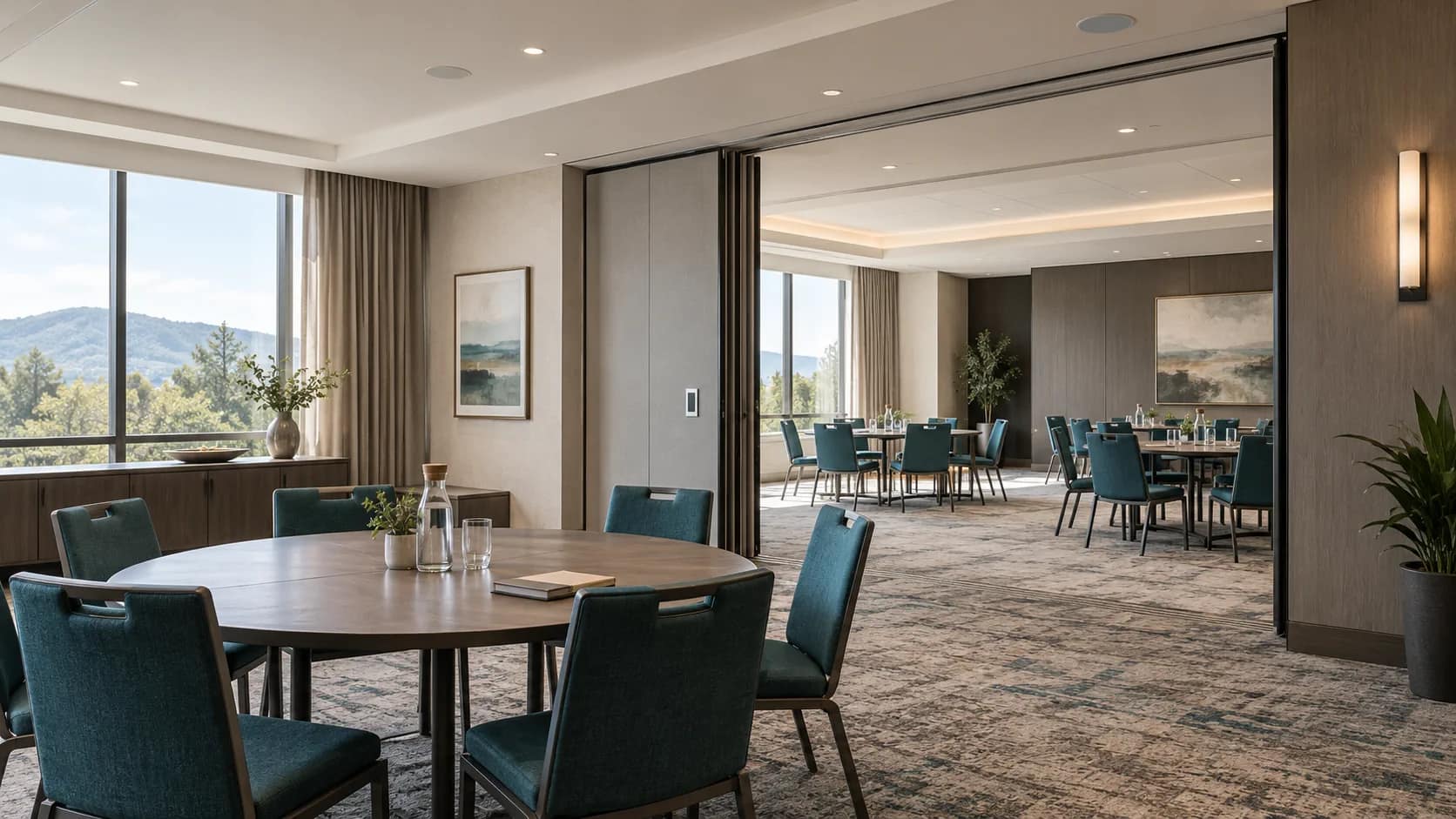
Consider a conference suite with three meeting sections, plus separate lobby and restaurant music. A breakfast briefing might use one section while another hosts a presentation. Later, two sections become one banquet space. That scenario illustrates why a hotel background music scope needs both a physical layout and an operating model. It is an example, not a claim that JET installed this configuration or that any hotel flag mandates this product.
AtlasIED AZM8 room combine: what changes when rooms join?
The manufacturer’s Atmosphere User Manual, Revision E, page 38 describes groups that combine selected zones. A group can use a common source and level, with individual zone offsets. Activation can be manual, through a general-purpose input, or through configured scheduling and routines. These are configuration options, not proof that a movable wall automatically controls the system.
The manual also distinguishes two un-combine behaviors. Revert restores the previous source and level settings; Release leaves the combined settings in place but allows independent adjustment again. That difference matters when the next meeting starts in only one section. It should be explained in the operator interface, not left as an invisible programming choice.
For the example suite, define independent rooms, joined rooms and the return to independent operation. A shared playlist may suit a banquet, while separate presentations need separate sources. The design should keep lobby music outside the selected meeting-room group. Confirm the installed firmware, supported accessories and documented group limits before selecting the final arrangement.
Eight zones are not eight speakers—or an integrated power amplifier
AtlasIED’s AZM8 product documentation identifies an eight-zone processor with browser-based control and room-combine capability. A zone is an audio-control area, not a speaker-count allowance. One room can require several loudspeakers, while two adjacent spaces may deliberately share a control zone. The speaker layout and electrical load still need their own design.
The manufacturer’s Atmosphere system examples pair AZM processors with separate amplifiers. AZMP models are a different, powered product family. Do not treat an AZM8 quote as a complete speaker-power package. The example conference suite therefore needs coordinated processor outputs, amplifier channels, speaker circuits, mounting and service access.
Reusing existing speakers can be sensible, but their count alone cannot establish compatibility. Circuit topology, speaker taps, amplifier capacity, acoustic coverage and the condition of existing wiring affect the result. A proposal that names a processor without documenting those interfaces has not answered the installation question.
AZM8 vs AZM8-D: Ethernet control is not automatically Dante audio
The AZM8-D product page explicitly identifies Dante networked audio. That suffix matters. A browser-control connection on an AZM8 should not be interpreted as evidence that the base unit offers the same Dante interfaces. Name the actual SKU and the required signal path before comparing proposals.
For a hotel, there are separate conversations about audio transport and access to controls. A tablet adjusting volume does not establish how program audio reaches an amplifier elsewhere in the building. Likewise, introducing Dante does not validate the property’s switching, security or endpoint compatibility. Those requirements belong in the deployment design. Our cloud-managed commercial audio briefing covers another distinct question: how management changes when audio platforms gain cloud services.
A documented hotel example: Hilton Garden Inn La Romana
AtlasIED’s Hilton Garden Inn La Romana case study reports an AZM8 installation serving areas including the lobby, three conference rooms, elevators, pool and gym. It describes different music levels and playlists across hotel spaces. The practical insight is differentiated audio: reception conversation and a livelier restaurant do not need the same soundtrack at the same level.
This is a manufacturer-reported installation by the integrator named in that case study, not a JET client reference, an independent performance test or a Hilton-wide brand requirement. It also does not establish that those conference rooms use movable-wall automation. The case supports hotel relevance; the manual supports the separately described room-combine feature.
Keep the background-music scope connected to construction and events
The original scope decisions still matter. Define the experience by space, zone boundaries, controller locations and speaker placement before finishes close. Coordinate cable pathways, amplifier power, network connections, rack ventilation and maintenance access. A neatly selected processor cannot resolve an obstructed ceiling location or an inaccessible equipment rack.
Retain explicit decisions about music sources, licensing, recurring services and support. The availability of a source input is not permission to play a consumer streaming account in a commercial space. The operator should receive the configured room modes, accessible controls, credentials and a documented way to restore normal operation.
Presentation audio, remote-participant conferencing and emergency announcements need separately defined requirements. Room combine does not, by itself, establish acoustic echo cancellation for video meetings or a code-compliant emergency voice system. State those outcomes independently rather than inferring them from a general DSP label. Our hotel sound-system design and acceptance resource keeps those wider boundaries visible.
Acceptance should exercise the real transition: separate meetings, joined event, then separate meetings again. Observe which source is heard where, whether local controls remain understandable, and what happens when the selected control path is unavailable. Agree on measurable coverage and operating outcomes; do not use a successful music demonstration as evidence that every event mode works.
Bring the actual meeting-room configurations to JET
JET’s A/V with Atlas service page includes divisible spaces, room inputs, controls and architectural coordination. Our hotel low-voltage delivery scope connects that AV discussion to pathways and field work. This spotlight explains one documented product application; it is not a universal recommendation, compatibility guarantee or statement of current stock.
Discuss your divisible meeting-room audio scope with JET. Bring the room layouts, intended combinations, existing speaker circuits, event inputs and exact proposed model. That gives the project team a concrete operating question to answer instead of another generic speaker shopping list.
Technical desk review: October 9, 2026. Sources include current manufacturer product pages, Atmosphere User Manual Revision E and the manufacturer case study. Features and supported combinations must be confirmed against the installed release. Featured image is an AI-generated room concept, not an actual client property or product photograph.