
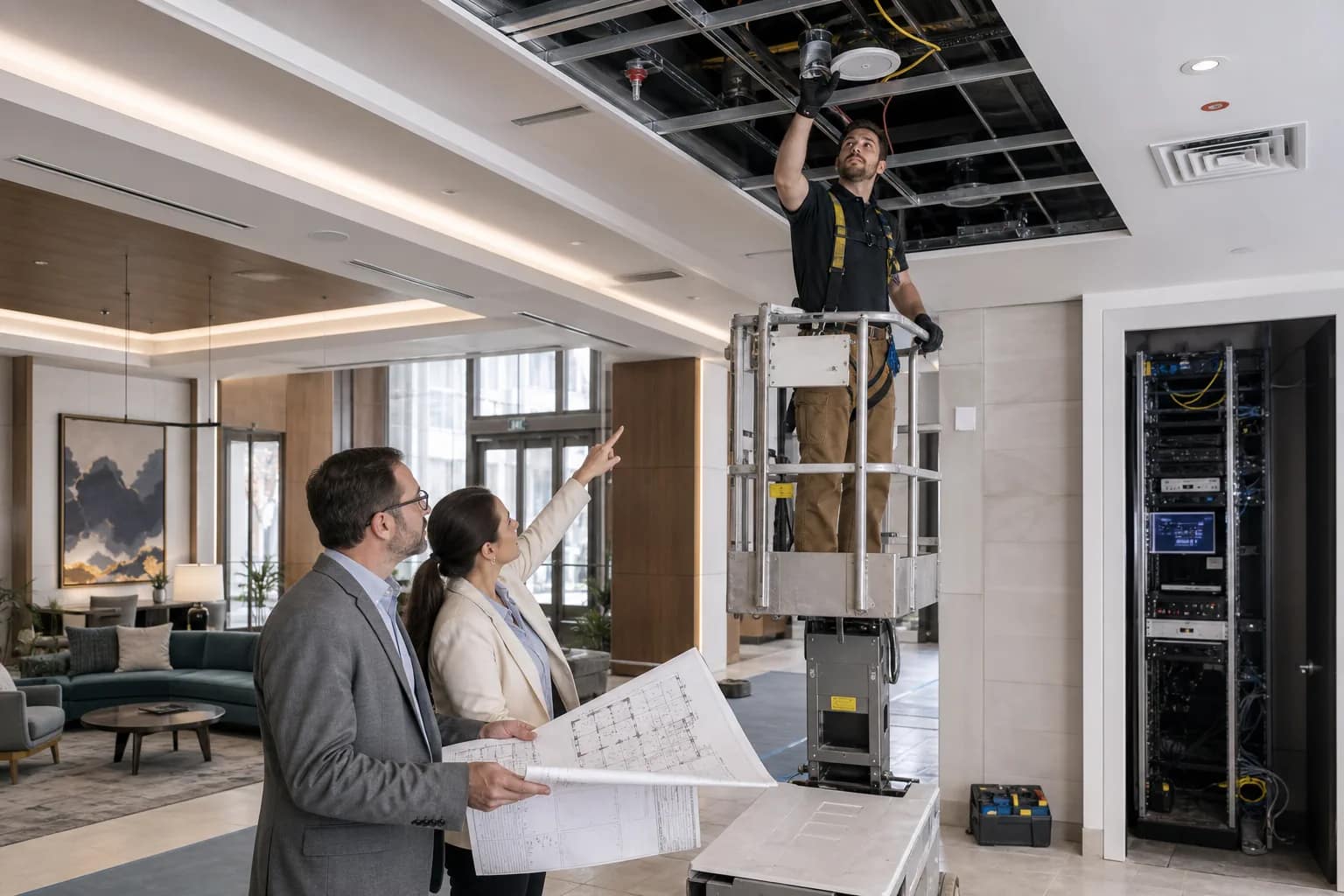
A hotel sound system affects more than background music. It can shape the lobby atmosphere, support restaurant operations, carry paging messages, serve meeting rooms, and become part of an emergency or after-hours response path. Yet many proposals are compared as speaker counts and amplifier sizes instead of as an operating system the hotel must control every day.
Owners should be able to trace the entire audio path: what plays, where it plays, who can change it, what interrupts it, which network and power services it depends on, and how the property proves the finished result is acceptable. The checklist below turns those questions into a practical review before equipment is purchased or final payment is released.
Define every hotel sound system zone
Start with an area schedule, not a product catalog. A hotel lobby, breakfast area, restaurant, bar, pool deck, fitness room, ballroom prefunction area, meeting room, back office, and loading area do not have the same acoustic conditions or operating purpose. Each space needs a named zone, a source, an intended listening level, a control location, and a responsible operator.
This is where the owner should distinguish ambience from paging and event audio. A source that works well for quiet lobby music may not provide intelligible announcements in a busy arrival area. A restaurant may need local volume control, while a public corridor may need locked settings. Writing the zone plan first keeps the design tied to hotel operations instead of letting the equipment list define the experience.
Separate background music, paging, and event audio
Ask the proposal to show which functions share equipment and which remain independent. Background music is usually continuous and low priority. Paging must be intelligible and may need to override music. Meeting or event audio may need microphones, local inputs, assisted-listening support, recording, or temporary production connections.
The priority rules should be explicit. What happens to music when a page starts? Can a meeting-room operator accidentally send audio into the lobby? Does a local restaurant control override a centrally managed schedule? If different vendors own music, life-safety systems, event production, and networked audio, the boundaries should be documented before commissioning.
Make controls simple for hotel teams
A sophisticated interface is not useful if the front desk, banquet team, restaurant manager, or engineer cannot perform the common task under pressure. List the daily actions by role: start or stop a source, change an approved playlist, adjust one zone, make a page, mute a space, restore the standard schedule, and report a failure.
Then limit permissions. Guests and temporary event vendors should not have access to property-wide controls. Local staff should not be able to disrupt zones they do not manage. Administrative credentials should belong to the hotel, not only to an installer. The final handoff should identify account owners, backup contacts, recovery steps, and the approved default configuration.
Review speaker placement before finishes close
Speaker count alone does not prove coverage. Ceiling height, surface materials, seating patterns, ambient noise, architectural features, outdoor exposure, and neighbor-sensitive areas all affect placement. The owner review should show actual speaker locations against reflected ceiling plans, lighting, sprinklers, access panels, cameras, signage, and other trades.
JET’s hotel background music scope guide explains why zones, controls, pathways, sources, and performance requirements should be settled before ceilings become the deadline. If the design changes during construction, record the revised location and cable path rather than relying on a field conversation.
Confirm low-voltage, power, rack, and network readiness
For a current view of network speakers, cloud control, and migration options, read this cloud-managed commercial audio system briefing.
The sound system may need speaker cable, category cabling, fiber, control wiring, dedicated power, surge protection, ventilation, rack space, grounding, wireless coverage, or a segmented network. Every dependency needs an owner and a due date. A complete proposal should also state who supplies patching, terminations, rack accessories, labels, and final as-built records.
Networked audio deserves the same operational care as other connected hotel systems. Identify switches, ports, VLANs, addressing, multicast requirements, remote access, monitoring, and cybersecurity ownership. The hotel’s low-voltage and structured-cabling plan should connect these requirements to pathways, equipment rooms, and closeout documentation.
Verify sources, schedules, and music licensing
The hotel should know what content source is approved for each zone, who owns the subscription, and how schedules are managed. Consumer streaming accounts may not meet commercial-use or operational requirements. The agreement should state recurring fees, renewal ownership, permitted uses, content controls, offline behavior, and the fallback when a cloud source or internet path is unavailable.
Also test daypart behavior. Morning, afternoon, evening, event, and overnight schedules may require different sources or levels. A good handoff leaves the property with a documented schedule and a simple way to restore it after a private event or troubleshooting session.
Require measurable acceptance testing
Acceptance should happen in each real zone under representative conditions. Listen from entrances, service points, seating areas, corridor transitions, and the edges of coverage. Confirm that volume changes are smooth, paging is intelligible, music returns correctly after an override, controls affect only the intended zones, and no area has obvious dead spots or distracting hot spots.
AVIXA standards provide professional-AV practices for system performance, audio coverage, rack planning, documentation, and verification. Owners do not need to turn the closeout into an engineering exam, but the project should translate performance requirements into repeatable tests and recorded results.
Capture the final zone map, approved settings, test date, exceptions, photos, configuration backup, and signoff owner. A demonstration proves the system worked once; an acceptance record proves what the hotel received.
Document support ownership before go-live
When audio fails, the property should not have to decide whether to call the content provider, network team, low-voltage contractor, amplifier manufacturer, control programmer, event vendor, or installer. Build a first-response path for common symptoms: one silent zone, all zones silent, distorted audio, failed paging, lost control, incorrect schedule, or an offline source.
For each symptom, state what hotel staff may safely check, what evidence the vendor needs, who receives the escalation, and who confirms closure. Include model and serial numbers, warranty dates, support hours, account identifiers, approved remote-access method, and the location of backups. This is especially important for evenings and weekends, when the people who designed the system may not be onsite.
Compare proposals by operating outcome
Normalize competing proposals before comparing price. Put zones, functions, equipment, controls, content sources, infrastructure, installation, programming, testing, training, warranties, subscriptions, and support into one matrix. Mark exclusions and assumptions. A lower equipment price can become an expensive project if pathways, rack work, programming, licensing, or commissioning appear later as change orders.
The strongest hotel sound system proposal makes ownership visible. It tells the hotel what the system will do, what the property must provide, how success will be tested, and who supports the result after opening.
Use the checklist before approval
- Every public and staff area has a named audio zone and purpose.
- Background music, paging, and event functions have clear priority rules.
- Controls and permissions match real hotel roles.
- Speaker locations have been coordinated with ceilings, finishes, and other trades.
- Power, rack, low-voltage, and network dependencies have assigned owners.
- Content sources, schedules, licensing, and recurring costs are documented.
- Acceptance tests measure coverage, intelligibility, controls, and override behavior.
- The hotel receives configuration backups, as-builts, training, and a support path.
JET Hotel Solutions helps hotel owners connect A/V scope with low-voltage pathways, network readiness, vendor coordination, acceptance evidence, and ongoing support. Request a hotel sound-system scope and readiness review before the proposal or installation becomes difficult to change.