
Hyatt Select and Unscripted by Hyatt offer two ways for an existing hotel to join the same hotel group without promising the same guest experience. For an owner considering a reflag, that difference matters beyond the sign: an upper-midscale transient hotel and an independent-minded upscale property can use retained infrastructure to deliver different service environments.
This update uses Hyatt’s October 5, 2026 development briefing and a named recent opening to explain those distinctions. It also retains this article’s broader conversion framework: physical reuse, room identity and service activation. It is not a Hyatt technical standards document or a description of JET work at the named hotels.
Hyatt Select and Unscripted: Two Conversion Routes
In its October 5 development update, Hyatt identifies Select and Unscripted as conversion routes for qualified assets. It describes Select as upper-midscale and suited to secondary and tertiary markets; Unscripted is an upscale collection with locally shaped properties. These are brand positions, not equivalent construction or IT packages.
The distinction predates this week’s update. Hyatt’s February 25, 2025 Select announcement positions it as a transient brand, complementing the extended-stay Hyatt Studios model. Its May 30, 2025 Unscripted announcement emphasizes conversion and adaptive reuse while allowing independent property identity. Neither brand is newly launched in October 2026.
For technology planning, the useful comparison is the operating pattern, not a claim that one brand always needs more equipment. A hypothetical roadside property focused on short stays and a boutique property with a locally programmed lobby might prioritize different public-space coverage, guest interfaces and entertainment settings. That is a project-design inference. Actual requirements come from the property’s approved brand and system documents.
Hive House: A Named Example, Not a Universal IT Package
Hyatt’s September 24 Hive House announcement describes a 45-suite CMC Hotels property in Cary, North Carolina joining Unscripted. It lists full kitchens, guest-suite and public-space Wi-Fi, and a multifunctional lobby. That named example shows why an independent-style brand cannot be reduced to one standard room-use pattern.
A suite used for a longer stay, a lobby used for work and a conventional overnight room create different connectivity contexts. Room count alone does not describe where guests gather, how long devices remain connected, or which spaces need dependable coverage. For JET, that connects the development story to the existing building’s network and service paths—not to an assumption about Hive House’s installed access-point brand or equipment count.
The announcement does not disclose its network design, lock integrations, switching configuration or television platform. We cannot infer those choices from the brand name, and JET is not claiming participation in this project. The transferable lesson is that preserving a property’s character and integrating its guest services are related but separate design questions.
The building can stay while the service environment changes
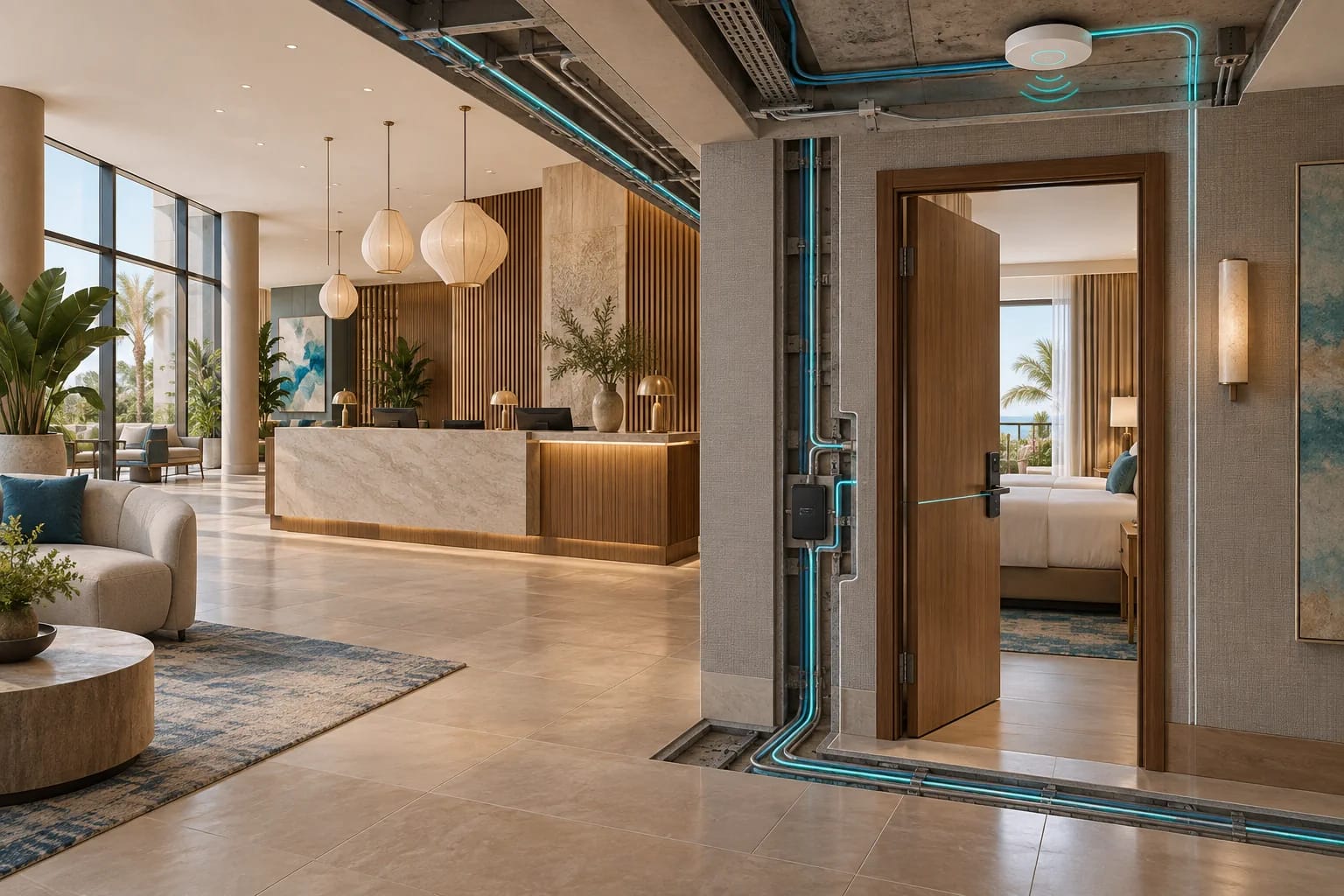
Think of the conversion in three layers. The physical layer contains pathways, cables, equipment rooms and installed devices. The service layer contains the applications and interfaces that make those devices useful. The activation layer determines when the new configuration becomes the operating hotel.
Those layers do not have identical replacement cycles. A usable cable run does not establish that an attached device supports the intended service. Conversely, a new application does not automatically require replacing every physical cable. The relevant question is compatibility across the full path, from the room device through the network to the service that controls it.
This is why technology planning for hotel renovations needs more than a room-by-room finish schedule. Physical reuse can be valuable, but its usefulness depends on condition, capacity and compatibility with the actual project requirements. A property-specific assessment is necessary; a brand growth announcement cannot supply those answers.
Room identity is a small detail with a long reach
Consider a hypothetical room that is renumbered during a conversion. Its physical door, television and access point might remain where they were. But the reservation environment, access-control system and guest-facing services may represent that room in different ways. A room-number change can therefore be a data-mapping task as well as a signage task.
Digital access makes the distinction especially clear. A guest needs the correct credential for the correct room, valid for the intended stay. Whether that is delivered through a physical card or an eligible mobile-key implementation depends on the installed lock platform and approved integrations. Mentioning a mobile app in a development announcement does not establish the compatibility of an individual existing lock.
The same principle applies to guest television and internet access. A television can turn on successfully while its guest-service integration is not ready. A network can provide internet access while the new guest authentication experience still requires configuration. Component operation and integrated service operation are separate observations.
A reflag has an activation date, not just a construction finish
Construction work can progress by floor or area. A brand transition may introduce another milestone when the property begins operating in its new service environment. Those timelines can overlap without being interchangeable. Some systems may be prepared in advance; others depend on a coordinated changeover or an externally managed activation.
For example, a representative room can demonstrate the intended guest journey before every room has been refurbished. That demonstration is useful only when its configuration reflects the eventual operating environment, including relevant interfaces. A stand-alone device demonstration does not prove an end-to-end arrival, access and in-room experience.
For the construction side of that problem, JET’s discussion of technology phasing while rooms remain in service explains how work areas and shared dependencies interact. In a reflag, that physical phasing must also be reconciled with the transition between the old and new service environments. This is an integration problem, not simply an instruction to replace everything.
What a brand announcement can—and cannot—tell an owner
Public development news is useful for understanding how hotel companies are positioning brands and existing assets. It can identify an announced opening date, property scale or intended guest benefit. It usually cannot settle whether a specific installed device is approved, whether an interface is included in a supplier’s scope, or whether an existing network has adequate capacity.
In technology project scoping, low-voltage infrastructure and endpoint procurement can be separate packages. Applied to a conversion, that distinction explains why a cabling scope and a guest-service launch are not the same deliverable. The infrastructure, equipment and integrations must be considered together even when they are purchased separately.
The interesting development story is not merely that an old hotel gets a new sign. It is that an existing asset can participate in a different guest-service environment. The strongest technology plan preserves what still fits, identifies what must change, and connects those decisions to the real operating transition.
Discuss the technology scope of your planned hotel conversion with JET—from existing infrastructure through the services the reflagged property needs to deliver.
Development sources checked October 11, 2026. Technical scenarios are illustrative, not published Hyatt requirements or verified installations at the named properties. Existing conceptual featured image retained; it is not a photograph of a Hyatt hotel or a JET client project.