
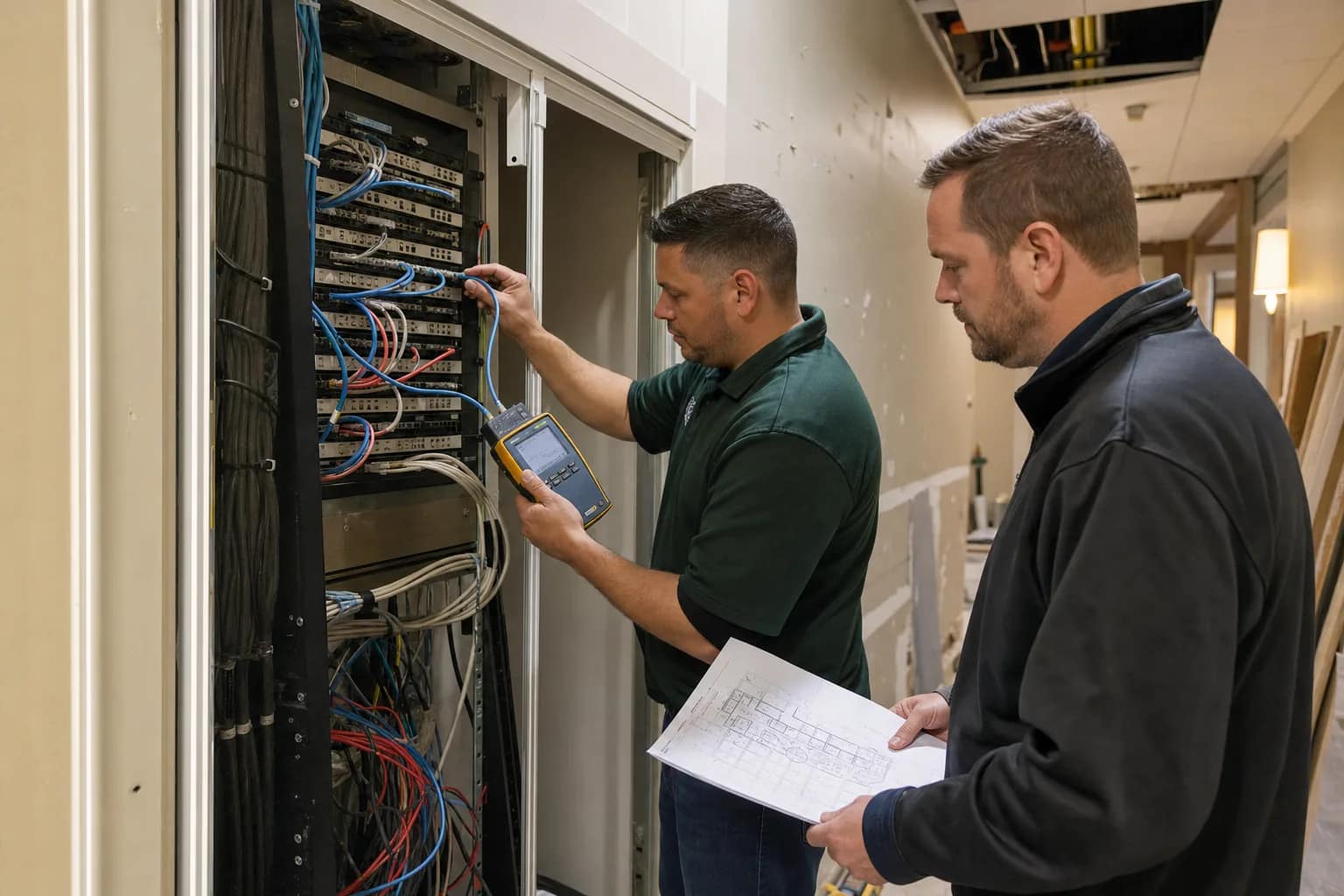
Existing hotel cabling can be an asset during a renovation. It can also be the assumption that creates the next change order.
The difference is evidence. A cable run does not become a budget credit because it is already in the wall, appears on an old drawing, or still carries traffic today. The project team needs to know where it starts and ends, what condition it is in, whether it supports the new application, and whether its location still matches the approved room and infrastructure design.
For hotel owners, developers, asset managers, and operators, the useful decision is not simply reuse or replace. It is a link-by-link record of what can remain, what needs rework, what must be replaced, and what is still unknown.
Do not turn existing cable into a project credit until the field condition, test result, destination, and new technology requirement all agree.
Start with the new design, not the old cable
Before evaluating reuse, establish what the renovated hotel actually needs. Confirm the current room count, device count, access-point placement, television strategy, phone locations, camera views, public-area outlets, MDF/IDF layout, and backbone requirements.
This matters because an existing link can test well and still be useless to the new design. A data jack hidden behind a new millwork package may be inaccessible. A cable that reaches the former access-point location may not support the new coverage design. A television connection at the baseboard may create exposed patching after the furniture changes.
Use one current basis of design and compare the field conditions against it. Old drawings are a starting reference, not proof of final quantity or placement.
Trace each candidate link from end to end
A reuse decision needs two confirmed endpoints. For every candidate link, record the room or public-area location, device served, outlet or termination, home MDF/IDF, patch-panel position, and pathway when visible.
Unlabeled or inconsistently labeled cable should remain in the unknown column until it is traced. A toner can help identify endpoints, but identification alone does not establish performance. The result should be tied to a room-level or area-level schedule so bidders are crediting the same links.
This is also the moment to catch abandoned runs, undocumented splices, shared pathways, inaccessible junctions, and cable that disappears above hard ceilings or through guest-occupied areas.
Inspect condition and installation quality
Visual inspection helps determine whether a link is worth testing and what repair work may be required. Look at more than the visible patch cord.
- Cable category, manufacturer marking, jacket rating, and approximate age.
- Kinks, crushing, tight bends, abrasion, heat exposure, moisture, paint, or construction damage.
- Field couplers, splices, damaged jacks, mixed components, and poor terminations.
- Unsupported bundles, excessive service loops, pathway congestion, and firestopping conditions.
- Patch-panel condition, rack capacity, grounding, labeling, and access for future service.
A link that can be repaired should not be counted the same as a clean pass. Track retermination, jack replacement, pathway correction, relabeling, and retesting as real labor and material.
Use the right level of cable testing
“Tested” is not a complete acceptance criterion. The project team should name the test level and the required result.
Fluke Networks distinguishes verification, qualification, and certification testing. Verification checks basic connectivity and wiremap. Qualification evaluates whether an existing link can support a particular network technology or speed. Certification measures the installed link against the performance requirements of a specified cabling category or class.
The appropriate requirement depends on the owner’s standard, the new equipment, the contract, and the warranty or brand-compliance path. A continuity result alone should not be presented as evidence that an existing link will support the intended application.
Keep the electronic result with the physical link identifier. A spreadsheet that says “cable passed” without a room, outlet, patch-panel port, test date, limit, and result is difficult to use during installation or closeout.
Match the test to the new application
The link must support what the renovated hotel plans to connect. Confirm the required data rate, power delivery, cable category, maximum channel length, connector components, and any manufacturer-specific acceptance conditions.
This is especially important when existing cable may serve new wireless access points, IP cameras, phones, IPTV devices, room controls, or other Power over Ethernet equipment. A link that carried a lower-demand device in the past may not be an acceptable basis for a higher-speed or higher-power design.
Also confirm the complete channel. Reusing horizontal cable while ignoring old patch panels, jacks, patch cords, or intermediate couplers can create a mixed link whose performance and support position are unclear.
Verify placement against furniture and coverage
Hotel renovations change more than finishes. Millwork, televisions, desks, headboards, ceilings, corridors, doors, and back-of-house layouts can all affect technology placement.
Walk the current design with the people responsible for Wi-Fi, television, voice, security, low voltage, interior design, and construction. Confirm that each reused endpoint is accessible, serviceable, and correctly positioned for the final device. For wireless and cameras, placement must also match the approved coverage or field-of-view design.
A technically capable cable in the wrong location is not a full reuse credit. The comparison should carry the cost of extension, relocation, concealment, repair, or replacement.
Separate four outcomes in the budget
A practical reuse schedule should not force every link into a simple yes/no field. Use four outcomes:
- Reuse: traced, physically acceptable, correctly located, and passed the required test.
- Reuse with rework: the link can remain after defined termination, labeling, pathway, or placement work.
- Replace: damaged, noncompliant with the new requirement, poorly located, inaccessible, or uneconomical to repair.
- Unknown: not traced, not accessible, not tested, or dependent on an unresolved design decision.
Give each outcome a quantity and cost treatment. Unknown links should carry a replacement allowance or alternate until the survey closes them. Otherwise, the apparent reuse credit can make one bid look artificially low.
Define ownership before bids are compared
Reuse work often sits between scopes. The low-voltage contractor may test the cable, while the Wi-Fi, television, PBX, or security provider decides whether it meets the new system requirement. The general contractor may own access, patching, ceilings, firestopping, or pathways.
Assign responsibility for:
- Field survey, tracing, testing, and test-result delivery.
- Design acceptance and final device placement.
- Retermination, repair, extension, and replacement.
- Access to guestrooms, ceilings, MDF/IDF rooms, and occupied areas.
- Labeling, as-builts, warranties, closeout, and failed-link remediation.
Then make every bidder use the same reuse schedule. One vendor should not assume 80 percent reuse while another prices full replacement without the difference appearing clearly in the comparison.
The owner-ready reuse record
The final record can be simple. For each room, area, or link, capture:
- Current endpoint and MDF/IDF location.
- New device or application.
- Cable category and visible condition.
- Required test level, test limit, date, and result.
- Placement and accessibility confirmation.
- Outcome: reuse, rework, replace, or unknown.
- Responsible party, budget treatment, and due date.
This turns a vague reuse promise into an auditable project decision. It also gives installation teams, vendors, ownership, and operations the same basis for pricing and acceptance.
JET Hotel Solutions helps hotel owners and project teams coordinate site surveys, low-voltage takeoffs, technology requirements, bid comparisons, vendor responsibilities, budgets, and project delivery. Bring JET into the renovation before an untested reuse assumption becomes a change order.