
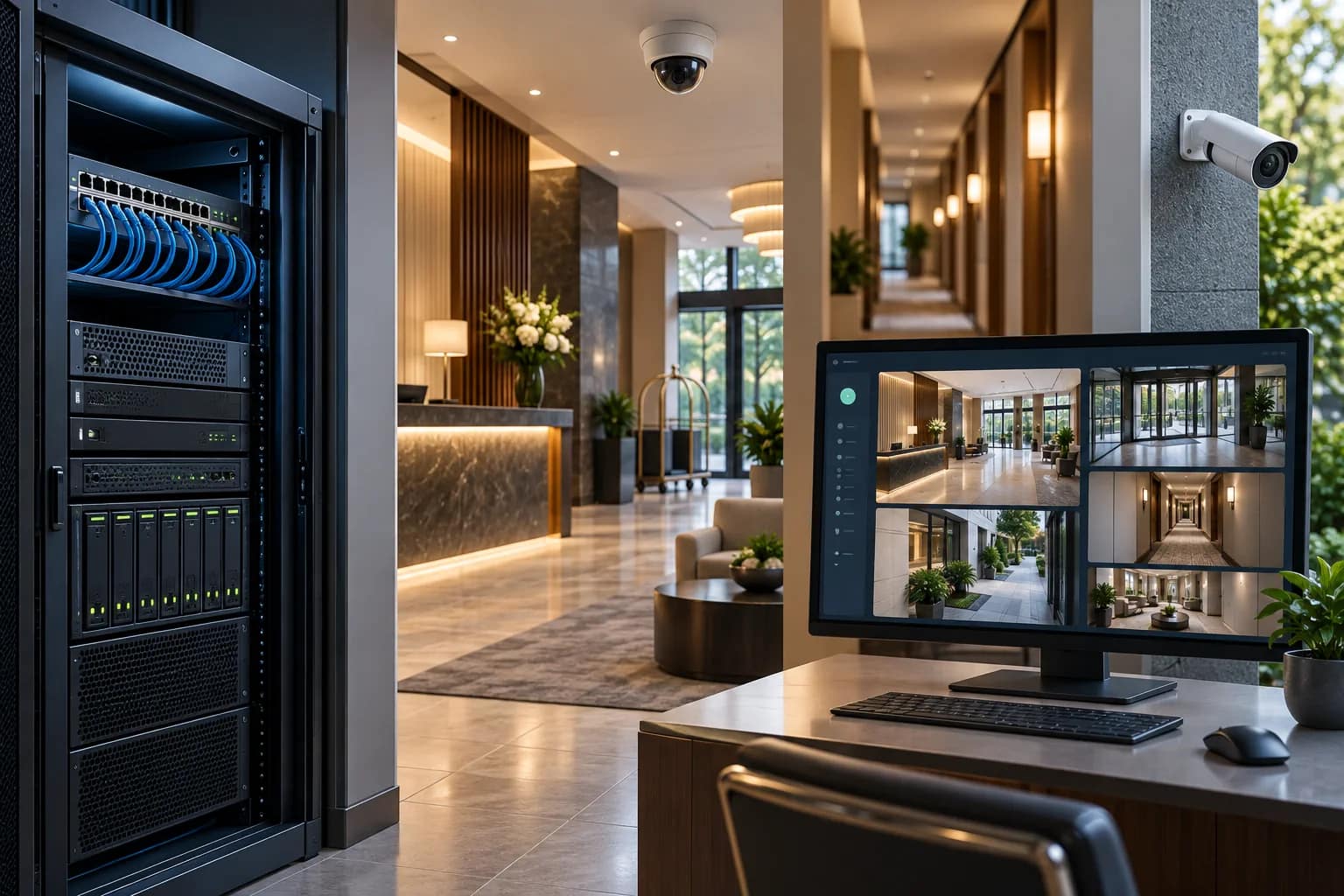
Cloud managed security cameras change more than where hotel video is viewed. They change where footage is stored, how an outage affects recording, who can investigate an incident across properties, how software is updated, and which costs remain after installation. For hotel owners comparing them with a traditional network video recorder (NVR), the useful question is not “cloud or local?” It is which architecture keeps the right evidence available under the property’s real operating conditions.
Hotels are unusually demanding camera environments. Public entrances, corridors, parking, service areas, pools, restaurants, and back-of-house spaces create different lighting, privacy, retention, and incident-response needs. A camera design also shares switches, cabling, power, internet capacity, user accounts, and support resources with other property systems. The best architecture is therefore the one that fits the hotel’s risk, network, staffing, and portfolio—not the one with the newest label.
Three architectures are competing, not two
A conventional NVR design sends video from IP cameras across the local network to one or more recorders at the property. The recorder owns most storage and playback. Remote access can be added, but local hardware, disks, operating software, and secure connectivity remain part of the property environment.
Fully cloud-recorded systems send video or selected footage to provider-managed storage. This can simplify central access, but it makes upstream bandwidth, recurring storage, provider architecture, and internet-outage behavior critical design inputs.
Many products described as cloud managed are actually hybrid. Cameras record to onboard solid-state storage or another local edge while management, health status, search, users, and optional archives live in the cloud. Cisco describes its current approach as cloud-augmented edge storage, for example. That distinction matters: a hotel should not assume “cloud managed” means every video stream is continuously uploaded, or that “local storage” means remote management is unavailable.
Cloud management changes the multi-property operating model
For a single hotel with trained local staff, a conventional NVR can provide straightforward local recording and familiar playback. For a management company or ownership group, the operating problem is different. Teams may need to see camera health across many properties, grant temporary investigator access, share a clip without exposing an entire recorder, or standardize retention and user permissions.
Cloud-managed platforms are strongest when those centralized workflows are valuable. A portfolio security leader can organize properties, cameras, users, and alerts in one management layer. Software and security updates may be delivered through the platform instead of handled independently on each recorder. That can reduce travel and inconsistent configuration—but it also concentrates dependency on the vendor’s identity, licensing, and service model.
A hotel should map actual roles before comparing interfaces: general manager, engineering, security, regional operations, ownership, insurer, law enforcement, and installer. Each role may need different live-view, playback, export, or administration privileges. JET’s hotel low-voltage planning connects camera coverage and operating use cases to the cabling, switching, power, and access model that can support those roles.
Outage behavior is the first technical dividing line
An internet outage should not automatically become a recording outage. A traditional NVR can continue recording locally when the WAN is down, provided cameras, switches, storage, and power remain healthy. A hybrid cloud-managed camera with onboard storage may do the same and synchronize management information after connectivity returns. A design that depends on continuous cloud upload may behave differently.
Owners should request a written outage sequence: what continues recording, how long local capacity lasts, whether live local viewing remains available, how alerts are queued, and what happens when service returns. The same test should cover a failed switch, recorder, camera, disk, internet circuit, and cloud service—not only a clean demonstration on a working network.
Local storage also has failure modes. A single NVR can become a concentration point when its disk array, power supply, operating system, or network port fails. Distributed edge storage spreads that risk across cameras, while cloud archives can preserve selected evidence away from the property. JET’s guide to IP cameras and local card storage explains why local recording can be a useful resilience layer rather than an either-or alternative.
Bandwidth calculations must use incident reality
A hotel network review should distinguish steady-state traffic from incident traffic. Continuous cloud recording can require substantial upstream capacity. Hybrid platforms may send only metadata and management traffic until a user requests live or historical video. NVR systems keep most recording traffic local but can still produce heavy WAN demand when multiple users view remotely or export footage.
Calculate traffic using the actual number of cameras, resolution, frame rate, codec, motion profile, simultaneous viewers, archive policy, and expected export behavior. Then test the design alongside guest Wi-Fi, back-office applications, voice, IPTV, and other hotel systems. The solution may need separate VLANs, quality-of-service policy, redundant internet, or upload controls to prevent a security investigation from degrading guest services.
Retention is a policy before it is a storage number
“Thirty days of retention” is incomplete unless the hotel knows whether it applies to every camera, continuous or motion recording, the selected resolution, and the busiest scene conditions. Local NVR capacity is typically purchased upfront and expanded by adding disks or recorders. Cloud and hybrid platforms may package retention into device licenses, storage tiers, or optional archives.
Total cost should include more than camera and recorder pricing. Compare recorder replacement cycles, hard drives, rack space, UPS capacity, software maintenance, remote-access security, technician travel, licenses, cloud archives, export fees if any, warranty, and the labor required to manage users and updates. A conventional NVR may be economical at one stable property. Cloud management may deliver more value where centralized operations reduce repeated local work.
Cybersecurity responsibility moves; it does not disappear
Network cameras are connected devices with identities, credentials, firmware, network behavior, logs, and end-of-life dates. NIST’s 2026 update to its IoT product cybersecurity guidance reinforces the need to define security requirements across the product and supporting services, rather than treating the device as isolated hardware.
With an NVR, the property or its provider usually owns more patching, account management, secure remote access, logging, and replacement planning. With a cloud-managed platform, the manufacturer may operate more of that lifecycle, but the hotel still must evaluate authentication, role-based access, encryption, data location, audit logs, vulnerability response, support duration, account recovery, and data export at contract end.
Ask who can access footage, how privileged actions are logged, whether multifactor authentication is enforceable, how users are removed after staff turnover, and what evidence remains if the subscription ends. These are operational requirements, not procurement fine print.
A practical hotel decision matrix
| Decision area | Conventional NVR | Cloud-managed or hybrid |
|---|---|---|
| Recording location | Primarily centralized at the property | Often distributed at the edge, with cloud management and optional archives |
| Internet outage | Local recording can continue | Depends on edge capacity and product design; verify in writing |
| Portfolio management | Usually assembled through separate remote-access tools | Commonly built into one multi-site management plane |
| Upfront infrastructure | Recorder, disks, rack, power, cooling, and secure access | Less recorder hardware in many designs, but licensing and network readiness matter |
| Lifecycle work | More local responsibility for software, disks, and remote access | More vendor-managed software, with continuing subscription and provider dependency |
| Migration fit | Can preserve compatible IP cameras and local workflows | May require camera replacement, licensing, and new identity/network design |
Choose the architecture from the incident backward
Start with three realistic incidents: an overnight parking claim, a guest-corridor investigation, and a multi-property request from ownership. Define who needs footage, how quickly they need it, how it is found, how long it must exist, how it is exported, and what happens if the internet or a device is down. Then compare architectures against those outcomes.
The hotel’s existing security camera acceptance checklist should still be used for views, privacy boundaries, timestamps, retention, access, and incident workflow. Architecture does not compensate for poor placement or untested coverage.
A strong decision may be conventional, cloud managed, or hybrid. What matters is that ownership can see the tradeoffs before the design is locked—and that the property receives a supportable system after opening. Request a hotel camera architecture review to compare the network, storage, access, retention, and support implications for a new build, renovation, or portfolio refresh.