
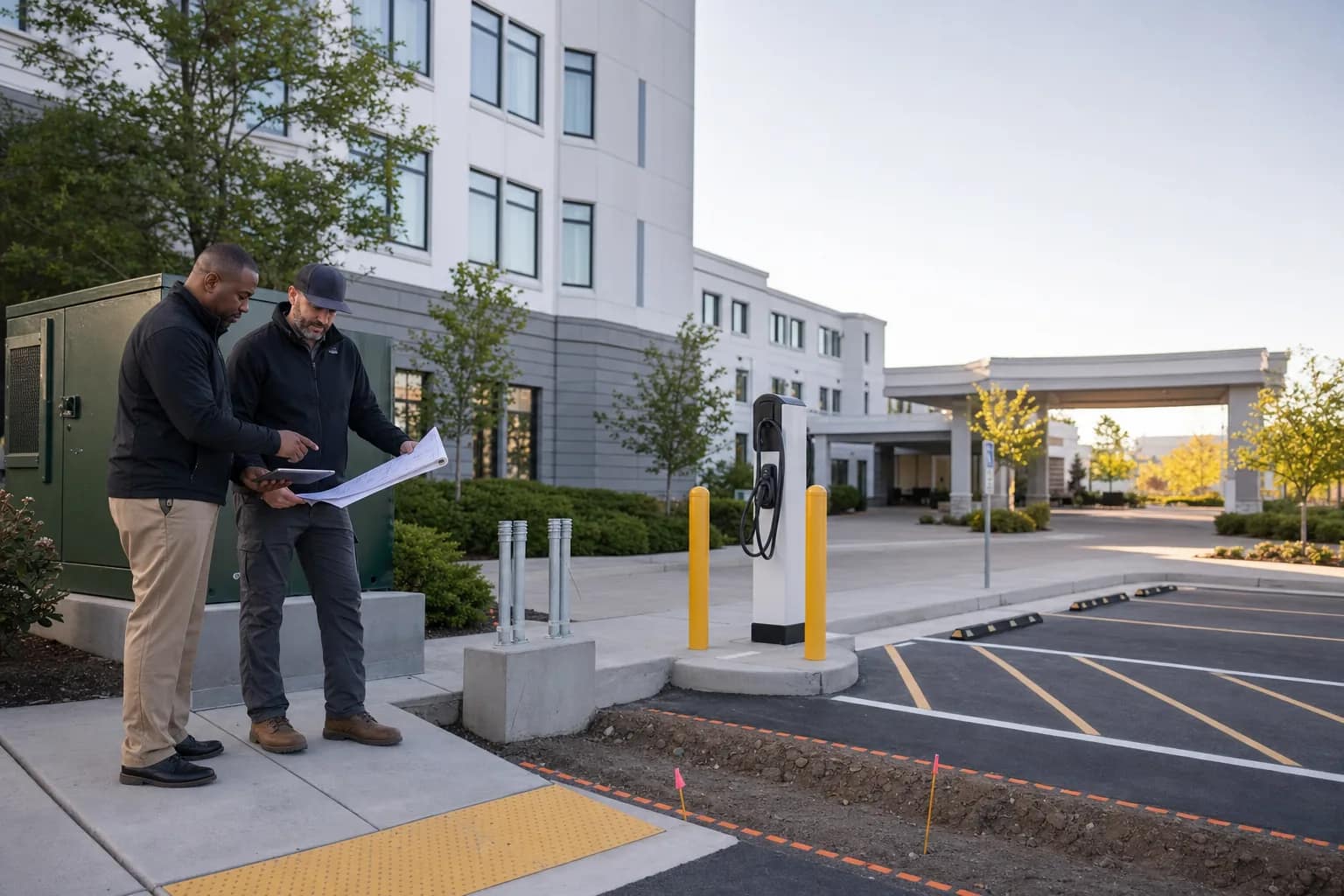
The charger is often the easiest part of a hotel EV charging project.
The expensive surprises usually sit around it: available electrical capacity, utility lead time, a transformer or panel upgrade, a long trench through finished paving, an inaccessible parking layout, weak cellular coverage, unclear payment rules, or a support model that leaves the front desk troubleshooting guest sessions.
That is why owners should confirm the site and operating plan before selecting equipment. A charger quote can look complete while leaving the property responsible for the work that determines whether the stations can be installed, commissioned, and kept available for guests.
Choose the hotel EV charging operating model and site path before choosing the hardware.
Why hotel EV charging site readiness is different
A hotel is both a destination and a 24-hour operating environment. Guests may arrive late, stay overnight, use valet parking, expect a working payment experience, or need an accessible charging space. Employees, fleet vehicles, restaurant visitors, meeting attendees, and rideshare drivers can create different demand patterns from overnight guests.
The site also connects several project teams. Ownership, hotel operations, facilities, the electrical engineer or contractor, the utility, civil and landscape trades, the charging network, payment providers, IT, the brand, and the permitting authority can each control a different dependency.
The U.S. Department of Energy’s Alternative Fuels Data Center recommends early utility coordination and site-level evaluation of available power and required upgrades. Its accessibility guidance also treats the charging equipment, parking space, route, and payment interface as one usable experience. Those decisions belong in the project basis, not in a late installation punch list.
10 checks before selecting EV charging equipment
1. Define who will charge and how long they will stay
Start with the operating use case. An overnight select-service hotel may favor a different mix than a valet resort, airport property, convention hotel, extended-stay property, or hotel with a restaurant and public parking.
Record the expected users, arrival periods, average dwell time, valet involvement, employee or fleet use, public access, and whether charging is an amenity, a paid service, or both. This determines the number of ports, charging speed, access rules, pricing, and turnover process more reliably than a generic charger count.
2. Select candidate spaces with hotel operations in the room
The closest spaces to the electrical room are not automatically the best spaces for the hotel. Compare electrical distance with guest arrival, valet flow, parking control, snow removal, landscaping, lighting, camera coverage, drainage, delivery traffic, maintenance access, and future construction.
Operations should also decide what happens when a vehicle finishes charging, a non-EV occupies the space, a guest leaves a cable across a path, or a charger is out of service. A technically convenient location can become an operational problem if these scenarios are ignored.
3. Confirm accessibility as a complete route
Accessible EV charging is more than adding a sign. Review the parking-space dimensions, access aisle, surface slope, curb transitions, reach range, cable handling, clear floor space, route to the hotel entrance, and usability of the charger and payment interface.
The AFDC accessibility guidance notes that state and local requirements can differ. The design team and authority having jurisdiction should confirm the applicable number and type of accessible charging spaces before the parking plan is approved.
4. Establish the electrical load basis
Document the proposed number of ports, maximum output, simultaneous-use assumption, load-management approach, future expansion allowance, and any other planned building loads. Then have the qualified electrical team evaluate the service, transformer, switchgear, panels, breakers, conductors, metering, and available physical space.
A spare breaker position does not prove that the property has capacity. The decision needs an electrical basis that accounts for the building’s existing and planned demand, not only the charger nameplate.
5. Involve the utility before the design is locked
Ask the utility to confirm the service process, available capacity, required studies, tariff or rate options, metering requirements, upgrade responsibility, anticipated lead time, and any make-ready or incentive program that may apply.
Utility work can become the longest project dependency. Early input may also change which side of a parking lot is practical. DOE notes that site-level utility evaluation helps identify power availability and the upgrades needed for the intended charging capacity. Treat that response as a design input, not a post-award formality.
6. Map every foot between power and the parking space
Walk the proposed route. Record trench length, conduit size and count, pull boxes, boring, wall penetrations, fire-rated assemblies, elevation changes, landscaping, irrigation, drainage, lighting, signage, existing utilities, concrete islands, paving restoration, and traffic-control needs.
For new builds and major renovations, include future conduit, panel space, and expansion pathways while the site is open. The AFDC’s EV-ready building guidance emphasizes the value of installing hard-to-retrofit capacity and raceways during construction. The local design and code basis still controls the actual requirement.
7. Confirm network and payment connectivity at the exact location
Networked charging may rely on cellular service, Wi-Fi, Ethernet, or a gateway. Test coverage where the equipment will stand, including inside parking structures. Identify who provides the connection, who pays for it, what happens during an outage, and whether the property network requires a security review.
Then define the guest transaction. Consider app, QR, RFID, credit-card, room-charge, valet, complimentary, and employee workflows. Pricing, taxes, idle fees, refunds, receipts, guest support, and payment accessibility should be owned before launch.
8. Compare the ownership and support model, not just the charger
Separate hardware purchase from software, networking, payment processing, commissioning, warranties, preventive maintenance, field service, parts, remote monitoring, driver support, and replacement obligations.
Ask who receives an alert, who answers a guest at 11 p.m., who can reset a station, who dispatches a technician, what response time is committed, and what data the hotel can export. A lower equipment price can create a larger operating burden if those responsibilities remain with hotel staff.
9. Validate permitting, incentives, and brand requirements locally
Building, electrical, accessibility, parking, zoning, signage, fire, environmental, and utility requirements vary by location and project type. Incentives, tax treatment, and utility programs also change over time and may have application, equipment, installation, data, or operating conditions.
Do not build the approval case around an incentive until eligibility, timing, documentation, and funding have been confirmed. Likewise, confirm current brand requirements and approved solutions for the specific property rather than relying on an old program sheet.
10. Design the handoff, reporting, and expansion path
Before award, define commissioning tests, staff training, guest instructions, escalation contacts, warranty records, network credentials, as-built drawings, serial numbers, payment settings, rate-change authority, utilization reporting, uptime reporting, and preventive-maintenance ownership.
Also show how the site can grow. Future ports may require more than spare conduit. Preserve electrical capacity, panel and transformer strategy, equipment clearances, communications, parking flexibility, and a load-management plan that can support expansion without replacing the first investment.
What an owner-ready EV charging scope should show
A comparable proposal should make the whole project visible. At minimum, the owner should be able to identify:
- The operating use case, user groups, access rules, and pricing approach.
- The selected spaces and an accessible route reviewed by the appropriate design team.
- The electrical load basis and responsibility for any service, transformer, panel, or distribution upgrade.
- The utility contact, application status, required study, rate basis, and expected dependency dates.
- The complete civil and electrical pathway, including restoration and excluded work.
- The communications, payment, software, data, and cybersecurity responsibilities.
- The equipment, installation, commissioning, permits, inspections, warranties, and maintenance included.
- The support workflow for guests, hotel staff, remote monitoring, and field service.
- The expansion basis and what is being installed now to protect it.
- Every allowance, exclusion, owner-furnished item, assumption, due date, and accountable party.
This is where procurement and project management protect the hotel. A charger proposal should not be approved until ownership can see the site work, operating work, and long-term responsibilities surrounding the equipment.
Make the site decision before the product decision
A useful EV charging plan begins with the hotel, not the catalog. Confirm demand, parking operations, accessibility, electrical capacity, utility coordination, pathways, connectivity, payment, support, and expansion. Then compare equipment and commercial models against the same owner-approved basis.
JET Hotel Solutions helps hotel owners coordinate EV charging with broader technology procurement, budgeting, site surveys, value engineering, vendor comparison, installation planning, project reporting, and closeout. The goal is a practical project that fits the property, protects the guest experience, and makes every dependency visible before work begins.