
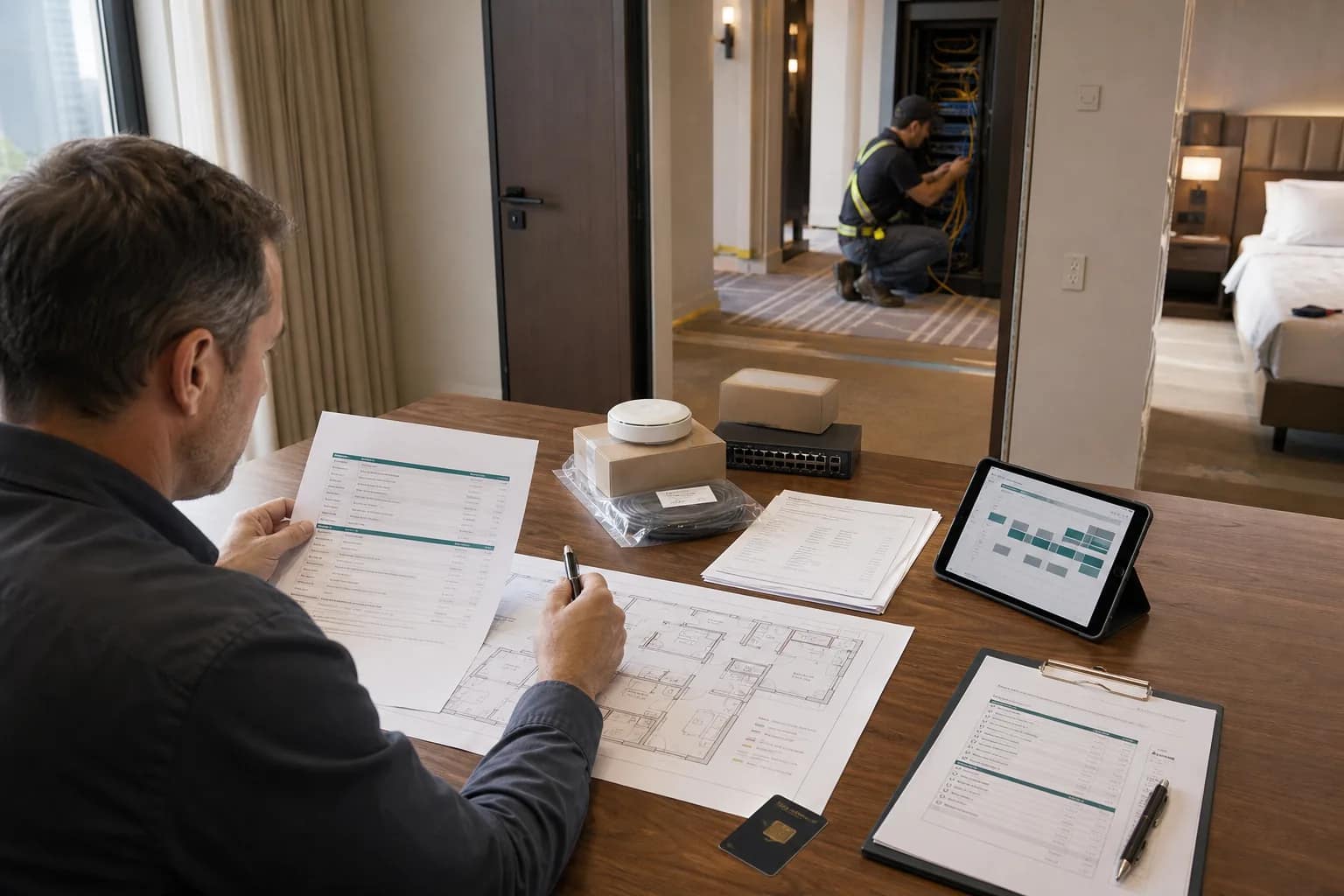
A hotel technology invoice should show more than an amount due. It should tell ownership which part of the approved scope has been completed, what evidence supports the request, what remains at risk, and whether the next payment will get ahead of the work.
That matters because a single hotel project may combine low-voltage cabling, guest Wi-Fi, PBX, television, audiovisual systems, CCTV, internet service, and other scopes. Equipment deposits, recurring services, installation labor, freight, commissioning, and closeout do not all reach the same milestone at the same time. A useful hotel technology payment schedule connects each release of funds to an observable project gate.
The structure is familiar in construction administration. AIA’s G702 and G703 payment forms track completed work, stored materials, previous payments, change orders, retainage, and a schedule of values. GSA contract-file guidance likewise pairs contractor invoices and progress reports with inspection and acceptance records. A hotel technology project can apply the same discipline without turning every invoice review into a paperwork exercise.
Build the payment schedule before the first invoice
Start with the final proposal, responsibility matrix, project schedule, and owner-approved budget. Break the contract into meaningful work packages rather than using one broad line such as “technology installation.” Each package should have an owner, value, planned completion date, evidence requirement, and payment rule.
Separate one-time project costs from recurring services. Internet circuits, phone service, monitoring, software subscriptions, content, licensing, and support may start on different dates. Ownership should be able to see when a recurring charge begins, what triggers it, and whether the hotel can use the service at that point.
Eight payment gates for hotel technology projects
1. Approved scope baseline
Before releasing a deposit, confirm the executed proposal matches the approved scope, quantities, alternates, exclusions, tax, freight, recurring cost, and project location. Attach the current responsibility matrix and identify owner-furnished or third-party dependencies. A deposit should release a defined package, not a collection of assumptions.
Evidence: executed agreement, approved scope matrix, room or device quantities, current drawings or survey record, and a baseline schedule.
2. Submittal and equipment-release gate
Some systems require a material deposit before equipment can be ordered. Tie that request to approved product selections, current quantities, lead times, shipping destination, cancellation or restocking terms, and confirmation that the purchase order was released. For brand-controlled systems, include the applicable approval or exception record.
Evidence: approved submittal, equipment list, release confirmation, lead-time record, and deposit invoice tied to the relevant work package.
3. Site-readiness gate
Do not let installation billing outrun the property. Verify that rooms or public spaces are available, pathways are complete, racks and backboards are ready, power and grounding are present, environmental conditions are suitable, and required internet or network dependencies have firm dates. On a renovation, the readiness record should also identify occupied-area restrictions and phasing.
Evidence: site-readiness checklist, dated photos, field report, open-issue list, and updated schedule.
4. Material-delivery gate
For equipment or stored-material billing, confirm what arrived, where it is stored, who controls it, and whether it matches the approved bill of materials. Record serial numbers when they matter for licensing, warranty, or asset management. Note shortages, substitutions, damaged cartons, and equipment still in transit.
Evidence: packing lists, receiving log, photos, serial-number record, approved substitutions, and storage responsibility.
5. Installed-quantity gate
Progress percentages should be supported by installed quantities and locations. “Cabling 80% complete” is difficult to verify; “312 of 390 tested guest-room drops installed on floors two through five” is much more useful. Use the same location naming across plans, field reports, test results, and invoices.
Evidence: marked-up plans, room or device tracker, daily reports, completed quantities, and unresolved field conditions.
6. Configuration and integration gate
Physical installation is not the same as an operational system. Confirm that required configuration is complete and that interfaces, licensing, internet access, VLANs, phone numbers, content, user roles, monitoring, and brand connections are available for testing. Assign every blocked item to a named party and date.
Evidence: configuration record, interface status, license confirmation, issue log, and test-ready approval.
7. Acceptance gate
Payment near substantial completion should follow witnessed acceptance scenarios, not installation photos alone. Test the system in the way guests and hotel staff will use it: place internal and external calls, connect representative devices, verify television and casting journeys, review camera coverage, test audiovisual sources, and document exceptions by location.
Evidence: signed test scripts, results, punch list, exception approvals, training record, and operational handoff.
8. Closeout and final-payment gate
Final payment should have a clear definition. Typical closeout records include corrected drawings, cable and device schedules, test reports, warranties, licenses, credentials transferred through an approved method, support contacts, escalation paths, recurring-cost confirmation, spare inventory, and resolved punch-list items.
Evidence: indexed closeout package, final acceptance, completed punch list, support handoff, and final change-order reconciliation.
Use one invoice-review table
| Review field | Owner question |
|---|---|
| Work package | Which approved scope and location does this invoice cover? |
| Current gate | Which milestone has actually been reached? |
| Evidence | What record supports the billed amount or quantity? |
| Prior payments | How much has already been paid against this package? |
| Changes | Are approved and pending changes separated? |
| Remaining exposure | Is enough value left to complete testing and closeout? |
| Recurring cost | Has any service billing started, and is the service usable? |
| Decision | Approve, approve with adjustment, or hold for evidence? |
Keep the table connected to the budget and schedule. If a milestone slips, ownership can see both the cash-flow effect and the operational consequence. If scope changes, update the work package and evidence requirement before the next invoice is reviewed.
Questions to ask before approving payment
- Does the invoice match an executed scope and approved change record?
- Can the billed quantity or milestone be verified by location?
- Are stored materials identified, protected, and controlled?
- Are unresolved dependencies visible, assigned, and dated?
- Is the remaining contract value sufficient for configuration, testing, punch-list work, and closeout?
- Have recurring charges started only when the contracted service is available?
The contract controls the actual payment terms, and owners should coordinate legal and accounting requirements with their advisers. The project-management goal is simpler: make every payment decision traceable to the scope, schedule, evidence, and operational result ownership approved.
JET Hotel Solutions helps hotel owners coordinate technology budgets, proposals, responsibilities, schedules, field verification, and acceptance across infrastructure and guest-facing systems. Related owner controls include JET’s project-readiness checklist, guest-facing technology scope matrix, and technology budget-refresh checklist.
References: AIA G702/G703 payment documentation and GSA example contract-file documents.