
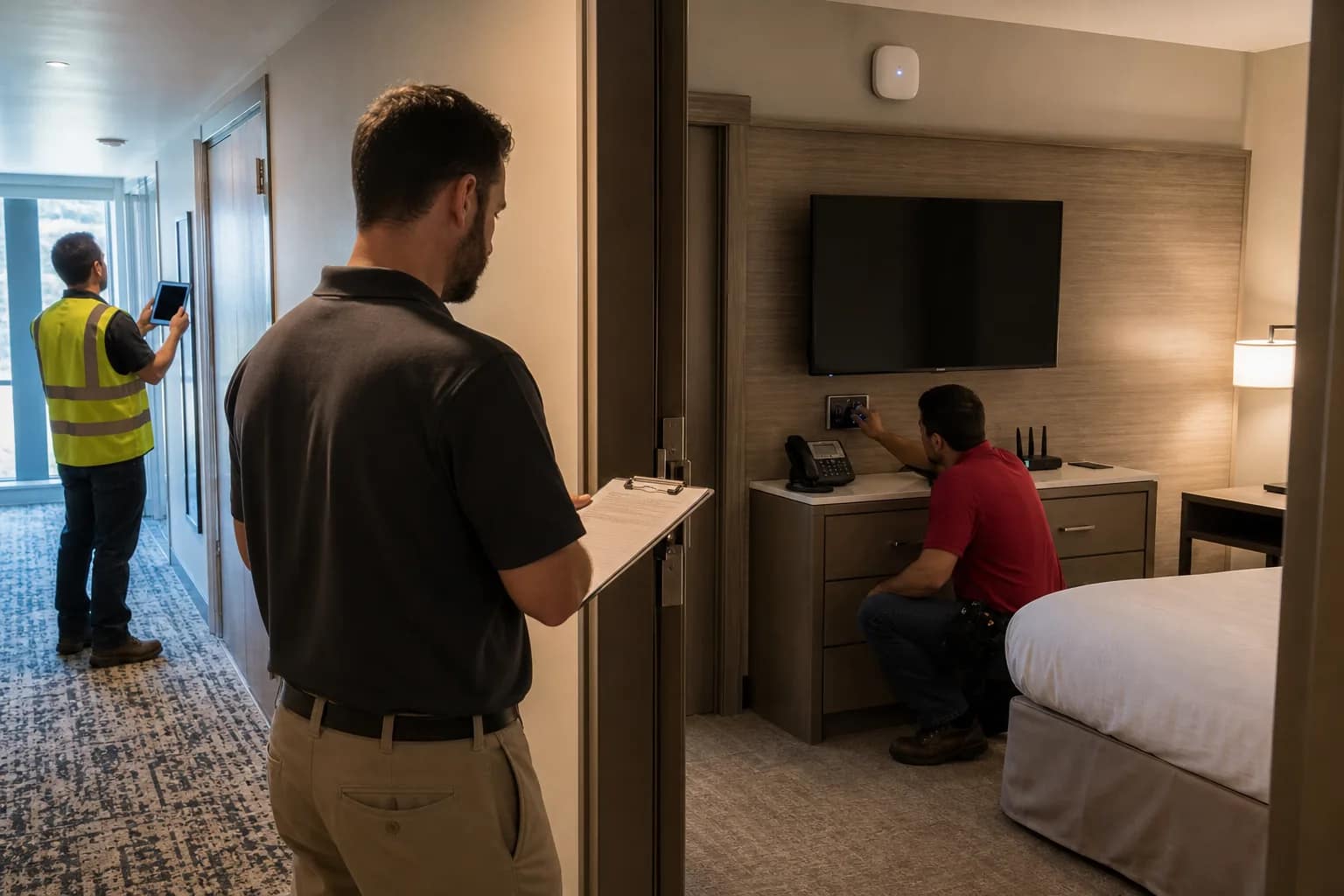
Quick answer: A hotel guest-facing technology scope matrix should lock seven decisions before procurement: the guest journeys being supported, room and public-area quantities, shared infrastructure dependencies, current brand and owner requirements, system integrations, implementation and acceptance responsibilities, and the recurring support model. Put Wi-Fi, television/casting, phones, AV, internet access, low voltage, power, and operations in one owner-controlled table so separate vendor proposals do not create gaps.
Hotel guest technology is often purchased as separate systems. The Wi-Fi provider prices access points. The television provider prices screens and casting. The voice vendor prices phones and trunks. The low-voltage contractor prices cable. The general contractor carries pathways and power. Operations assumes someone else is coordinating the room experience.
Guests do not experience those contracts separately. They experience one room: join the network, place a call, use the television, cast privately, charge a device, request help, and expect the hotel to support all of it. A scope matrix gives ownership one place to confirm how those systems meet at the room, the network, the schedule, and the support desk.
The matrix is not an equipment list. It is the record of who must deliver, connect, test, accept, and support each guest-facing outcome.
Why guest-facing systems need one coordination record
Guest expectations make coordination more important, not less. J.D. Power’s 2025 North America Hotel Guest Satisfaction Index study identified technology and connectivity as part of the measured hotel experience. It also found that 40% of surveyed guests considered a smart TV or streaming capability a need-to-have amenity, while 60% used the smart TV when it was available in their room.
At the same time, AHLA’s current HTNG workgroup agenda describes increasing convergence between AV and IT infrastructure across in-room entertainment, streaming, digital signage, conferencing, and connected devices. Its completed work on converging AV and IT notes that treating technology as an afterthought can create confusion, cost overruns, and operational problems.
The owner-side lesson is practical: a television decision can affect Wi-Fi design, switching, internet capacity, privacy, content, room controls, and support. A phone decision can affect emergency calling, network ports, power, number porting, and cutover. A guest-facing technology package becomes usable only when these dependencies have named owners.
1. Define the guest journeys before choosing products
For lobby and meeting areas, compare hotel digital signage applications to distinguish promotional playlists, event schedules and interactive wayfinding.
Add the hotel digital signage readiness guide when lobby displays, meeting-room boards, menu screens, or amenity promotions need the same owner-approved guest journey map.
Start the matrix with the experience the property must support. Avoid beginning with a vendor model or a copied room standard. List the journeys that matter at this hotel:
- Joining guest Wi-Fi from a room, lobby, meeting space, pool, or exterior area.
- Watching linear content and securely casting personal content to the correct room television.
- Calling the front desk, emergency services, local numbers, or outside lines from a guest-room phone.
- Using meeting-room audio, displays, control, and connectivity without staff rebuilding the room for every event.
- Receiving hotel information or service through approved screens, phones, mobile channels, or digital signage.
- Getting help when a device, account, circuit, integration, or room workflow fails.
For each journey, record the minimum acceptable result and any brand requirement. This keeps value engineering focused on the outcome. It also prevents a lower equipment price from removing an integration, coverage area, privacy control, or support function that the hotel expected.
2. Reconcile rooms, spaces, devices, and exceptions
Next, connect every quantity to a current property record. Guest-facing scope should reconcile with the room matrix, floor plans, reflected ceiling plans, public-area layouts, meeting-room plans, door schedule, millwork, furniture, and equipment-room locations.
Build the matrix around room and space types rather than one average room. Include standard kings, double queens, suites, accessible rooms, hearing-accessible rooms, connecting rooms, staff areas, meeting rooms, lobby zones, exterior amenities, elevators, and any dual-brand shared spaces.
Then expose exceptions. A suite may need another television or phone. A hearing-accessible room may require a different communication device arrangement. A meeting room may need floor-box connectivity, additional network capacity, control interfaces, or assisted-listening support. A hard-to-reach exterior zone may change wireless design and pathway cost.
Every quantity should show its source and status: confirmed by drawings, confirmed by survey, brand-required, owner-selected, allowance, or pending decision. This is more useful than a total with no traceable basis.
3. Put shared infrastructure dependencies beside each system
Guest-facing technology depends on infrastructure that may sit in another contract. For every system, identify:
- Pathway, cable type, outlet, patching, labeling, and test requirements.
- Switch port, PoE budget, VLAN, IP addressing, firewall, remote access, and monitoring.
- Internet bandwidth, carrier handoff, redundancy, static IP, and activation timing.
- Electrical circuit, receptacle, UPS, surge protection, grounding, blocking, and mounting.
- MDF/IDF rack space, cooling, access, and housekeeping responsibilities.
- Furniture, millwork, wall construction, device height, and finish coordination.
Do not let a proposal say only “network by owner.” Name the exact port, location, configuration, ready date, and party responsible. The same applies to “power by electrical,” “cable by others,” or “internet by hotel.” A dependency without a deliverable and due date is still an open scope item.
4. Record the current brand requirement and approval path
Brand compliance should be a visible matrix field, not a general note. Record the standard title or version, approved-product constraint, required submittal, review party, exception path, and final evidence needed for acceptance.
Separate three categories:
- Required: necessary for current brand compliance, code, safety, or contract obligation.
- Owner standard: selected for portfolio consistency, supportability, lifecycle, or guest experience.
- Optional enhancement: valuable but not required for opening or compliance.
This separation makes value engineering credible. The team can challenge optional scope or select a different implementation method without quietly removing a mandatory result. It also prevents an old standard, a discontinued device, or a different hotel’s assumption from surviving into the current procurement package.
5. Map every integration and data handoff
Guest-facing systems rarely stand alone. The matrix should identify each integration, the direction of information flow, the party configuring each side, test credentials, and the acceptance scenario.
Common coordination points include the PMS, guest authentication, room assignment, casting association, emergency-location records, SIP trunks, television content, mobile or app services, payment, digital signage content, building systems, and remote monitoring. Not every property uses every integration, but every proposed integration needs an owner.
AHLA’s HTNG guest-room entertainment requirements are a useful example: casting depends on robust guest-room Wi-Fi, an understandable guest workflow, and a method that keeps content associated with the correct room. Buying the television and casting device does not by itself prove that complete experience.
6. Assign implementation, cutover, and acceptance
For each matrix row, name who will design, furnish, install, configure, integrate, test, approve, train, document, and support. These roles may belong to different companies.
Then connect the scope to the project schedule:
- When are pathways, power, rooms, racks, internet, and network services ready?
- Which devices require staging, licensing, programming, or shipment before installation?
- Which model room or pilot area proves the repeatable standard?
- Which systems must overlap during cutover?
- What is the rollback trigger if the live hotel workflow fails?
- Which functional tests release a room, floor, meeting space, or property to operations?
Acceptance should test real hotel workflows, not only equipment power. Join the network with guest and staff device types. Walk difficult boundaries. Cast to the correct room and confirm the session clears. Place emergency and front-desk calls. Test television controls, content, integrations, and support escalation. Record failures, owners, corrections, and retests.
7. Show recurring cost, lifecycle, and support ownership
The final decision is how the hotel will operate the system after installation. Record monthly and annual charges, contract term, license count, content fees, monitoring, software, support level, warranty, replacement responsibility, escalation, and renewal conditions.
Also name the first support path for each guest-facing issue. Front-desk and engineering teams should not need to reconstruct the vendor stack during an outage. Keep the property/account number, circuit or system ID, support number, authorized contacts, remote-access method, current diagram, last change, and escalation owner in the handoff package.
Lifecycle belongs in the procurement decision. Confirm software support, security updates, replacement availability, compatibility with the selected network and integrations, and the expected refresh trigger. A cheaper device with a shorter supported life can be the more expensive operating choice.
A compact guest-facing technology scope matrix
| Matrix field | Owner question | Minimum evidence |
|---|---|---|
| Guest outcome | What must work for the guest or staff member? | Journey, location, acceptance scenario |
| Quantity | Does scope match the current property? | Room matrix, plan, survey, exception list |
| Infrastructure | What must be ready around the system? | Pathway, cable, power, network, internet, rack |
| Compliance | Which standard or approval controls the decision? | Version, submittal, exception, approval record |
| Integration | Which systems exchange data or control? | Interface owner, configuration, test case |
| Delivery | Who designs, installs, tests, and accepts? | Responsibility matrix, schedule, closeout record |
| Operations | Who supports and pays after turnover? | SLA, recurring cost, warranty, lifecycle plan |
Use the matrix to normalize vendor bids
Issue the same matrix with every request for proposal and require each bidder to mark every row as included, excluded, allowance, owner-furnished, or by others. Ask for a note whenever the proposed method changes the stated guest outcome, brand requirement, infrastructure dependency, implementation sequence, or support model.
Compare bids by complete outcome rather than by vendor category. One Wi-Fi proposal may include survey, switching, configuration, monitoring, and acceptance while another prices only access points. One television proposal may include casting, content, licensing, installation, and support while another assumes the hotel will furnish network configuration and mounting labor. The matrix makes those differences visible before totals are compared.
After selection, convert the winning response into the project responsibility record. Add vendor contacts, submittal dates, owner decisions, ready dates, test scripts, closeout requirements, and changes approved during construction. This avoids creating a new coordination document after contracts are signed and preserves the assumptions ownership actually approved.
What ownership should approve before procurement
The approval packet can remain concise. Include the scope matrix, marked-up plans or room/space quantities, current standards and exceptions, infrastructure dependency log, integration list, vendor inclusions and exclusions, recurring-cost schedule, implementation milestones, acceptance plan, and open decisions.
The owner should be able to answer five questions before releasing purchase orders:
- Are all proposals delivering the same guest and operating outcomes?
- Do quantities and locations match the current property?
- Are every pathway, power, network, internet, and integration dependency assigned?
- Is the implementation and acceptance sequence compatible with the hotel schedule?
- Does the hotel understand the recurring cost and support model?
JET Hotel Solutions helps hotel owners turn separate low-voltage and guest-facing technology proposals into a coordinated procurement and project-management record. Related controls include JET’s low-voltage responsibility matrix, guest Wi-Fi acceptance test, and hotel TV procurement checklist.