
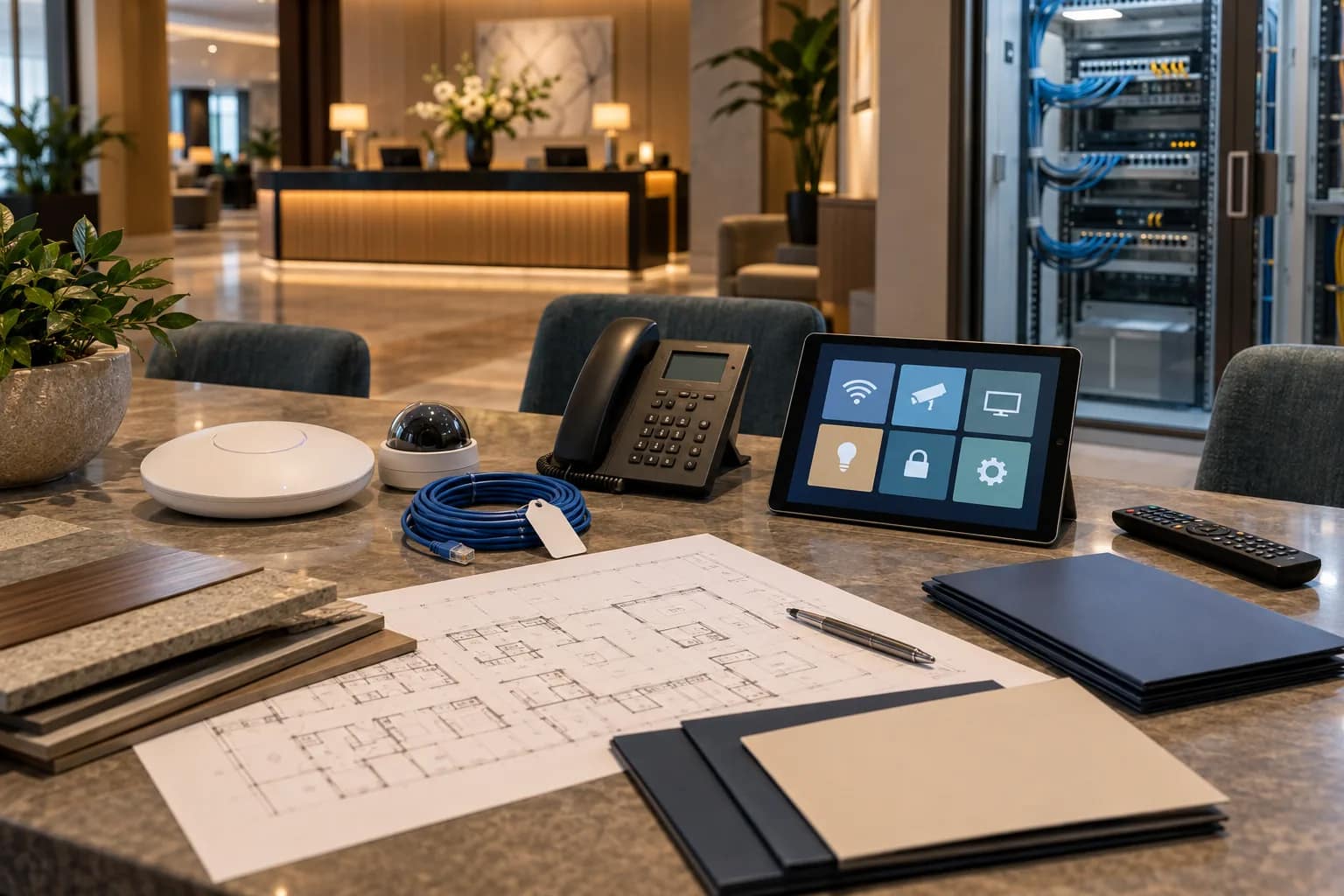
A hotel technology consultant should help ownership make better technology decisions before the project becomes a pile of separate vendor quotes. In a hotel, Wi-Fi, low voltage, PBX, guest-room TV, cameras, access control, circuits, monitoring, and support are not isolated purchases. They share rooms, pathways, timing, infrastructure, and operating consequences.
The useful question is not simply whether a consultant can recommend a product. The better question is whether the consultant can help the owner define the operating result, compare vendor scope honestly, protect the schedule, verify acceptance evidence, and leave the property with a support path after go-live.
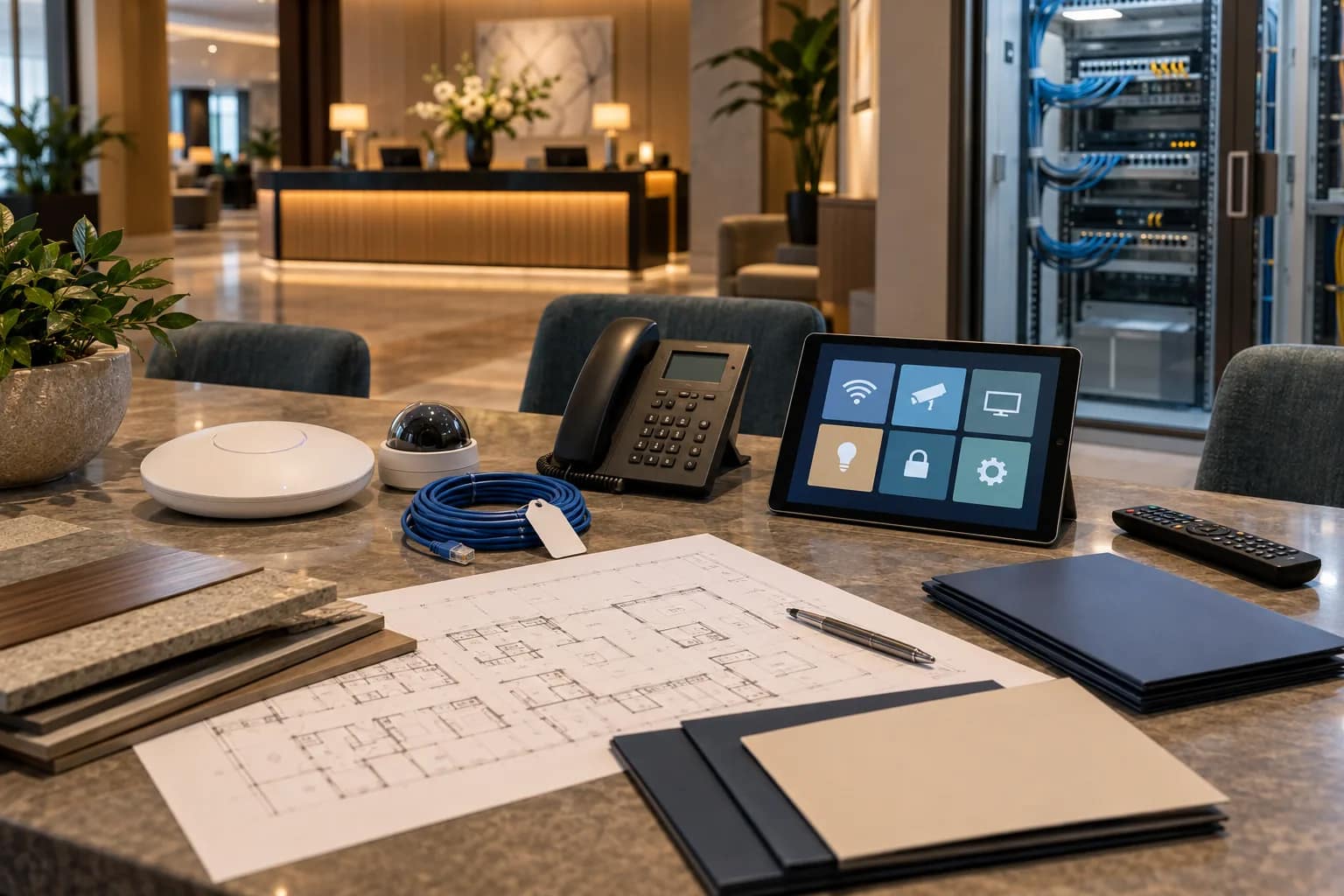
Start with the owner outcome, not the vendor category
Many hotel technology decisions start too narrowly. One team asks for Wi-Fi pricing. Another asks for TV options. A third asks about phones, cameras, or low-voltage cabling. Each quote may be valid inside its own lane, but the hotel still has to operate one property.
Before comparing proposals, ownership should name the practical outcome. Examples might include opening a new-build hotel with guest Wi-Fi, phones, television, cameras, and monitoring ready for inspection; refreshing a property without breaking existing circuits or guest-room systems; or moving several vendors into one clean support model.
JET’s owner-aligned hotel technology process is built around that kind of project record: plan, procure, deliver, and support. A consultant is most useful when that record exists before final vendor decisions are made.
Normalize every proposal before comparing price
A hotel technology consultant should help owners compare like with like. A low number can hide missing cable, fewer access points, excluded room testing, incomplete PBX handoff, unpriced TV dependencies, or no after-hours support path. A higher number may include site survey, documentation, staging, training, acceptance testing, and support that another vendor left out.
Normalize the proposals into one comparison table before deciding. At minimum, include:
- which systems are included and excluded;
- which rooms, public areas, closets, and back-office spaces are covered;
- who owns cabling, equipment, configuration, testing, and closeout;
- whether existing infrastructure is assumed, surveyed, or replaced;
- what recurring subscriptions, support, monitoring, and warranty costs remain;
- what acceptance evidence the owner receives before final payment.
This step is especially important when separate vendors price different slices of the same operating result. The owner needs to see the combined scope, not only the individual quotes.
Map shared infrastructure before vendor selection
This hotel coax reuse and new cabling comparison explains the tradeoffs between reusing room infrastructure and installing new pathways.
Dual-brand projects add another layer: this guide to technology planning for dual brand hotels shows where one backbone should stay shared and where brand-specific systems must remain separated.
Hotel technology systems often meet in the same physical spaces. Guest Wi-Fi, cameras, phones, IPTV, POS, staff safety, access control, and back-office systems may depend on the same MDF, IDFs, switches, conduit, fiber, patch panels, power, UPS, and labels. If those dependencies are not visible before vendor selection, the property inherits coordination risk.
A good consultant should ask how each proposed system touches the building. Which closets are involved? Which pathways are available? Are there enough ports, power, cooling, rack space, and cable records? Are ceilings, millwork, signage, furniture, and public-area layouts final enough to confirm device locations?
That is why an early hotel technology site survey matters. The survey should not only count devices. It should expose the field conditions that make the scope real.
Define who decides and who owns exceptions
Technology projects slow down when every exception waits for a different person. The owner, brand, general contractor, designer, operator, purchasing lead, IT vendor, low-voltage contractor, and system vendors may all influence a decision. Without a decision map, small questions become schedule problems.
The consultant checklist should name the decision path for scope changes, substitutions, added locations, deleted devices, owner-retained work, and exceptions discovered during installation. For each decision, record who recommends, who reviews, who approves, and what evidence closes the issue.
This is not bureaucracy. It protects the project from informal field changes that later become guest-facing problems or invoice disputes.
Require acceptance evidence, not just installation status
A vendor can install equipment without proving the hotel is ready to operate it. For owners, acceptance should be tied to evidence. That evidence might include room test records, cable certification, labeled patch panels, photos of MDF and IDF conditions, system login transfer, escalation contacts, monitoring alerts, PBX and 911 test results, TV channel validation, camera view samples, and exception lists.
The level of evidence depends on the project. A small refresh should not need the same package as a full new-build opening, but every project should answer the same operating question: can the hotel support the system after the vendor leaves?
The AHLA HTNG community exists because hotel technology depends on coordination across systems, standards, vendors, and operations. Its public work reinforces a practical point for owners: hotel technology is an operating stack, not a set of disconnected boxes.
Connect go-live to the support model
Consulting should not end at product selection. The support model is part of the scope. Before go-live, the hotel should know who receives the first call, what the front desk or engineering team should capture, which vendor gets escalated first, what account numbers or portals matter, and who confirms the issue is closed.
This is where technology consulting connects to operations. A property may have strong vendors and still fail guests if no one owns the handoff between them. The consultant should make that handoff visible before launch.
For many projects, the handoff record is just as important as the installation record. It should show contacts, escalation paths, warranties, recurring services, monitoring ownership, training notes, and unresolved exceptions.
Use this checklist before hiring or assigning the role
Before hiring a hotel technology consultant, or before assigning the work internally, owners can use this short checklist:
- Can the consultant explain the operating outcome in hotel language?
- Will they normalize vendor scope before comparing prices?
- Do they understand low voltage, Wi-Fi, PBX, TV, cameras, circuits, and support dependencies?
- Will they produce owner-ready records, not just meeting notes?
- Do they identify assumptions and exclusions before work starts?
- Will they verify acceptance evidence before final payment or go-live?
- Do they connect installation decisions to the ongoing support path?
The right answer is not always to add another advisor. Sometimes the owner simply needs a stronger scope matrix, a better site survey, or a clearer handoff package. But when multiple systems and vendors touch the same hotel outcome, an owner-side technology coordinator can prevent expensive confusion.
What JET reviews with owners
JET Hotel Solutions helps hotel owners and operators review technology decisions across low-voltage infrastructure, guest Wi-Fi, network access, PBX and phones, Free-to-Guest TV and IPTV, CCTV and security, staff safety, EV charging dependencies, monitoring, vendor coordination, and support paths.
The goal is not to make every decision more complicated. The goal is to make the right details visible before they become field changes, delayed openings, guest complaints, or unsupported systems.
If your hotel is comparing proposals, preparing a renovation, opening a new property, or trying to bring several technology vendors into one operating path, request an owner-side hotel technology scope review before the project becomes harder to correct.
Source: AHLA HTNG.