
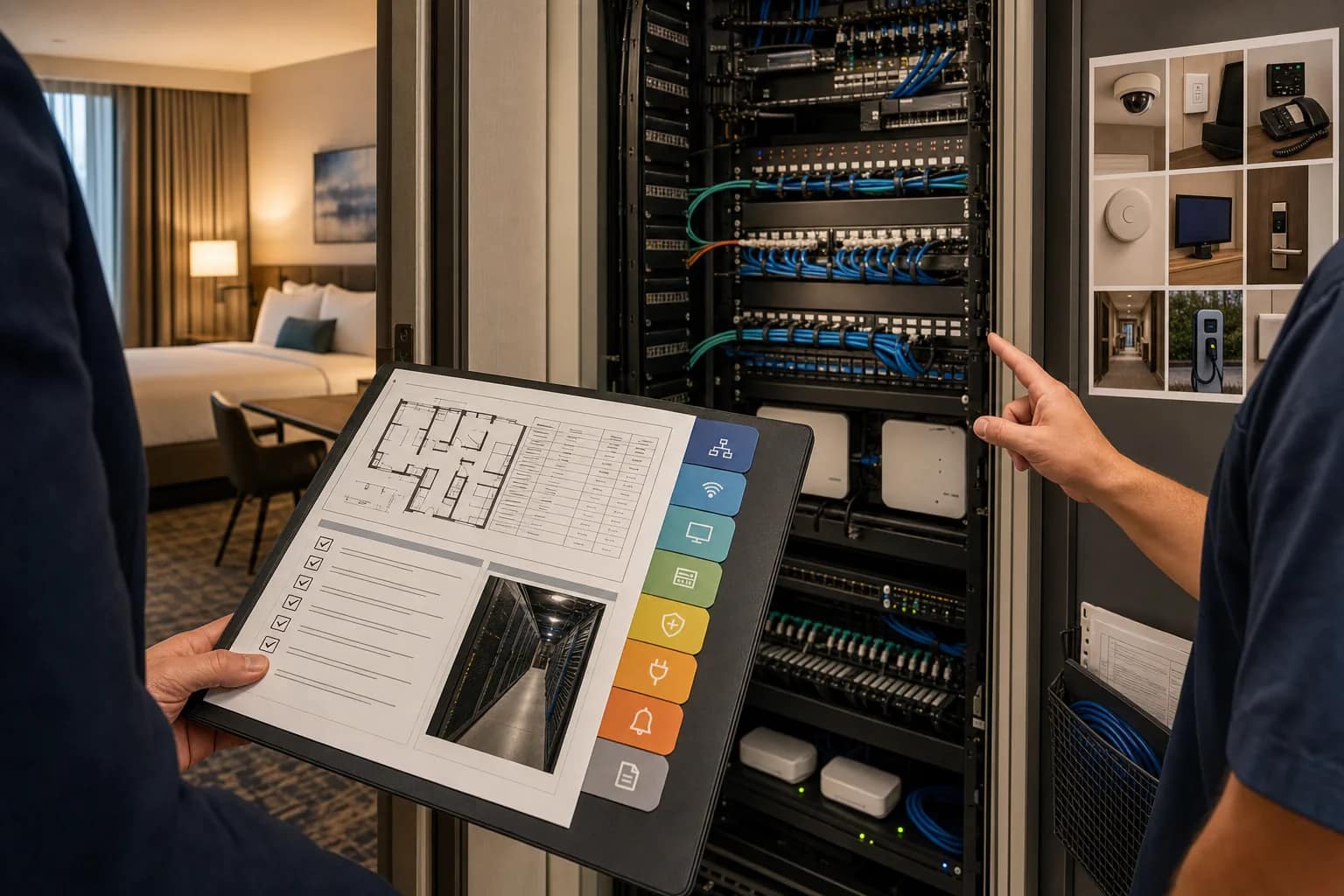
Short answer: a hotel technology handoff should include enough documentation for ownership to understand what was installed, where it lives, how it was tested, who supports it, who controls access, and what still needs attention.
An invoice is not a handoff. A clean-looking closet is not a handoff. A few emails from three vendors are not a handoff.
A good handoff is the package that lets the next technician, vendor, GM, engineer, or ownership representative walk into the property later and answer the basic question quickly:
What is this, what does it support, and who owns the next step if it fails?
That matters in hotels because the technology stack is not one system. Guest Wi-Fi, Network Access, IPTV or Free-to-Guest TV, phones/PBX, CCTV/security, POS, PMS dependencies, staff tools, EV charging, back-office systems, circuits, and vendor portals can all touch the same closets and pathways.
When that handoff is weak, the next outage becomes a scavenger hunt.
Why A Paid Invoice Is Not A Handoff
Hotel technology projects often end at the exact moment documentation becomes most important. The installer finishes. The vendor submits the final invoice. The GC wants to close the punch list. The property team is trying to open rooms, solve guest issues, or move on to the next project.
That is when ownership needs to slow down for one practical check: can the property support what was just installed?
In real hotel low-voltage scopes we reviewed, the handoff was not about a handful of data jacks. One project included more than 300 new cabled locations. Another included more than 500. Those scopes covered guest-room drops, wireless access points, camera locations, phone-only locations, TV and public-area locations, data-only drops, MDF/IDF buildout, fiber risers, patch panels, racks, cable management, certification testing, and closeout documentation.
That amount of infrastructure cannot live only in someone’s memory.
If the handoff is incomplete, the hotel may pay the next vendor to rediscover what the last vendor already knew. That is avoidable.
What Should Be Visible
Start with the physical environment. Before final payment or go-live, ownership should have a visual record of the rooms, racks, labels, and paths that future work will depend on.
Ask for:
- Photos of every MDF and IDF after completion
- Photos of patch panels and rack layout
- Photos of major device locations, including WAPs, cameras, public-area TVs, phones, POS drops, and special vendor devices
- A marked floor plan or as-built drawing showing the final device/drop locations
- Clear closet naming so IDF does not mean three different spaces depending on which vendor is speaking
- A record of any concealed pathway or above-ceiling work that could matter later
This is especially important before walls or ceilings close. If the hotel waits until a future renovation or outage to ask where a cable path runs, the answer may require destructive discovery or avoidable labor.
What Should Be Documented
A good closeout package connects the building to the closet and the closet to the support record.
For a hotel low-voltage, network, Wi-Fi, TV/IPTV, camera, phone, POS, or renovation project, the documentation should include:
- Final cable IDs
- Room, area, or device location for each drop
- Use case for each drop, such as WAP, CCTV, phone, IPTV/TV, POS, data-only, public-area device, or BOH system
- MDF/IDF closet where each cable terminates
- Patch-panel number and patch-panel port
- Switch port and VLAN information when appropriate
- Marked floor plan or as-built drawing
- Copper, fiber, or coax test results where applicable
- Certification reports, including cable IDs and pass/fail results
- Equipment list and model information
- Warranty paperwork and warranty requirements
- Open items, exclusions, assumptions, and change-order risks
The most useful version is not just a stack of PDFs. It is a simple record that can answer: room 318 WAP lands in which IDF, on which panel, on which port, with what test result, and under whose support path?
That is the difference between paperwork and an operating map.
What Support Information Should Transfer
Technology handoff is not only cabling. The hotel also needs to know what happens after go-live.
At minimum, ownership should have:
- Primary vendor contact for each system
- After-hours support path where available
- Escalation path if the first support contact cannot solve the issue
- Warranty start date and warranty end date
- What is included vs billable after acceptance
- Remote support, on-site support, monitoring, backup, and software-update details where applicable
- Who owns carrier/TelCo follow-up when the issue is outside the equipment vendor
- Login ownership for portals, dashboards, controllers, cloud management tools, and vendor systems
- A process for transferring access when a vendor or employee changes
Login ownership is easy to underestimate. If the Wi-Fi dashboard, camera system, PBX portal, IPTV platform, EV charging dashboard, or monitoring tool is tied to the wrong person’s email, the hotel may not discover the problem until an outage, billing issue, warranty request, or vendor transition.
The handoff should make ownership clear before the project team leaves.
What To Check Before Walls Or Ceilings Close
Some technology mistakes become expensive only because the hotel waits too long to ask the question.
Before drywall, ceiling close, or final concealed work, ask:
- Are cable paths actually usable, or did HVAC, sprinkler, electrical, or structural work consume the planned route?
- Are conduits, cores, sleeves, backboards, and access panels complete where needed?
- Are WAP, camera, TV, phone, POS, and public-area drops located where the systems actually need them?
- Are room layouts, meeting rooms, front desk, bar/restaurant areas, and back-office spaces still matching the drawings?
- Are cable labels or temporary IDs being maintained before trim-out?
- Are any exclusions or owner/GC responsibilities likely to create a change order later?
This is where JET sees many hotel teams get trapped. The technology scope looks small compared with the whole build, but a missed pathway or undocumented assumption can ripple into Wi-Fi, TV, phones, cameras, POS, and guest experience.
What To Check Before Final Payment Or Go-Live
Before accepting the project, ask for a handoff review. It does not need to be complicated. It needs to be real.
Use this checklist:
- Can we identify every MDF and IDF by name and location?
- Can we match every important label to a room, area, device, or system?
- Can we trace WAPs, cameras, TVs, phones, POS drops, and BOH connections back to the correct closet?
- Do we have final port-count sheets?
- Do we have marked floor plans or as-builts that reflect the actual install, not just the original design intent?
- Do we have test results and certification reports for the installed cabling?
- Do warranty terms depend on certified installation, approved parts, or submitted test results?
- Do we know which support work is included and which becomes billable?
- Do we know who owns support after go-live?
- Do we know who controls logins and admin access?
- Are open items, assumptions, exclusions, and change-order risks written down?
- Does ownership have a copy of the package somewhere accessible after the project team leaves?
If those answers are scattered across vendor inboxes, the project may be installed but not truly handed off.
How JET Reviews A Handoff
JET Hotel Solutions looks at hotel technology as a property stack, not as separate invoices. The point is not to make the owner become a cabling expert or a network engineer. The point is to make the project supportable.
In a handoff review, JET is looking for practical alignment across low-voltage planning, Network Access, guest Wi-Fi, IPTV or Free-to-Guest TV, phones/PBX, CCTV/security, POS/PMS dependencies, circuits, monitoring, warranties, support paths, and vendor coordination.
The question is simple:
If something breaks six months from now, can the next person understand the property fast enough to fix it?
If not, the handoff package needs work before the hotel signs off.
FAQ
What is a hotel technology handoff checklist?
A hotel technology handoff checklist is the list of records ownership should receive before accepting a technology project. It should include closet photos, device locations, cable IDs, patch-panel records, floor plans, test results, warranty documents, vendor contacts, support paths, login ownership, and open items.
What should be in a hotel low-voltage closeout package?
A hotel low-voltage closeout package should include cable IDs, locations, uses, MDF/IDF terminations, patch-panel ports, marked floor plans or as-builts, test and certification reports, warranty information, equipment lists, photos, and known exclusions or change-order risks.
Why does login ownership matter in hotel technology projects?
Login ownership matters because many hotel systems are managed through vendor portals, cloud dashboards, controllers, monitoring tools, or admin accounts. If those credentials belong to the wrong vendor or employee, support and vendor transitions become harder later.
When should a hotel request handoff documentation?
Request documentation before the contract is signed, verify it before walls or ceilings close, and require the final package before final payment or go-live. Waiting until an outage is the expensive way to discover what is missing.
Is this only for new hotel construction?
No. Handoff documentation matters for new builds, renovations, Wi-Fi refreshes, ISP changes, IPTV upgrades, camera work, PBX changes, POS network changes, EV charging installs, and any project where future support depends on understanding what was installed.
Bottom Line
A hotel technology project is not complete when the invoice is paid. It is complete when the property can support what was installed.
That means ownership needs more than a final bill. It needs closet photos, device maps, labels, port-count sheets, test results, warranty records, vendor contacts, login ownership, and a clear escalation path.
Before final payment, go-live, or before ceilings and walls close, ask JET Hotel Solutions to review the handoff package. It is much easier to fix the record while the project team is still engaged than during the next outage.
Related reading: Labels Save Hours: The Hotel Network Documentation Checklist, 5 Things Hotels Miss Before a Network Cutover, and Hotel Vendor Coordination: The IT, POS, and Security Checklist Before a Cutover.
Public sources used: TIA FOTC on ANSI/TIA-606-D; Projul low-voltage cabling guide; Fitchburg structured cabling specification; Reddit networking discussion on new-building cabling requirements.