
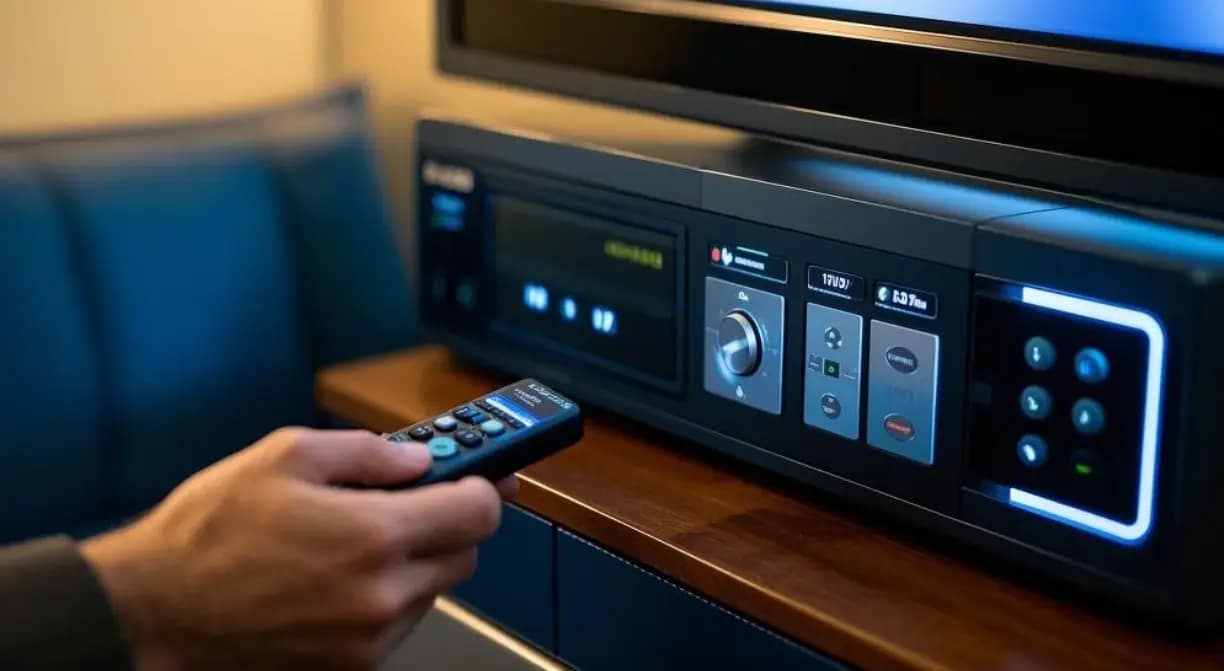
A hotel TV distribution system carries programming from its source to guestroom and public-area screens. For an owner planning a renovation, the useful question is which parts of the existing distribution path can support the proposed service, and what must be replaced before rooms return to inventory.
Start with an infrastructure survey, a model-by-model compatibility check and a written acceptance plan. This guide focuses on those decisions. For a broader feature comparison, see our hospitality TV systems guide; for pricing scope, use the separate hotel TV budget comparison guide.
Separate the distribution path from guest-facing features
Describe the proposed system in four layers: the programming source and commercial service; the headend or receiving equipment; the cable or network path; and the television or other endpoint. Then list the guest services separately, including the channel guide, hotel information, casting and any room-service or property-management integration.
Delivering live channels does not establish that every other feature is included. Require the supplier to identify the equipment, licenses and dependencies for each requested feature. A screen that displays live television in a demonstration has not yet passed a casting, privacy or integration test.
Compare RF, IP and mixed designs against the building
RF distribution over coax
Where a proposal reuses coax, request measured evidence that the existing path meets the selected system’s requirements. The survey should identify cable runs, splitters, amplifiers, outlets and problem rooms. Ask which components will be retained, which will be replaced and who will correct failed tests. A drawing marked “existing coax” is not a condition report.
IP distribution
For an IP design, ask the integrator to document the required switching, uplinks, addressing and traffic handling for the selected platform. Have the network team review capacity and configuration alongside other hotel services. The scope should explain how television traffic and management access will be controlled, monitored and supported. Do not assume the guest Wi-Fi design alone answers these questions.
Hybrid or phased replacement
A renovation may retain part of the distribution infrastructure while changing the headend, endpoints or guest services. DIRECTV describes its HD COM System, also called COM3000, as a centralized live-TV platform that can use coaxial, Ethernet or fiber infrastructure, depending on the property setup. Its product overview also identifies additional hardware for custom guides and house channels. These are product-specific capabilities, not a guarantee that any existing hotel installation is compatible. Source: DIRECTV HD COM System overview.
Ask each bidder for a diagram showing the actual proposed signal path, including transitions between technologies. For a phased project, require an explanation of how renovated and unrenovated rooms will operate at the same time.
Build a compatibility register before ordering
Record the exact TV model, size, firmware, room type and required accessories. Ask the vendor to approve that register against the proposed headend, content protection, management software and guest features. Include replacement models and mixed generations of TVs, rather than validating only a sample from the newest floor.
LG’s Pro:Centric Direct documentation illustrates why this matters: it describes delivery over IP or RF, but cautions that compatibility and features depend on the television model, firmware, country and system configuration. Confirm the intended U.S. deployment with the supplier using current documentation. Source: LG Pro:Centric Direct documentation.
The register should make exclusions visible. If a feature needs an external device, a software subscription, a supported PMS interface or a specific TV generation, put that dependency beside the feature. For casting-specific planning, see our in-room casting guide.
Specify the site survey deliverables
Use the following list as a procurement starting point, adapted by the project team to the actual property:
- Inventory: guestroom and public-area screens, room types, current equipment, support arrangements and known faults.
- Physical conditions: distribution routes, closet space, power, cooling, cable condition and access restrictions.
- Test evidence: measurements and pass/fail criteria referenced to the proposed manufacturer’s requirements, with unresolved exceptions listed.
- Remediation scope: component quantities, labor responsibilities, assumptions and items awaiting investigation.
- Cutover plan: room-access windows, service interruptions, temporary arrangements, rollback responsibilities and a pilot-room decision point.
For new construction, coordinate these requirements with the hotel structured cabling design before routes and equipment spaces are finalized. For an occupied renovation, align the work sequence with operations before promising an outage window.
Agree on acceptance tests before rollout
A pilot should represent the conditions the final installation must handle: relevant TV generations, room types and distribution paths. Set measurable acceptance criteria in the project scope rather than inventing a universal signal threshold or channel-change target.
- Programming: verify the contracted channel lineup, sound, picture, guide behavior and any authorized public-area service.
- Guest controls: test the remote, power-on behavior, volume controls and the accessibility functions specified for the chosen equipment.
- Connected features: where included, test the agreed casting, hotel-information and integration workflows. Confirm room isolation and the required checkout/reset behavior.
- Recovery: demonstrate the agreed response to power or network interruption, including the steps staff must take and escalation contacts.
- Handover: provide the equipment inventory, configuration records, approved diagrams, training, warranty details and a tracked punch list.
These checks are a practical project checklist, not a certification of regulatory compliance or a promise of increased revenue. Have the responsible professionals review property-specific obligations and the final design.
Put ownership of unresolved items in writing
Before approving rollout, assign a responsible party and resolution date to every open item. Distinguish a failed test from a deferred feature and a contractual exclusion. Record who supports the content service, network, TVs and software after installation, especially when several vendors share the delivery.
Preparing a new build or renovation? Discuss your hotel technology project with JET Hotel Solutions. Bring the equipment inventory, existing drawings and planned construction sequence so the conversation can start with the property’s actual requirements.