
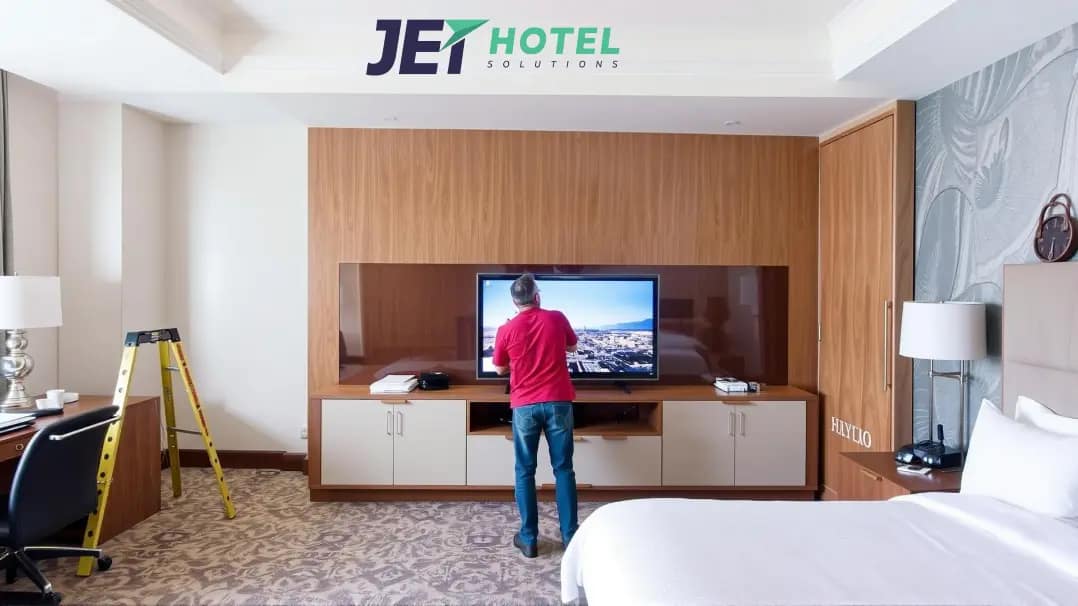
Hospitality TV systems can combine live television, streaming, guest-device casting and hotel information. Those are different services, not interchangeable product labels. For owners and operators evaluating a renovation or replacement, the useful comparison is what each proposed system actually includes—and what must be supplied by the network, television, content provider or hotel team.
Start with the service scope below, then use our hospitality TV system cost and budget guide to compare one-time and recurring charges. A vendor feature page is evidence of an advertised capability, not proof that every television model, property configuration or contract includes it.
Separate the TV system into four service layers
- Content and distribution: Which live channels and content rights are included, and how will the signal reach each room? Document the existing distribution path rather than assuming that a casting upgrade replaces it.
- Guest entertainment: Identify native TV apps, casting from a guest device and video-on-demand separately. Confirm the supported devices, TV models, subscriptions and guest steps for each.
- Hotel communication: Welcome screens, promotional messages and hotel information are distinct from ordering, payment and fulfillment. A restaurant promotion does not establish that the TV can send an order to the kitchen.
- Infrastructure and operations: Assign responsibility for network readiness, in-room hardware, configuration, support, checkout behavior and staff training.
For the underlying signal path, ask the bidder to show which existing components remain and which are replaced; do not treat a new interface as a complete infrastructure scope.
What the vendor documentation actually establishes
SONIFI describes STAYCAST as a hospitality casting solution. Its published features include mobile pairing, room-specific device isolation and automatic disconnection at checkout. It also describes embedded deployment in compatible set-top boxes or smart hotel TVs. That is a casting scope—not evidence of voice-operated room-service ordering or a guaranteed food-and-beverage revenue increase. Request written confirmation of supported equipment and the checkout integration for your property.
Enseo describes its in-room entertainment offering across live TV, streaming, casting and on-demand content. Its separate Messenger documentation describes on-screen hotel messages, scheduling and audience targeting. These are useful distinctions when comparing entertainment against promotional communication. Ask which modules, interfaces and support services are in the proposed contract; do not assume a messaging feature includes an ordering workflow.
These examples illustrate different service layers, not a ranking or an exhaustive vendor shortlist. Confirm current brand requirements and model-specific compatibility before treating any feature as available at your hotel.

Require a demonstration of the complete guest journey
Use a representative guest room before approving a property-wide rollout. Have the supplier demonstrate live-channel access, the proposed casting or app experience, and what happens when a guest checks out or changes rooms. Test with the actual network configuration and supported guest devices, not only a standalone showroom screen.
For any paid service or promotion, follow the journey past the TV: Who receives the request? How is availability checked? Where does payment occur? Who resolves a failed request? Ask for written interface names, supported versions, prerequisites, fees and a clear responsibility split between vendors. Record unresolved items as exclusions or open decisions rather than assumed capabilities.
Evaluate revenue claims without building them into the base case
There is no universal revenue uplift established by the product descriptions cited here. Treat vendor case studies as property-specific results, not a guaranteed return for your hotel. If upselling is a project objective, agree on a pilot measurement plan: eligible stays, offer exposure, completed purchases, cancellations, fulfillment costs and incremental margin. Distinguish a guest viewing a message from a completed sale, and account for seasonal or promotional differences when comparing periods.
Turn the comparison into an actionable scope
Request a proposal that names the entertainment services, content rights, room equipment, network work, integrations, support boundaries and renewal terms. Keep optional marketing modules separate from the minimum guest-entertainment requirement. This makes it easier to compare bids without paying twice for overlapping services or overlooking work assigned to another contractor.
For a hotel renovation or new-build discussion, share your room inventory, existing TV models, distribution layout and planned service requirements with JET Hotel Solutions. Those details provide a more useful starting point than an assumed revenue percentage.
Editorial review: November 1, 2026 (U.S. Eastern Time). This update replaces earlier unsupported performance and feature claims with source-linked product descriptions and property-specific evaluation guidance.